Why AI agents for business operations stall at a process edge
The short version
- AI agents for business operations stall where a process stops being predictable, not where a model stops being capable.
- Four edges cause almost every stall in AI agents for business operations: data the agent was never given, a step it may not take, a judgment it should not make, and a branch never written down.
- The loudest failure is rarely the commonest edge, so teams repair the wrong one first.
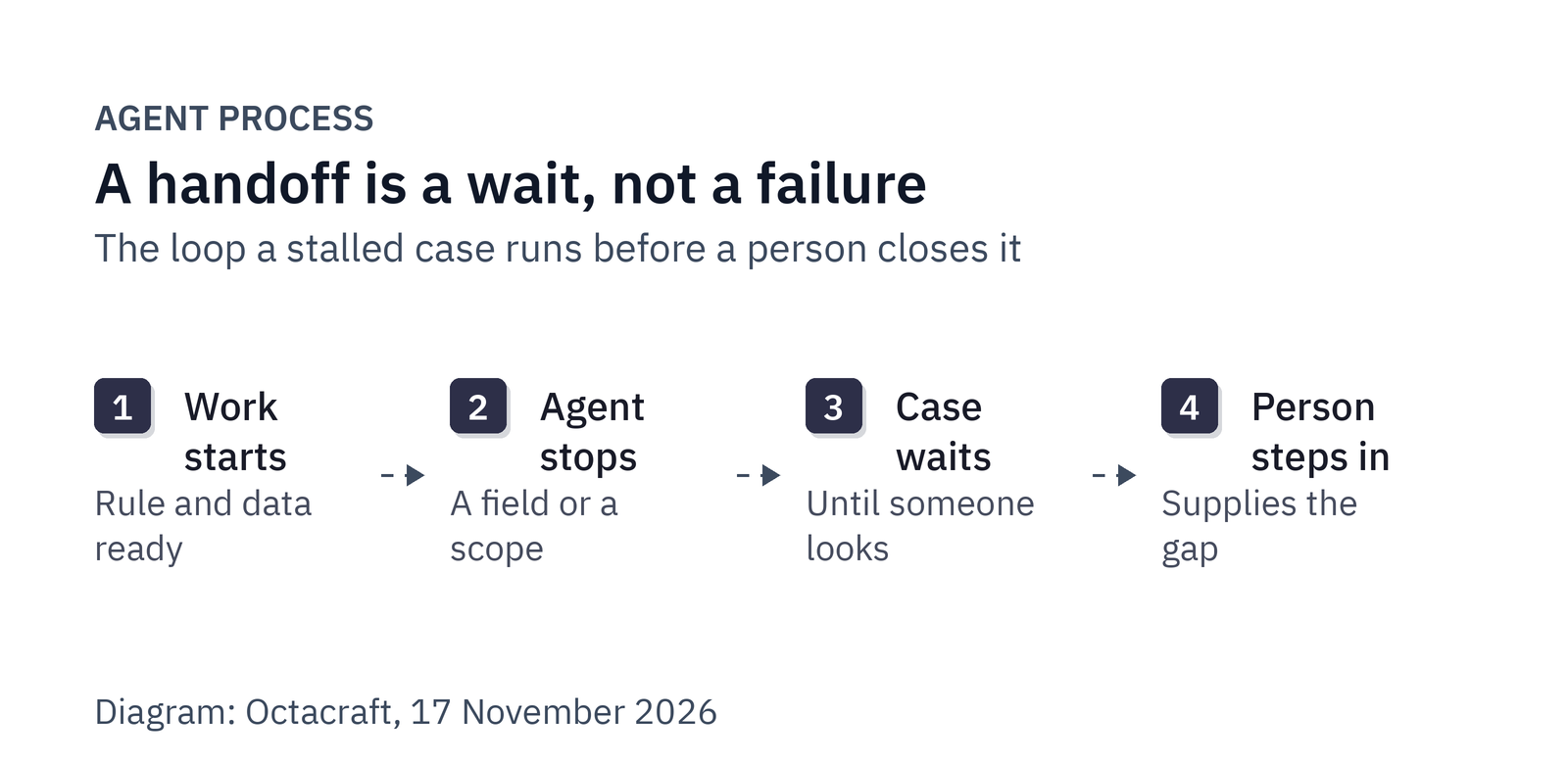
- A handoff is not a defect. It is a queue, and the cost sits in the time a case waits there.
- Watch one number: the share of cases that finish without a person touching them.
The agent handled the first five steps alone. Then it stopped. The case sat in a queue until somebody opened the file.
Nothing in the model broke. AI agents for business operations stop at the edge of a process. That edge is the point where the work needs something the system was never given.
Why do AI agents for business operations stall partway through a process?
AI agents for business operations stall where the process stops being deterministic. The model can hold the rule and still lack the input. It may lack the permission or the authority to finish. The cause sits in the design around the model, so the fix does too.
Most teams buying AI agents for business operations read that as a model problem and buy a better model. It meets the same edge on the same case, a month later.
The published evidence points the same way. A benchmark gave tool-using agents real domain rules and APIs. The strongest function-calling model finished under half its tasks. It also failed tasks it had already passed on a repeat run (Yao et al., tau-bench, arXiv, June 2024). Reliability was the gap, not reasoning.
A study of 1,600 annotated traces across seven frameworks found 14 failure modes in three groups. System design and verification ranked ahead of model ability (Cemri et al., arXiv, March 2025).
What a handoff is in an agent process
For AI agents for business operations, a handoff is the point where automated work passes back to a person. The case leaves the agent and waits in a queue or an inbox. It carries what the agent learned only if somebody built the case record to carry it.
A handoff is not an approval step. AI agents for business operations meet both, and only one of the two is planned. An approval is designed. The process expects a person, waits for a decision, and resumes. A handoff is unplanned. The agent reached a step it could not take, so it stopped.
Anthropic draws the same line between a workflow and an agent. Agents suit problems where the number of steps cannot be predicted (Anthropic, Building effective agents, December 2024). That freedom is also what walks AI agents for business operations into an edge nobody planned for.
OpenAI’s guidance for builders treats the stop as the normal failure path. An agent that cannot finish should halt and hand control back to the user (OpenAI, A practical guide to building agents, 2025). The handoff is designed behavior. What most deployments lack is a design for what happens next.
Business process automation definition, and where an agent differs
Business process automation is software running a defined sequence of steps without a person re-entering the same data. The rules are written down, and the software follows them.
AI agents for business operations are given a goal, a set of tools and a policy. They choose their own steps. That freedom lets them reach places a fixed workflow never would. It also means they meet edges a fixed workflow never meets.
A fixed workflow with no branch for a case fails at once, and the log says so. An agent improvises first. It retries, substitutes a field, or answers from a policy page. By the time it stops, the case has been open longer and the record is less clean. Work out what an agent can own today and what stays human before you add a second one.
The four handoff types where agents stop
AI agents for business operations stop at one of four edges. The type matters, because each one has a different owner and a different fix.
| The edge | What it looks like | The first check |
|---|---|---|
| Type 1: missing data | The agent has the rule but not the field it needs | Call the tool. Is the field in the response at all? |
| Type 2: missing permission | The step exists and the account may not take it | Does the token carry write scope for that step? |
| Type 3: judgment call | The decision carries money, legal weight or a person’s future | Would a manager want to sign this one alone? |
| Type 4: undocumented exception | Real traffic takes a branch no diagram has | Do the logs show cases that share no path with the flowchart? |
Type 1: the data the agent was never given
Type 1 is where AI agents for business operations stop most often, and it is the quietest edge. The agent holds the rule. The policy text sits in its context. The field it needs is missing from the response. A date of birth lives in a table with no API. A cancellation reason sits in an email nobody parsed.
The agent does something reasonable. It asks, it guesses, or it stops. None of those is a model failure, and that is why AI agents for business operations keep stalling here. On a policy question it may answer anyway, and the answer will read well.
Air Canada’s website chatbot told a customer he could claim a bereavement fare after flying. The airline did not permit that. He relied on the answer. A tribunal held the airline responsible and ordered it to pay $812.02 in damages, interest and fees (Moffatt v. Air Canada, 2024 BCCRT 149, 14 February 2024). The agent had a rule. It did not have the rule that was actually operating.
Type 2: the step it is not allowed to take
The second edge catches AI agents for business operations that passed every test in the lab. The agent can see the step and cannot take it. Permissions are enforced by the systems it calls, not by the prompt. A read-only token cannot post a credit note. A service account without mailbox delegation cannot send from a shared address.
A guardrail can stop a bad action. It cannot grant a good one. The stall is a scope problem, and scopes are set outside the agent.
The Model Context Protocol makes the same point at the protocol level. A call is authorized by the token’s scopes. A server answers 403 when the scopes are wrong or too narrow (Model Context Protocol specification, 2025-06-18). Widen the token and the step completes. Nothing in the model changes.
Type 3: the judgment call it should not make
The judgment call is the edge AI agents for business operations should reach, not avoid. A refund above a threshold, a hiring decision, a clinical call, a termination, a legal position. Each carries a consequence that lands on a named person. Automating it moves the risk rather than removing it.
OpenAI’s guide names the same line from the builder’s side. Refunds, payments and other irreversible actions should pause for a human until confidence grows (OpenAI, A practical guide to building agents, 2025).
In regulated work the pause is required by law. The European Union’s AI Act obliges high-risk systems to allow human oversight. The overseer must be able to override an output and stop the system (Regulation (EU) 2024/1689, Article 14). At that edge the handoff is compliance, not a shortcoming.
Type 4: the exception that was never documented
The fourth edge is where AI agents for business operations fail quietly. It is the branch a process map hides. Real traffic takes paths nobody drew: the duplicate order, the part-shipped line, the customer who pays twice, the contract with a side letter.
An agent working from the written process has no route through that branch. It either stops or forces the case into the nearest documented path. That is the fourth edge, and it is the one most AI agents for business operations meet last. The second outcome is worse, because the case closes and the record is wrong.
The tell is in the logs. Look for cases that share no path with the diagram, then count them. A branch that appears once a week is not an exception any more. It is a step the process never described. Document the branch in the same fields as the rest.
Which edge did your agent hit?
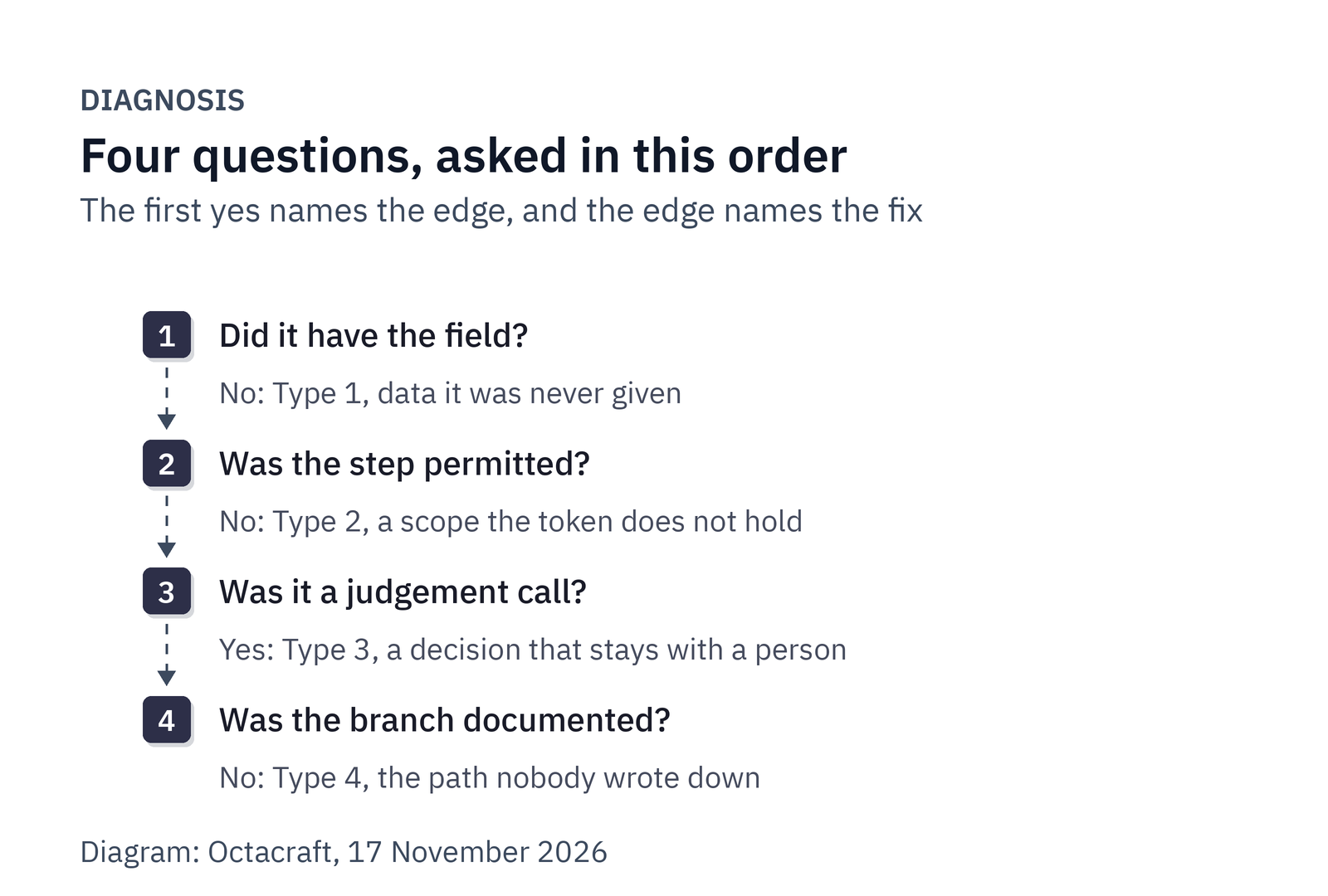
Four questions separate the edges. They work on any deployment of AI agents for business operations. Ask them in order, about the case that stalled. The first yes names the edge, and the edge names the fix.
The four questions
- Did it have every field it needed? A no points to Type 1. Call the tool and read the response before you touch the model.
- Was the action permitted for the account it runs as? A no points to Type 2. Check the scopes on the token.
- Was the decision one a manager would want to sign? A yes points to Type 3. Keep the handoff and record the decision.
- Did the case match any path on the diagram? A no points to Type 4. Write the branch down before the next case arrives.
Where AI business process automation usually stops first
Data is where it stops first. AI business process automation meets the same four edges as an agent, and the missing field is the one that shows up before the missing permission, the judgment call or the undocumented branch. What changes between the two is when the edge appears. A fixed workflow meets it at build time, when the diagram is drawn. AI agents for business operations meet it in production, one case at a time.
We check data first, because a field is a finite question. Call the tool, read the response, and the answer is there or it is not. A permission is a decision somebody has to make and record. A judgment call is a policy. A missing branch is a documentation project. For most teams buying AI agents for business operations, that order is also the cheapest one to clear.
Business process automation examples that stall at the same edge
The shape repeats across processes. An invoice flow stops on a purchase order it cannot match to a receipt. The receipt system exposes totals, not lines. A support agent can reply but cannot send the replacement it promised, because the order system grants read only.
In each case the AI agents for business operations did the work and could not finish the case. A person finished it by hand. The pattern is the human-side version of the same stall. It is the one behind the five approval bottlenecks that cost a firm a week every month. It is also why support triage is the safer first automation than a refund promise.
The advantages of business process automation do not include judgment
The advantages of business process automation are real. Less re-entry, faster cycle time, consistent steps, and a log of what ran. Every one of them holds for AI agents for business operations, up to the edge.
They stop at judgment, and that stop is the design. Consistency is what automation buys. Accountability for a decision that belongs to a named person is not for sale, at any license tier.
When a handoff is correct
Keep the handoff where the consequence is personal, where the rule is contested, or where the case is rare enough that no test would cover it. In those places a handoff is cheaper than the alternative. The alternative is a wrong decision taken quickly and at volume.
One test settles it. If the case went wrong, who would have to explain it? If the answer is a person by name, the case should pass through that person. That is what makes AI agents for business operations safe to run at volume.
Why process automation tools cannot cross these edges
Process automation tools are built for the documented path, and they are good at it: triggers, conditions, connectors, retries. What they cannot do is expose a field nobody published. They cannot grant a scope the security team has not approved. They cannot invent a branch the business has not agreed.
An agent platform on top of them inherits the same limits, because the limits live in the systems being called. Three parts of the stack decide whether AI agents for business operations can cross an edge. The data layer exposes fields. The identity layer grants scopes. The process owner decides what may be automated at all.
That is why the fix is rarely a better agent. It is a data contract, a scoped credential and one documented branch. Gartner expects more than 40% of agentic AI projects to be canceled by the end of 2027. It cites cost, unclear value and weak risk controls (Gartner, 25 June 2025). Most spend on AI agents for business operations dies at edges like these, not at the model. Choosing the five operations to hand over first is what keeps a deployment alive.
The short answer, in one paragraph
AI agents for business operations stall at four edges: data the agent was never given, a step it may not take, a judgment it should not make, and a branch never written down. Ask four questions, name the edge, and fix it where it sits. That is the whole maintenance routine. Then measure the share of cases that finish without a person. If that number is flat, the problem was never the model.
Frequently asked questions
Why does my AI agent stop and hand the work back to a person?
Because it reached a step the process did not equip it for. AI agents for business operations usually stop on a missing field, an account without the right permission, a decision that needs a person, or a branch nobody documented. The model rarely stops for lack of reasoning.
Is a handoff a failure?
No. A handoff is the designed failure path for an agent. OpenAI’s own builder guidance describes halting and returning control as correct behavior. A handoff becomes a problem when nobody measures how long the case waits, or when the same edge takes the same case every week.
How do I measure unattended completion?
Count the cases that finish without a person touching them. Divide by all cases started in the same period. Take the figure from the case record, not the agent’s own log, because an agent reports a step as done when it wrote something. Read it weekly for every AI agents for business operations deployment you run.
What is the difference between a handoff and an approval?
An approval is designed into the process. A person is expected at that point, and the work resumes when they decide. A handoff is unplanned: the agent reached a step it could not take. Approvals are healthy. A handoff is a signal that the process has an edge nobody equipped.
Should we remove the handoff and let the agent finish?
Only where the consequence is reversible and the rule is settled. Keep it where the decision carries money, legal weight or a person’s future. Keep it where the case is rare enough that no test would cover it. For AI agents for business operations in regulated work, human oversight at that edge is required by law.
If you have an agent that keeps stopping at the same step, tell us where it stops and what it needed. We will name the edge, and say whether the fix is a field, a permission or a decision that should stay with a person.
Philip Bassey is Octacraft’s Chief of Staff. As part of his responsibilities, he oversees the interdepartmental activities to see that our processes are documented and those that need publishing are published. He writes about the work between a system going live and a team trusting it.

Philip Bassey is Chief of Staff at Octacraft, where he oversees the interdepartmental activities that keep our processes documented and the ones worth publishing published. He writes about operations that are engineered into systems instead of held together by memory.