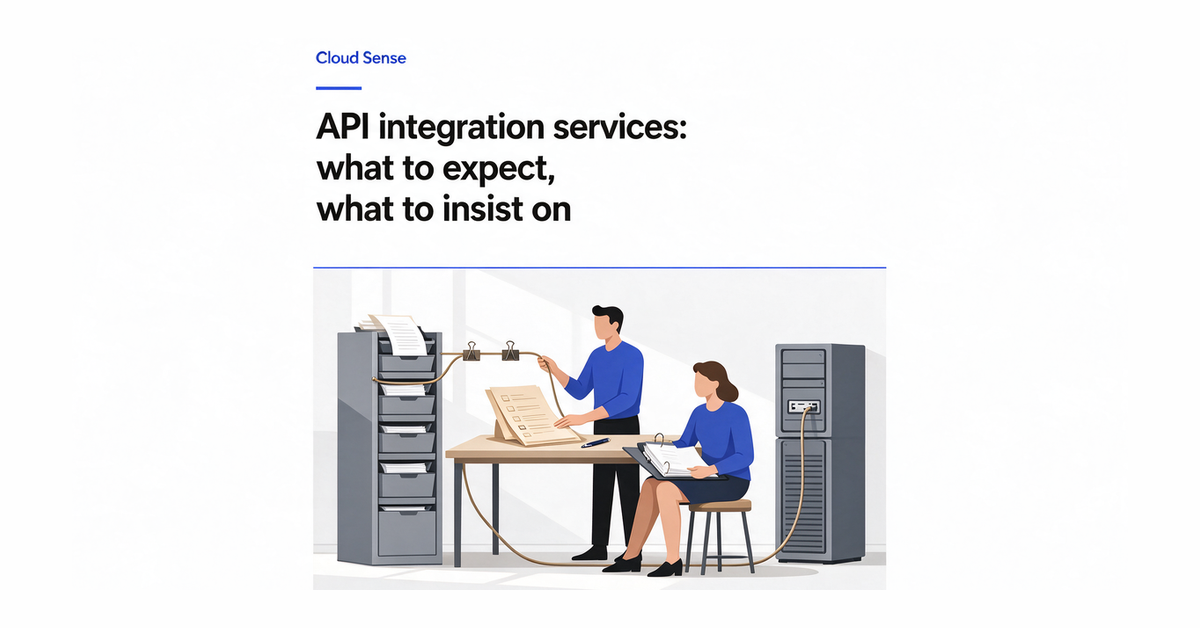
API integration services: what to expect, what to insist on
The short version
- API integration services move data between two systems so nobody re-keys it. The connection is the easy part.
- Expect five phases: discovery, authentication, field mapping, testing, monitoring.
- Insist on eight clauses in an API integration services contract, starting with credentials held in an account your firm controls.
- Most quiet breakages after go-live come from an expired token, a renamed field or an unrecorded rate limit.
- A clause you cannot check yourself is a clause you will argue about during an incident.
The contract is a week from signature. The demo worked. Both systems have APIs, and someone has already sketched the field mapping on a whiteboard.
What you are buying is not that connection. It is the promise that the connection still works in year two, when a supplier renames a field and a token expires without warning.
That promise is written before you sign, or it is not written anywhere.
The short answer
An integration fails in year two for boring reasons. A token expires. A field changes shape. A rate limit is crossed. None of those are code faults, so better code does not prevent them.
What prevents them is a contract that names who holds access, what happens on a failed call, and who is told when the flow stops. Eight clauses cover that ground, and five phases deliver it. Buying API integration services without the contract is how year two turns into a repair project.
What an API integration covers
API integration services connect two systems so that data moves between them without a person re-keying it. That is the whole definition, and it is worth holding on to when a proposal describes something larger.
A one-way sync sends records from one system to the other. A two-way sync lets both systems write. That doubles the ways a record can end up wrong, and it roughly doubles the testing work.
Everything that decides whether the sync survives sits between those two endpoints. In API integration services work, four things matter: how the connection proves who it is, which field goes where, what happens when a call fails, and who finds out when the flow stops.
An integration is not a middleware platform, and it is not a data migration. Naming it correctly protects you from an API integration services quote that quietly includes one. When the older system has no usable interface, the work stops being an API integration services job. It becomes a different project, which we wrote about in modernizing a legacy system without a rewrite.
What API integration services should deliver in five phases
API integration services should deliver five phases: discovery, authentication, field mapping, testing and monitoring. Each phase ends with a document a buyer can read. Each one can be marked done or not done.
- Discovery. Someone reads both systems and writes down what each one holds. Done when you have a field inventory and a list of records with no clean match. This phase saves the most money, and it is the one we describe in the requirements session we run before quoting a build.
- Authentication. The connection gets a way to prove who it is, ideally a scoped key you own. Done when the key lives in your account, not the vendor’s.
- Field mapping. Every field in scope is matched. Each one gets a rule for values that arrive empty or malformed. Done when the mapping document exists and a reader who knows neither system can follow it.
- Testing. The flow runs against real records, including the ugly ones. A name with an ampersand. A zero quantity. A duplicate email. Done when the failure cases have been run and the results written down.
- Monitoring. Someone is told when the sync stops. This phase has no end date, which is why it is the first to be dropped from a quote.
We do not publish a duration band for these phases, and you should be wary of one quoted before discovery. Discovery sets the length of everything that follows in an API integration services project.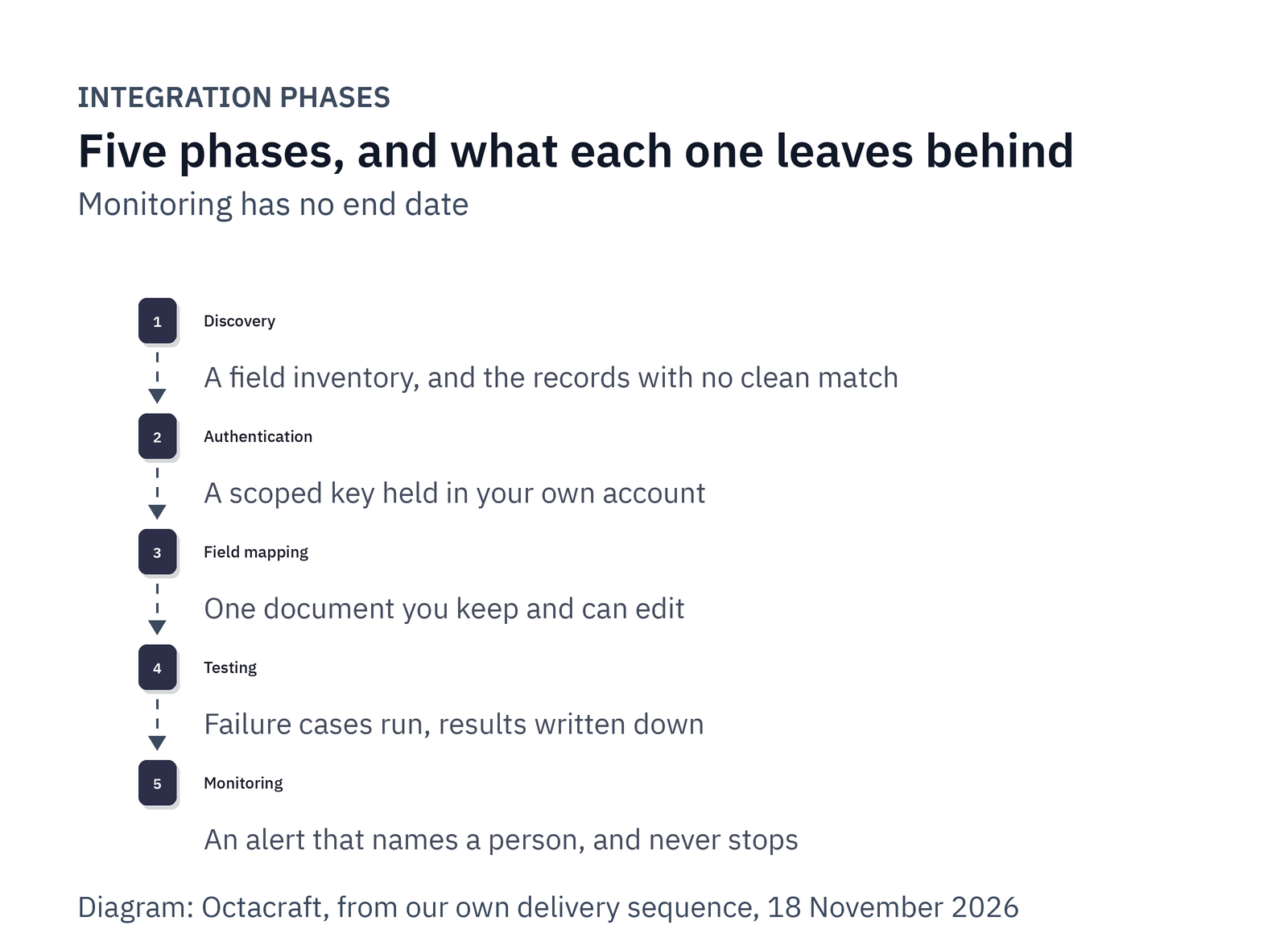
What should we insist on in an integration contract?
In an API integration services contract, insist on clauses that name who holds access, what happens when a call fails, and what you receive when the work ends. A contract with scope and price but none of those three is unfinished. The gap shows up as an argument during an outage, not at signature.
The test is simple. For each clause, ask who can check it without calling the vendor. If nobody can, the clause is decoration.
We make the same argument about cloud contracts. The parts that read like paperwork decide who pays when something breaks. Our piece on what a managed cloud services contract covers, and what stays yours works through it line by line.
The integration contract checklist: eight clauses to insist on
Eight clauses carry the weight. Each one has a pass condition, so you can mark it before signing rather than after the first incident. They are written for the buyer of API integration services, not for a lawyer.
1. Credentials and ownership
The API keys, OAuth clients and service accounts belong to your organization. Say so in the contract, because otherwise the keys end up with the vendor by default. Pass condition: you can log in to the supplier’s developer console and see the credentials without asking the integrator for a password.
If the keys sit in the vendor’s account, you cannot revoke access when the relationship ends. You also cannot see when they were last rotated, which is the detail an auditor asks for first.
2. Rate limits and throttling, in writing
Every API has a ceiling, and the contract should name it. Stripe allows 100 requests a second per account in live mode and 25 a second per endpoint. It answers a breach with HTTP 429 and a header naming the reason (Stripe rate limits documentation, read 18 November 2026).
Pass condition: the document states the limit and what the integration does when it is hit. It should also say whether the supplier will raise it on request, which is a question buyers forget to ask.
HTTP 429 has been a standard status code since RFC 6585 in April 2012. The response may carry a Retry-After header that tells the client how long to wait (RFC 6585). A client that ignores that header turns a short pause into a queue.
3. Error handling and retries
Retries are safe only when the write can be repeated without doubling the effect. Microsoft’s retry guidance puts it plainly. If the operation is not idempotent, a retry can execute it twice, and the example it gives is charging a card (Azure Architecture Center, retry pattern).
So the clause needs three parts. Which failures are retried at all. How long the retries run, stated as a number. And how a duplicate is caught, usually with an idempotency key on the write or a logged event identifier on the read.
Stripe’s webhook documentation shows the shape, and it is the one to copy into an API integration services retry clause. It retries delivery for up to three days with exponential backoff in live mode, and it tells receivers to log event IDs and skip the ones already processed (Stripe webhooks documentation, read 18 November 2026). Pass condition: your contract states a retry window and names the guard against a double write.
4. Data mapping documentation
Every field in scope gets a line, and the document is handed over as an editable file. Ask for it in the API integration services proposal, not after go-live. Pass condition: a new developer can read the mapping and predict what happens to a record with a missing value, without opening the code.
One row of the template we use looks like this.
| Source field | Source system | Target field | Target system | Type | Transform rule | When the value is empty |
|---|---|---|---|---|---|---|
| order.customer_ref | Webshop | customer.external_id | Accounting | text, 40 | Trim spaces, uppercase, strip leading zeros | Hold the record and raise a mapping exception |
The last column is the one that gets skipped, and the one that produces silent gaps. A record syncs with a blank where a customer number should be, and nothing complains.
5. Monitoring and alerting
A sync that fails at 03:00 should wake a named person by 03:05. An API integration services contract should name that person and a backup. Pass condition: an alert reaches a named person and a shared inbox, and a missed run counts as a failure rather than a warning.
Ask what happens when the alert itself fails. A monitor running on the same server as the sync goes quiet at the same moment. That is how weeks of blank values go unnoticed.
6. Exit and handover
On termination you receive the code, the credentials, the mapping document and a written runbook. Pass condition: a different firm can take the connection over without a discovery project.
Where personal data is involved, European law makes part of this non-negotiable. Article 28 requires a written contract with a processor. It also requires the processor to delete or return the data at the end of the service, and to allow audits (GDPR Article 28, in force since May 2018).
If an API integration services supplier will not sign those terms, that is your answer. Ask before the price is agreed, when they are cheap to add.
7. Authorization scope and data protection
The integration should hold the smallest permission set that does the job. The contract should say so as a list of scopes, not a general promise, and a scoped list is the cheapest API integration services clause to win. Pass condition: you can read the list and match each entry to a described action.
This is where most API security failures live. The OWASP API Security Top 10 for 2023 puts broken object level authorization first and broken authentication second. Its ninth entry is improper inventory management: old endpoints and unreviewed versions still answering requests (OWASP API Security Top 10, 2023).
8. Deprecation and version notice
Every API is eventually withdrawn, at least in part, and API integration services work outlives the version it was built on. The contract should state how much notice you get and what happens to your version when a new one ships. Pass condition: the notice period is a number of days, not “reasonable notice”.
The signal exists in the protocol. RFC 8594, published in May 2019, defines a Sunset response header. It announces the date a resource stops answering, so a client can plan instead of discovering it (RFC 8594). Few suppliers send it. That is why the notice period belongs in your contract as a promise rather than an assumption.
Where integrations fail after go-live
Three failures account for most silent breakages. An expired credential. A field that changed shape. A rate limit that turned a queue into a backlog. Each one looks like success to whatever scheduler is running the job, and none of them arrives as an error in the interface.
Silent auth expiry
A refresh token expires, a certificate lapses, or an admin changes a password. The next call fails with a 401. The retry loop gives up, and the run reports a handled error. Clauses one and five are the defense. You can regenerate the credential yourself, and an alert reaches a person when it stops working.
Schema drift
A field is renamed, a value becomes an object, a date format moves from ISO to local. The call succeeds and the data is wrong. That is worse than a failure, because nothing raises a flag. The mapping document is the only way to notice, and only if someone checks it against the live response after a supplier release.
Rate-limit collisions
A month-end export and a nightly sync hit the same endpoint in the same hour. Both get 429. Both retry at the same interval. The queue settles into a loop that clears hours late. Jitter, a client-side token bucket and a stated retry window fix it, which is why clauses two and three sit next to each other.
OWASP’s tenth entry for 2023 is unsafe consumption of APIs. Teams trust data from a third party more than they trust their own users, so they apply weaker checks to it. That is the thread under all three failures, and the reason an API integration services contract needs a monitoring clause at all. The connection gets treated as infrastructure and then forgotten.
REST API best practices that belong in the contract
Four REST API best practices belong in an API integration services contract, not a style guide. Each one decides what happens on a bad day: retry-safe writes, readable rate-limit headers, stable identifiers, versioned endpoints.
Retry-safe writes mean an idempotency key on every create. Readable headers mean the client honors 429 and the Retry-After value instead of guessing. Stable identifiers mean the sync keys on an ID rather than an email address, which changes. Versioned endpoints mean the integration stays on a known version while someone tests the next one.
None of these are exotic. They separate a connection that recovers from one that needs a person at 03:00. Ask for them in the statement of work and they cost a day of API integration services time. Ask after go-live and they cost a change request.
Custom API integration services or a standard connector?
Use a standard connector when both ends offer one and the field mapping is short. Commission custom API integration services when the mapping is the business rule. That part is what a connector cannot express, and it is the part to test in any API integration services proposal.
The test in any API integration services decision is the number of rules, not the number of systems. Two systems with forty conditional rules need custom work. Six systems moving one field each do not. We set out the same trade for a different purchase in business process automation software against a custom build.
How API development and integration services differ
API development and integration services are two jobs. Development builds an interface your systems expose to others. Integration consumes somebody else’s interface and maps it onto yours. A proposal should say which one you are buying, because only one gives you an asset you can reuse.
If a supplier quotes both under one line item, ask for the split. The build half has a design you can review. The integration half has a mapping you can review. One line hides which half you are paying for.
API integration tools: what you should be handed
At handover, an API integration services supplier should leave you three things. The connector or middleware that runs the sync. The mapping document that explains it. An alert that reaches a named person. Anything less is a demonstration, not a delivery.
Take the account on the tool as well as the keys, because that choice decides your exit options more than any API integration services clause does. If the middleware runs in the integrator’s tenancy, you are renting the plumbing along with the work. The exit clause then becomes the most important page in the contract.
Choose the tool after the mapping, never before it. A platform picked in a sales meeting tends to become the shape of the solution. Our comparison of AI agents, RPA and Zapier makes the same point about matching the tool to the handoff.
Third party API integration: who owns the relationship
For third party API integration, your firm should hold the account with the outside supplier, even when the integrator builds and runs the connection. That is the rule we apply to every third party API integration engagement. Price changes, terms changes and deprecation notices all arrive at the account holder.
Delegated access solves the practical problem. The integrator gets a scoped login on your account. You keep the ability to revoke it, read the billing and see the notices. The arrangement costs nothing, and it removes the worst form of lock-in, which is not the software but the credential.
Frequently asked questions
These are the questions that come up in the last meeting before signature.
How long should API integration services take?
Discovery is the longest phase, because it is the first time anyone writes down what both systems contain. We do not publish a duration band for API integration services, and a number quoted before discovery is a guess. Ask what the discovery phase delivers and who signs it off.
Who should own the API credentials?
Your firm should, and it is the first thing to fix in an API integration services contract. The keys, the OAuth client and the service account belong in an account you can log into, even when the integrator does the work. Keys held in the vendor’s account cannot be revoked cleanly, and their rotation dates stay invisible to your auditors.
What is a rate limit and why does it belong in the contract?
A rate limit is the number of requests an API accepts in a set period. Stripe allows 100 a second per account in live mode and 25 a second per endpoint. An API integration services contract should state the limit, what the integration does at HTTP 429, and whether the supplier will raise it.
What should the contract say about personal data?
Where personal data crosses the boundary, Article 28 of the GDPR requires a written processor contract. It must cover documented instructions, confidentiality, sub-processor approval, deletion or return of the data at the end, and audit rights. That applies to any API integration services supplier handling customer records.
Can we start with a connector and move to a custom build later?
Yes, and it is often the right order. Run the connector first and let the field mapping show where the rules sit. Move to custom API integration services work when the exceptions outnumber the standard cases, not before you can count them.
Related reading: when the choice is between middleware, an iPaaS subscription and custom connector code, the three names compared on who operates the link and what one unit of work costs is the decision this checklist runs behind.
If you are weighing two proposals for the same connection, send us both. We will tell you which clauses we would refuse to sign, including the case where the cheaper one is fine.
Philip Bassey is Octacraft’s Chief of Staff. As part of his responsibilities, he oversees the interdepartmental activities to see that our processes are documented and those that need publishing are published. He writes about the paperwork that decides whether a system keeps running.

Philip Bassey is Chief of Staff at Octacraft, where he oversees the interdepartmental activities that keep our processes documented and the ones worth publishing published. He writes about operations that are engineered into systems instead of held together by memory.