AI agents for customer service: what breaks in the first 30 days
The short version
- AI agents for customer service fail in five repeatable places in month one. Each one is a missing input, not a model that went rogue.
- Most of those failures sit at two edges of the process. Intake is messy, and the handoff needs judgment. The documented middle is safe.
- A wrong policy answer is a liability, not a quality score. One tribunal has already charged an airline for its chatbot’s wrong refund rule.
- The costliest failures are invisible to the customer. A confident wrong answer, and a handoff to a queue that cannot help, both look like service.
- Five questions, asked weekly, keep the failures surfacing after launch attention moves on.
Week two usually starts with a transcript forwarded from the queue. Someone has circled a sentence the bot wrote. The sentence is wrong in a way that sounds certain, so the customer acted on it.
That is the ordinary shape of a first month with AI agents for customer service. The demo answered questions. Production answers from a different set of inputs, and some of those inputs are missing, stale or out of reach.
Below is the failure list we work through when a support agent goes live. We rank by damage rather than by frequency, because frequency is yours and damage is not. Then we come to the repair order and the review that keeps the list from growing.
AI agents for customer service: the five failures that show up first
Frequency depends on your queue. Time to detection does not, and that is what makes a failure expensive. These five are the ones we see first with AI agents for customer service. They are ordered by how much damage each does before anybody notices.
1. A confident answer to a question the agent has no data for
This is the failure that gets forwarded, because the sentence reads well. The agent fills a gap with a plausible number, a return window or a delivery date. Nothing in the reply signals that it guessed. It is the first-month failure that gets quoted back to you, and the hardest to argue with.
Retrieval does not remove the problem. Stanford’s RegLab tested two legal research tools built on retrieval. It found they produced incorrect information between 17% and 33% of the time (Magesh et al., 2024). Law is not support, but the mechanism is the same. A system that answers from documents still answers when the documents do not cover the question.
What to check. Take the twenty questions your queue gets most often. Put them to the agent one at a time, and mark every answer where you cannot point to the document or record it used. That list is your first work item. It also gives AI agents for customer service a test set to rerun after every change.
2. Order and account context the agent cannot see
The agent can describe the refund policy. It cannot see whether this customer was refunded twice last month. So it answers the policy question correctly and gives advice that is wrong for this order. This is where AI agents for customer service part company with a chatbot: the bot describes the policy, the agent is expected to act on the order.
The Consumer Financial Protection Bureau made this point in its 2023 review of chatbots in consumer finance. Chatbots handle basic inquiries and lose effectiveness as problems get more complex. A bot that repeats the system information a customer is disputing cannot settle the dispute.
What to check. Pick any status question and trace the answer to its source. If the reply came from a help article rather than the order record, the agent is describing your business instead of the customer’s situation. Most AI agents for customer service are wired to the help center first and to the order system second. The help center is the easier connection to make, and the easier one to leave stale.
3. Escalations that land on the wrong desk
AI agents for customer service inherit whatever routing your help desk already had, including its faults. An agent that hands a billing dispute to a delivery team has done half a job. The customer waits in a second queue and repeats the story. They start the next conversation angrier than the first.
Intercom’s own documentation for its Fin agent shows how this gets built. Escalation fires on data you attach to a conversation. That data can be a negative sentiment score, an issue type, or a customer value above a threshold, and it is written as a routing rule you maintain (Intercom help center, accessed 26 November 2026). Where the attached data is thin, the routing is a guess. We covered the routing half of this in help desk automation without losing the customer.
What to check. Read ten handoffs from AI agents for customer service end to end. For each one, ask whether the receiving team had the order, the history and the customer’s own words in front of them. If the handoff is a summary, the second queue starts by rebuilding context that already existed.
4. Policy answers that drift after a price or returns change
Your returns window changes on a Monday, and the help center article changes with it. The index the agent reads on Tuesday may not have changed at all. AI agents for customer service read policy from an index, and an index is a copy. So the agent keeps quoting last quarter’s rule with the same confidence.
This one has a price. In February 2024, a British Columbia tribunal ordered Air Canada to pay a passenger $812.02. Its website chatbot had told him he could claim a bereavement fare retroactively. The airline’s own linked page said he could not. The tribunal rejected the idea that a chatbot is a separate entity and held the airline responsible for the information on its site (Moffatt v. Air Canada, 2024 BCCRT 149). The lesson for AI agents for customer service is that a link to the right page is not a defense.
That mistake now carries more than a refund. Since 2 August 2026, Article 50 of the EU AI Act requires that people be told when they are interacting with an AI system, if you serve customers in the EU. A policy answer from an unmarked bot is a compliance question as well as a service one.
What to check. Put a date on every policy document the agent reads. Diff those dates against the live policy pages. Anything older than your last price or returns change is a wrong answer waiting for a customer to find it.
5. Tone and language at the edge of the training set
Language is where AI agents for customer service look strongest in a demo and weakest in a live queue. The agent is fluent in the language of your most common customer and clumsy for everyone else. The CFPB flagged the same pattern. A chatbot’s limited syntax can fail people with limited English proficiency, and the effect falls hardest on customers who already struggle to get help.
Klarna’s assistant was strong here, running in more than 35 languages within a month of launch, as the company said in its February 2024 release. Language coverage is one launch metric a vendor cannot fake. Either the customer understood the answer or they did not.
What to check. Put your ten most common questions to the agent in each language you serve, including the ones your queue sees rarely. Have a native speaker on the team read the answers, not a translation tool.
Why do agents break at the edges of a process rather than in the middle?
An agent directs its own steps and picks its own tools, rather than following a fixed path. That definition comes from Anthropic’s write-up on building effective agents (December 2024), and it explains the pattern.
The middle of a support process is documented, repetitive and sourced. That middle is where AI agents for customer service look competent. Password resets, order status, address changes: the steps are known and the data sits in one place. A good answer there is a lookup. Agents do well at that, which is why the demo looks strong. It is also the part of the queue where AI agents for customer service earn their cost.
The edges are different. Intake is messy, because customers describe a problem in their own words and leave out the detail that decides the answer. Handoff needs judgment, because someone has to decide whether this is an exception, a policy call or a complaint. In both places, the context that settles the question lives with a person rather than in a document.
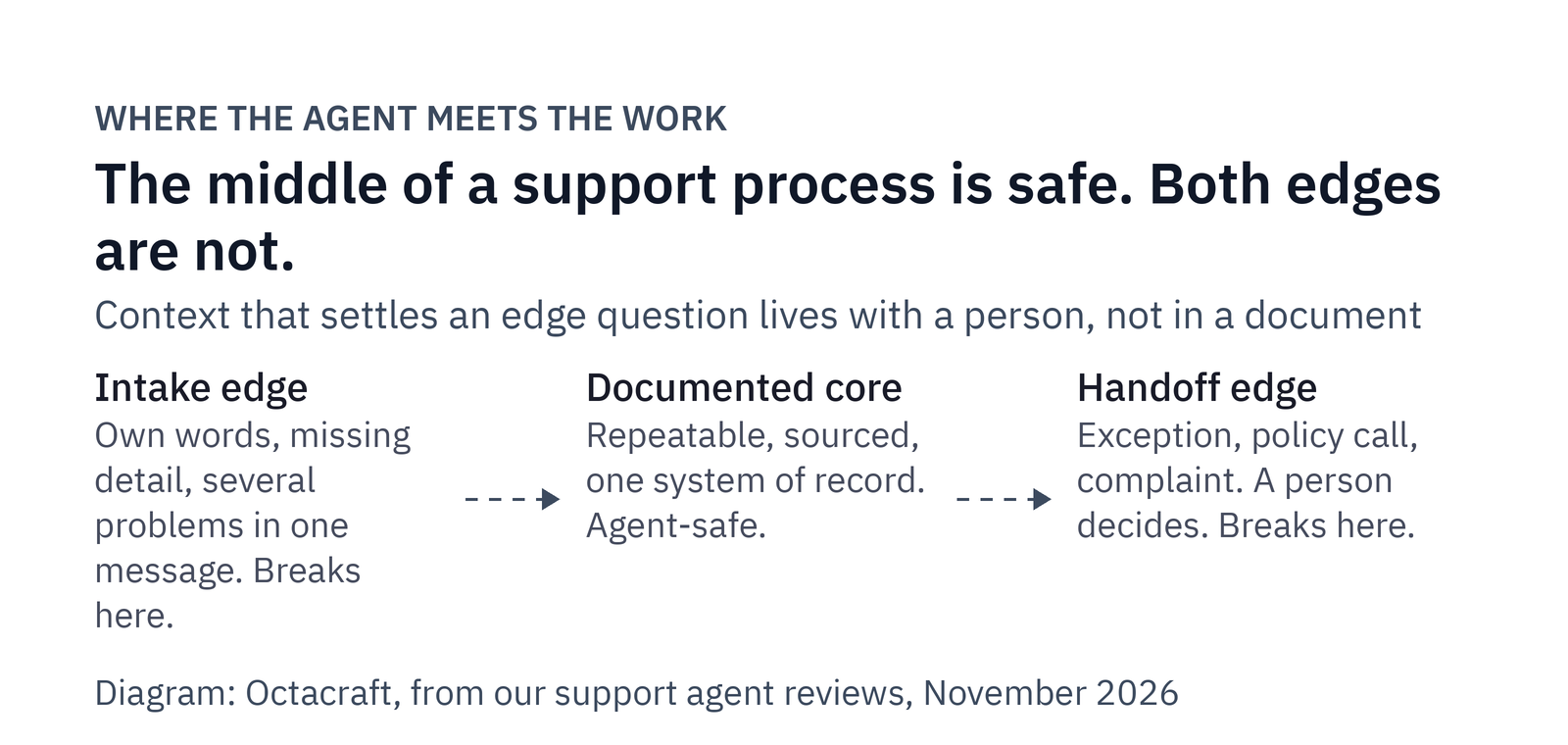
So the agent arrives at the edge, finds no document that settles the question, and does what it is built to do. It produces the most likely next sentence. That sentence is the failure. We described the same edge in why AI agents for business stall at a process edge. It holds for a support queue as well as for back-office work.
The consequence is practical. You cannot fix an edge failure by writing a better persona. You fix it by giving AI agents for customer service a way out of the edge, and by giving the person taking over enough context to continue.
What should you fix first?
Repair in the order of damage, not the order of effort. The easy fixes are cosmetic and the expensive ones are structural. That is why teams spend month one rewriting prompts and month three rebuilding the handoff.
Start with context. The first repair for AI agents for customer service is a tool, not a sentence. An agent that can read the order record and the account tier stops inventing status answers. That removes the failure customers punish most. Add the tools, then test the same twenty questions again before touching a single instruction. That rerun is how you tell whether AI agents for customer service improved, or only changed.
Then rewrite the escalation rules with real data attached: order value, customer history, sentiment, and the words the customer used. AI agents for customer service that cannot see order value will route by keyword, and keyword routing is what put the billing dispute on the delivery desk. A handoff that carries context costs one API call. A handoff that makes the customer repeat the story costs the relationship.
Wording comes last, and it is a smaller job than week one suggests. Prompt edits change how AI agents for customer service phrase an answer, not which data they can reach. A clearer instruction improves the answer in the safe middle of the process, where the answers were already fine.
Does a customer service automation platform fix any of this?
Partly, and only the parts you configure. A customer service automation platform supplies three things: retrieval over your content, connections to your systems, and routing rules for the handoff. Each failure above maps to one of those three. Most AI agents for customer service on the market supply all three. The difference is how well each one is wired to the systems you already run. That is why the platform choice is a real decision rather than a procurement formality.
What no platform supplies is content quality and routing logic. A platform that cannot reach your order system will fail at context, however good its language model is. We tell buyers to test the integration before they read the demo script. The same argument runs through the scoping rules that prevent half of these failures.
Which customer service automation tools change the failure rate?
The ones that log every conversation with the source it used. A transcript tells you what the customer saw. A transcript with the retrieved document attached tells you why the agent said it. That is the difference between a review that fixes something and a review that produces opinions. AI agents for customer service that log the retrieved source cost more per month and repay it in the second week.
Rank customer service automation tools on that capability before you rank them on price or template count. Then check whether the tool reports escalation and resolution as two separate rates. A single deflection number hides the difference between a question answered and a customer given up on. We made a related case in why response time is a queue problem.
What an AI virtual assistant should never answer
Some conversations should never reach AI agents for customer service as the last stop. The line we draw is consequence. If a wrong answer costs money, access or a legal position, a person owns the reply.
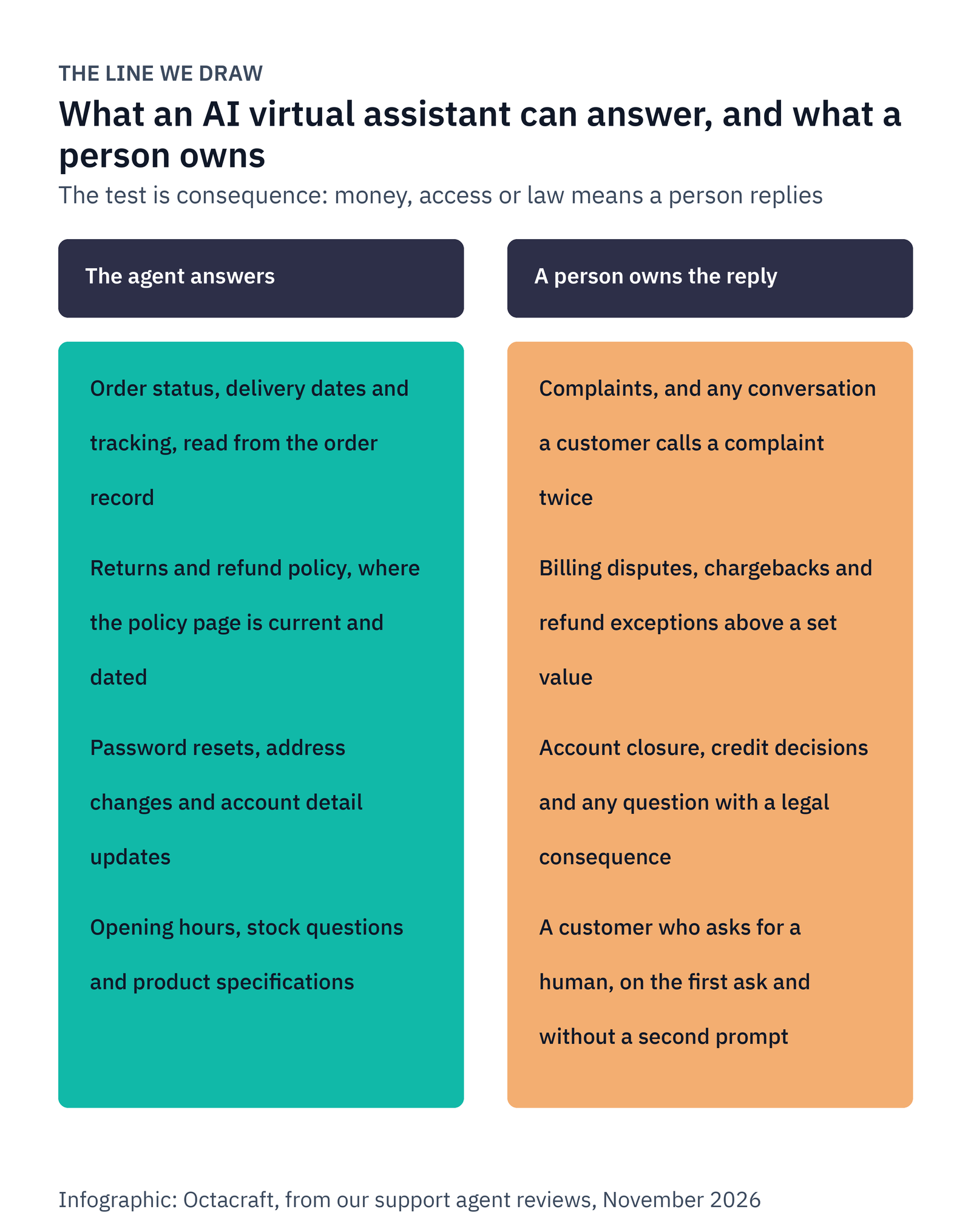
That leaves a wide middle for an AI virtual assistant to work in. It also gives your team a rule they can apply at speed. The rule only works when the customer knows which side of the line they are on.
Klarna’s chief executive put it plainly in May 2025, a year into running support mostly on AI. It is critical to be clear to the customer that there will always be a human if they want one, he said. Cost had been too dominant a factor in the earlier design, he added, and that produced lower quality (Bloomberg interview, reported by Fortune, 9 May 2025).
Say it in the widget, in the first message and in the handoff itself. AI agents for customer service that name the exit early get shorter transcripts. A customer who can see the way out stops fighting the bot to find it.
What AI systems cannot see, and why the weekly review matters
AI systems see the data you connect and nothing else. They do not see the argument in Monday’s standup. They do not see the exception the team agreed to last week, or the customer who has called three times. The model is not the problem. The boundary is.
That is why the review matters more than the launch. NIST’s AI Risk Management Framework treats measurement and monitoring as ongoing functions rather than a pre-deployment test (NIST AI 100-1, January 2023). One support queue deserves the same treatment. A failure nobody reads is a failure you ship again next week.
By week four, launch attention has moved on and the queue looks calm. The failures have not gone. AI agents for customer service produce fewer of them, in places the launch checklist never covered. Five questions keep AI agents for customer service honest after week four. Which transcripts did the agent answer without a source? Which handoffs came back a second time? Which policy answers were older than the policy? Which languages produced a clarification request? And which customer asked for a person twice?
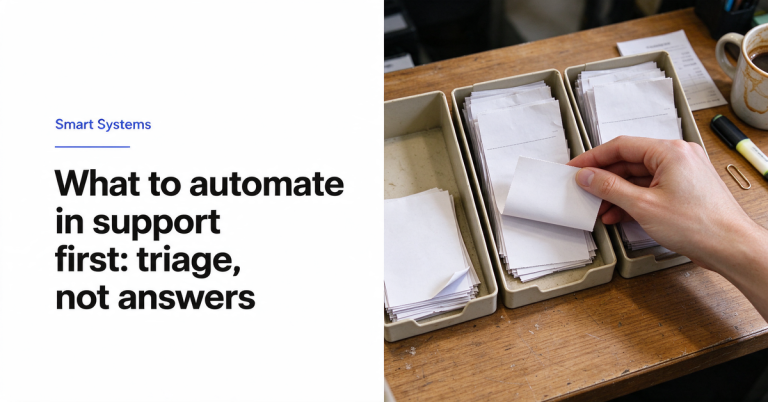
Give that review to the person who owns the queue, not to the project team. The queue owner already knows which answers feel wrong, because the owner is the person who reads what AI agents for customer service actually said. The log turns that instinct into a list with dates on it. Our own reading of what to hand over first is in what to automate in support first, and this failure list keeps confirming it.
Expect the list to shrink slowly. The first two weeks remove the obvious failures. The third week finds the ones that only appear in combination: a policy change, a customer with two orders, and a language the reviewer does not read.
FAQ
Four questions support leads ask us in the first month, answered short.
What goes wrong with AI customer service agents in the first month?
Five failures dominate. AI agents for customer service answer confidently where they have no data. They miss order and account context, escalate to the wrong queue, quote policy that has drifted, and lose tone at the edge of the training set. Each one traces to a missing input rather than to the model’s general ability.
How do you measure whether an AI support agent is working?
Track resolution and escalation as two separate rates for AI agents for customer service. Then sample transcripts weekly and count the answers you can trace to a document or a record. A high resolution rate with untraceable answers is a queue that will produce a wrong policy answer later, and the customer will find it before you do.
Should we start an AI agent on chat or email?
Email, for most teams under 500 people. The volume is lower, the customer is not waiting in a window, and a reviewer can read every conversation in the first two weeks. Move to live chat once the answer set is stable and the escalation rules have been tested on real transcripts.
What does an AI agent cost to run each month?
It depends on the model, the volume and whether you pay per resolution or per conversation. We publish the running cost of the agents we build, with model fees and tool calls separated. It sits in our breakdown of what an AI agent costs to run each month.
The next thirty days
AI agents for customer service are only as good as the process around them. Month one is not a test of whether the model is good. It is a test of your support process. AI agents for customer service need data, routing and a review to be right at the edges, and month one shows you which of the three is missing.
If a transcript is already sitting in your inbox, start there. Name the missing input, fix that one, and read ten more transcripts next week. Send us the transcript and the queue if you want a second read on which of the five you are looking at.
Philip Bassey is Octacraft’s Chief of Staff. He runs the operating reviews that keep our delivery and support work documented, and writes about the decisions buyers face before and after a system goes live.

Philip Bassey is Chief of Staff at Octacraft, where he oversees the interdepartmental activities that keep our processes documented and the ones worth publishing published. He writes about operations that are engineered into systems instead of held together by memory.