AI automation services: five operations to hand over first
The short version
- AI automation services pay back fastest where the work runs daily, the input is already machine readable, and a wrong answer is cheap to catch.
- For a firm of 50 to 300 people, AI automation services pay back soonest when document intake goes first, then first-pass support triage and recurring report assembly.
- Data entry between two systems and follow-up sequences come later. The first shares a build with intake, and the second carries a relationship risk.
- Payback is the month the hours removed cover the build, the run cost and the review hours. Quotes tend to leave the review hours out.
- Three conditions move an operation down the list: no API, handwritten input, and volume too low to justify a build.
Most AI automation services budgets are approved before anyone agrees what the money buys. The vendor list comes first, then three demos that look alike, then a pilot on whichever process the loudest manager owns.
The order of work decides the return. The same budget pointed at document intake can pay back inside two quarters. Pointed at a quarterly board pack that three people assemble by hand, it may never pay back at all.
This piece ranks five operations by how fast they pay back for a firm of 50 to 300 people. It gives the three variables behind the ranking, the order they produce, the arithmetic that turns that order into a payback month, and the cases where the honest answer is to wait.
Why the order of work decides the return
Payback is a ratio. The numerator is the value of the hours removed. The denominator is the build, the run cost and the review hours left behind.
Volume sits in the numerator. Two firms can buy the same AI automation services and get different returns, because one handles 4,000 invoices a month and the other handles 300. The software is identical. The arithmetic is not.
AI automation services are usually sold as a platform, a pilot or a managed service. None of those labels tells you where to start. The process does, and the process has a shape: how often it runs, what arrives, and what happens when it is wrong.
The order also compounds. The first build produces the extraction layer, the exception queue and the review habit. The second build reuses all three. A firm that starts with its hardest process pays full price for the layer and learns the least from it.
How we rank these: three variables
AI automation services fail on the ranking more often than on the tooling. Rank each candidate on how often it repeats, how clean its input is, and what a wrong answer costs. Repeat rate sets the size of the saving, input quality sets the build time, and error cost sets the review a person must keep.
Repeat rate is the variable people underestimate. Two hundred invoices a day is 4,000 a month, and four minutes saved on each is 267 hours. The same four minutes on a quarterly report is one hour a year.
Input quality decides the build. An invoice that arrives as a PDF with a fixed layout is a solved problem for any document extraction service. A photograph of a handwritten delivery note is not, and no ranking should pretend otherwise.
Error cost decides how much review stays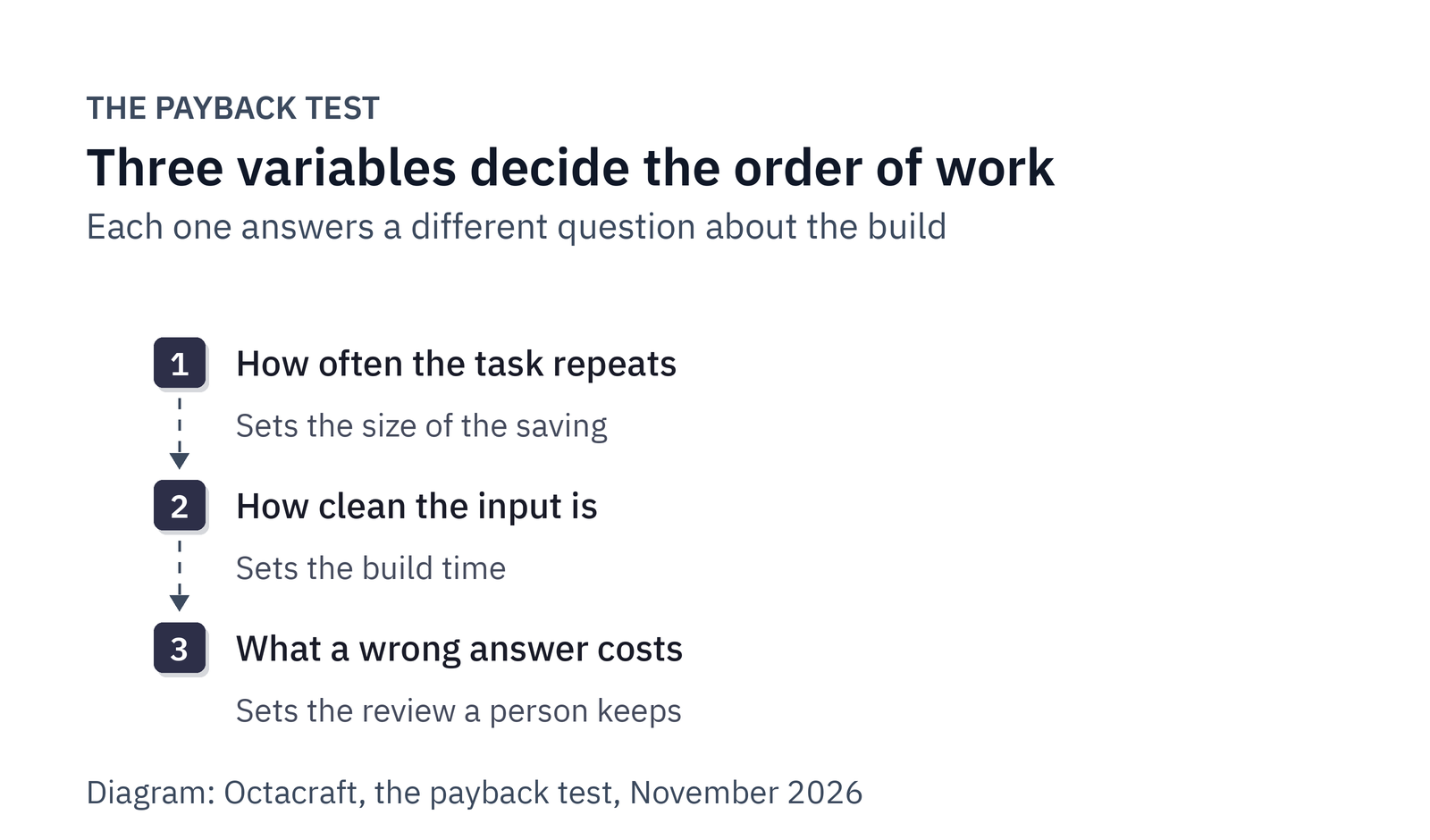
Why customer-facing work comes later
AI automation services should fail first where no customer can see it. Run the internal operation for a month, learn where the model is wrong, then move toward the customer with evidence.
The common mistake is to start with the chatbot. It is the most visible build, so its failures are public, and one public failure ends the programme before the second process starts.
Start inside. The invoice queue teaches the team what a confidence score means, who reads the exception list, and how a wrong field gets corrected. Those three habits transfer to support and to sales.
AI automation services: the five operations, ranked
For a 50 to 300 person firm the order is document intake, first-pass support triage, recurring report assembly, data entry between two systems, and follow-up sequences. Intake and data entry often share one build.
The table is the ranking at a glance. The reasoning for each place follows.
| Rank | Operation | Who does it now | Repeat rate | Review a person keeps |
|---|---|---|---|---|
| 1 | Document intake and routing | Bookkeeping clerk | Daily | Exceptions and a sample |
| 2 | First-pass support triage | Customer service representative | Daily | The reply itself |
| 3 | Recurring report assembly | Financial analyst | Weekly or monthly | The numbers before they ship |
| 4 | Data entry between two systems | Bookkeeping clerk | Daily or weekly | Every field that feeds a payment |
| 5 | Follow-up and reminder sequences | Sales representative | Weekly | The message and the timing |
1. Document intake and routing
Today the documents arrive in a shared inbox. Someone opens each one, reads the supplier, the date and the line items, and types about 20 fields into the accounting system. Then they forward it to whoever approves it.
After the build the document is captured once. A model reads the fields, the record is classified, and it is routed to the right queue. Only the exceptions wait for a person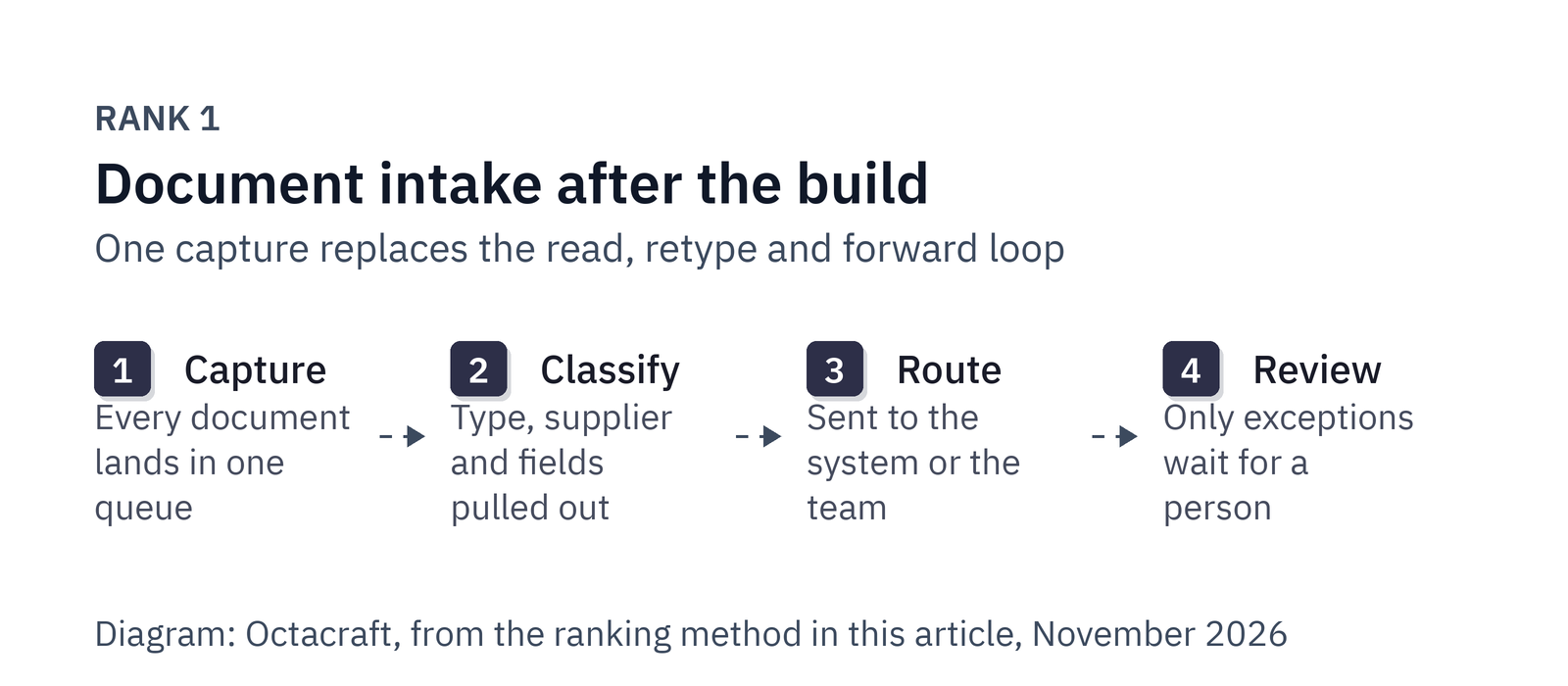
At 2,000 documents a month and four minutes of keying each, that is about 133 hours of clerical work. A bookkeeping clerk costs $38.10 a worked hour at the US median once benefits are loaded (BLS, May 2025 and BLS, June 2026). The work is worth about $5,080 a month.
Extraction is the cheap part. Amazon charges $0.05 for a page with form fields and $0.0015 for plain text (AWS Textract pricing, accessed November 2026). At 2,000 pages that is $100 a month against $5,080 of labour.
The accuracy argument is weaker than vendors suggest. A pooled review of 93 studies put the error rate of a single manual entry pass at 0.29% of fields (Garza et al., International Journal of Medical Informatics, 2024). That is roughly one wrong value in a 20 field invoice every 17 documents. Extraction does not remove the check. It moves the check to the exception queue, which is why manual entry costs more than the typing.
2. First-pass support triage
Triage is the read, classify and route step, not the answer. A model can decide that a message is a billing query about a duplicate charge, then send it to the accounts team with the account number attached. It is the part of AI automation services that removes handling time without touching the reply.
The saving is the handling time before the reply. A customer service representative costs $33.67 a worked hour at the US median (BLS, May 2025). At 3,000 messages a month and 90 seconds of sorting each, that is 75 hours, or about $2,500.
Keep the first reply with a person for the first month. An automated acknowledgement can leave the first response clock untouched while the customer feels ignored. That is the trap inside the queue itself, and it is why response time is an operations problem.
3. Recurring report assembly
The work is pull, clean, check and format. Four hours a month per report is normal, and the person doing it is often the most expensive one in the room.
A financial analyst costs $77.87 a worked hour at the US median (BLS, May 2025). Four hours a month is about $311, and ten reports is $37,000 a year.
The mechanism is a scheduled refresh, not a model. Power BI caps shared capacity at eight scheduled refreshes a day, and it pauses a schedule after two months with no viewer (Microsoft Learn, updated 18 September 2026). A report nobody opens is a report nobody needs.
Reports rank third because the volume is low. The hourly rate is the highest of the five and the hours are the fewest, which is a shape most AI automation services quotes handle badly. Moving from manual reports to automatic reporting is mostly a data problem, not a writing one.
4. Data entry between two systems
This is the same extraction layer pointed at a different consumer. An order taken in one system has to exist in the fulfilment system, and someone retypes it because no integration was bought.
It ranks fourth for a good reason and a bad one. The good reason is that the build is cheap once intake exists. The bad reason is that this work is where a wrong value travels furthest, so the check matters more here, not less. AI automation services that skip the check save hours and create rework.
If your first build was intake, treat this as the second release rather than a new project. Most AI automation services roadmaps put it there. If it is not, price it as a standalone and count how many systems the value lands in.
5. Follow-up and reminder sequences
Follow-up ranks last, and it is the operation most often bought first. AI automation services are sold hardest on this one, and the reason to wait is that the failure is social rather than technical.
The evidence on delay is old and still the best available. A test lead sent to 2,241 US firms got a reply inside an hour from 37%, and 23% never replied at all. Among firms that answered, the average wait was 42 hours (Oldroyd, McElheran and Elkington, Harvard Business Review, March 2011).
A sales representative costs $57.49 a worked hour at the US median (BLS, May 2025). Forty open deals touched four times a month at 12 minutes each is 32 hours, or about $1,840.
The rules are legal as well as social. Commercial email in the US must carry a working opt-out and honor it within 10 business days (FTC, CAN-SPAM guide, accessed November 2026). A sequence that ignores that is a liability with a send button, and it is why the follow-up gap is cheaper to fix with a date field than with a tool.
How long until each one pays for itself?
Payback for AI automation services is the build quote divided by the monthly saving after run and review costs. Document intake at 2,000 documents a month saves about $4,400 a month, so a $25,000 build pays back in under six months.
The formula is short. Months to payback equals the build cost divided by the monthly labour removed, less the run cost and the review cost. That division tests any AI automation services quote in about five minutes.
Run the arithmetic on intake. Labour is $5,080. Extraction is $100. Review is 15 hours of checking and exception handling, which is $570. The net is $4,410 a month, and a $25,000 build is 5.7 months.
These are arithmetic on published wage data and stated volumes, not a measurement of a delivered build. We publish a measured result when a build has run long enough to produce one, and this one has not.
The review cost that gets left off the quote
Review is the hours a person still spends on the output. It has two parts: the exceptions the model refuses, and the sample somebody checks to know the refusal rate is honest.
Most AI automation services quotes price neither. A 5% exception rate on 2,000 documents is 100 records, which is about 7 hours at four minutes each. A 20 hour sample check brings the line to 27 hours, or $1,030.
At 27 hours the net falls to $3,950 and the payback moves to 6.3 months. At 40 hours of review it is just over seven months. Review load is the number that decides whether the ranking survives contact with your team.
Where this order breaks down
AI automation services rankings break in three cases: no API on the systems involved, input that arrives scanned or handwritten, and volume too low to cover a build.
Without an API or a supported connector, an AI automation services build becomes an integration project. That is worth doing, and it is not the first build. Fix the connection first, then return to the ranking.
Handwritten input raises the exception rate and the review hours. A build that assumes clean scans will fail on the third supplier who sends a photograph of a delivery note.
Low volume is the hardest case to argue. At 200 documents a month the labour line is $508. No AI automation services build pays back against that, and the honest answer is a form that rejects bad data at the point of entry.
AI business process automation: what the scope covers
AI business process automation covers discovery, the build, the review loop and handover. It leaves the process definition, the exception rules and the system access with your team.
An AI automation services engagement has four parts. Discovery maps the process and counts the volume. The build writes the extraction, the rules and the queue. The review loop runs for a month with a person checking the output. Handover gives the team the documentation, the credentials and the runbook.
AI automation services should leave three things with you, and what they do not cover matters as much. The process definition stays with the client, because the person who does the work knows the exceptions. The access stays with the client, because the system owner should grant it. The definition of correct stays with the client too.
Ask any provider which of those four parts is a deliverable and which is a meeting. The answer tells you what you are buying.
AI powered business process automation is not an agent
The phrase covers both, and they are different builds. AI powered business process automation runs a fixed path with a model inside it: capture, classify, route, check. The path is written down and testable.
An agent chooses its next step. That is useful for open-ended work and a poor fit for a process that must produce the same output every time. Four of the five operations above are fixed paths.
The line between the two is the subject of what an AI agent can run in a business today, and it is worth settling before a vendor settles it for you.
Best AI agents for business: start with the operation
The best agent for a business is the one that fits the operation ranked first. AI automation services buyers should pick the operation, then the tool class, then the vendor. Most shortlists run that order backwards.
The tool class follows the output. A document output needs extraction. A queue output needs classification and routing. A scheduled output needs a connector and a refresh. Only the open-ended case needs an agent.
AI automation services sold as a platform licence invert the reasoning. The licence has to be justified by processes it can carry, so the processes get chosen to fit the licence.
Best AI agents for small business: where the list changes
Under about 100 staff the volume rarely justifies a bespoke agent. One hundred documents a month is about 7 hours of keying, or $255. That is a form and a rule, not a project.
The list changes in three ways at that size. Buy the extraction layer rather than building it. Keep one named reviewer rather than a queue. Skip the platform until the second process needs it.
A small firm gets more from the review habit than from the model. AI automation services for a 40 person firm should cost less than a hire and leave one person accountable for the output.
The order in one rule
If an operation runs daily, arrives as a document, and a wrong answer is caught before it leaves the building, hand it over first.
If it fails one of those three, the next operation on the list is the better first build. That rule applies to any AI automation services shortlist, and it survives a change of budget or a change of vendor.
The conditions are worth testing properly before you spend anything. The decision tree for a first process walks them in order.
Frequently asked questions
How long until AI automation services pay for themselves?
For document intake at 2,000 documents a month, about six months after a $25,000 build. The saving is roughly $4,400 a month once extraction and review costs are subtracted. A low-volume operation may never pay back, and a quarterly report rarely does.
Which operation should we hand to AI first?
The one that runs daily, arrives in a machine readable format, and fails where a customer cannot see it. For most firms that is document intake and routing. AI automation services bought before that test tend to start in the wrong place.
Do AI automation services replace staff?
AI automation services remove hours from a process rather than a headcount from a team. The review queue still needs a named person, and the first reply to a complaint should stay human. The saving shows up as capacity, which is why the payback improves at high volume.
What does an AI automation services engagement include?
Discovery, the build, a month of review and a handover. You keep the process definition, the exception rules and the system access. Ask which of those four parts is a deliverable and which is a meeting before you sign anything.
What can AI automation not do yet?
It cannot take responsibility for a wrong payment, read messy handwriting without review, or decide what counts as correct for your business. Those three stay with a person, and a sensible AI automation services build routes them there from day one.
If you are buying AI automation services with no order in mind, send us the five processes that eat the most hours. We will rank them against the three variables in this piece and say which one we would hand over first, including the case where the answer is none of them.
Philip Bassey is Octacraft’s Chief of Staff. As part of his responsibilities, he oversees the interdepartmental activities to see that our processes are documented and those that need publishing are published. He writes about the work between a system going live and a team trusting it.

Philip Bassey is Chief of Staff at Octacraft, where he oversees the interdepartmental activities that keep our processes documented and the ones worth publishing published. He writes about operations that are engineered into systems instead of held together by memory.