

Automation strategy: a decision tree for your first process
The short version
- An automation strategy is a ranking problem before it is a technology problem. Rank the processes, then pick one.
- Score every candidate on cadence, single team ownership and customer visibility. Pain is a poor guide to buildability.
- A process that crosses two teams stalls an automation strategy, because no single owner can approve the change.
- The tree ends in three first builds: a schedule, an integration or an approval step.
- Thirty days in, success is fewer touches, a checked exception queue and one named owner.
Nine processes need fixing and every one of them has a sponsor. The list came from complaints, so the loudest process sits at the top.
That list is a poor plan. The loudest process usually crosses three teams, and a build across three teams needs three sets of permission before anyone writes a rule.
Automation strategy is the work of ranking processes on cadence, ownership and customer visibility before you buy a tool. This piece gives you the three questions we ask on a first call, the scorecard we fill in while the client talks, and a decision tree you can run on a whiteboard in twenty minutes.
Why ranking candidates by pain picks the wrong process
Ask a team which process hurts most and you get an honest answer. You also get the hardest project on the list, and a poor basis for an automation strategy.
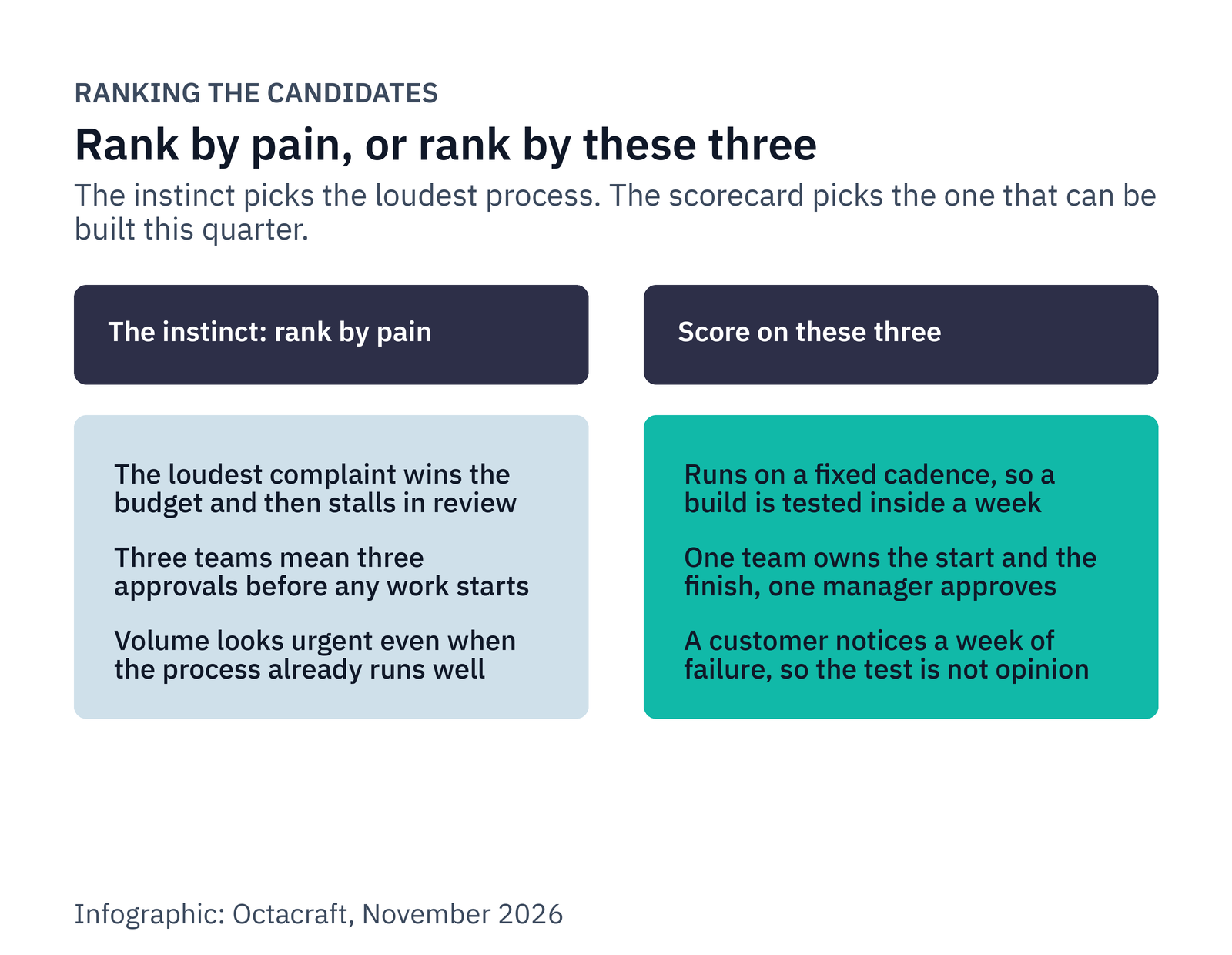
Pain tracks frequency and friction, not buildability. A billing dispute touches sales, finance and support. It runs through three systems and three managers, so every fix needs three agreements. Pain is a poor input to an automation strategy.
Your automation strategy will also overweight volume if it ranks by pain. Four thousand records a month feels urgent. It may also be a process that already runs well, and then you have bought a faster version of something that was not costing much.
The repair is to rank on three conditions: a cadence, one team owning the start and the finish, and a customer who notices failure. An automation strategy built on those three survives a change of finance director. A ranked list of complaints does not.
Automation strategy: the three questions we ask on every first call
Ask how often it runs, which team owns both ends, and whether a customer would notice a week of failure. The answers predict whether the process can be built this quarter. They do not predict whether it matters most.
We ask the three questions in order and write the answers down while the client talks. An automation strategy that skips them usually starts with a tool.
- How often does this run: daily, weekly, or whenever someone remembers?
- Which team starts it and which team finishes it, and do both report to the same manager?
- If this process broke for a week, would a customer notice?
Cadence buys a test loop. A daily process can be run, checked and corrected by Friday. A quarterly process gives you one test a quarter, and by then the analyst who understood it has moved team.
Ownership buys a decision. One manager can approve access, a change of rule and a rollback. Two managers need a meeting, and the meeting needs a slot in a full diary.
Visibility buys the budget and the test. A customer who notices a failure gives you a pass or fail check that does not depend on opinion. Those three answers are the whole automation strategy for a first call.
How to score the answers
Score each answer 0, 1 or 2 and add them up. The maximum is 6. Put the total on the board. An automation strategy that shows its arithmetic is harder to argue with than one that does not.
| Question | 0 | 1 | 2 |
|---|---|---|---|
| How often does it run? | When someone remembers | Monthly or quarterly | Weekly or more often |
| Which team owns the start and the finish? | Two or more teams, different managers | One manager, two teams | One team, one owner |
| Would a customer notice a week of failure? | No one outside the team would know | A customer would ask eventually | A customer would complain inside the week |
A 5 or 6 puts the process on the shortlist. A 3 or 4 means it is real but blocked, so fix the blocker first. Below 3, spend the quarter on the process above it. An automation strategy that ignores the middle band tends to build the blocked process anyway.
Where the score lies to you
Two false positives are common.
The first is a high volume process that already runs well. It scores 6 and has almost nothing to fix. Ask what the team does at month end. If the answer is nothing unusual, the score is measuring health rather than opportunity.
The second is a low volume process with a senior sponsor. It runs twice a quarter, so it scores 2 on cadence and still wins the room. One test a quarter is not a project. An automation strategy that counts enthusiasm as cadence will wait a year for its first result.
There is a third trap in the ownership column. Two managers who both say yes are not one owner. They are enthusiasm. Ownership means one name beside the exception queue at eight in the morning.
The decision tree, top to bottom
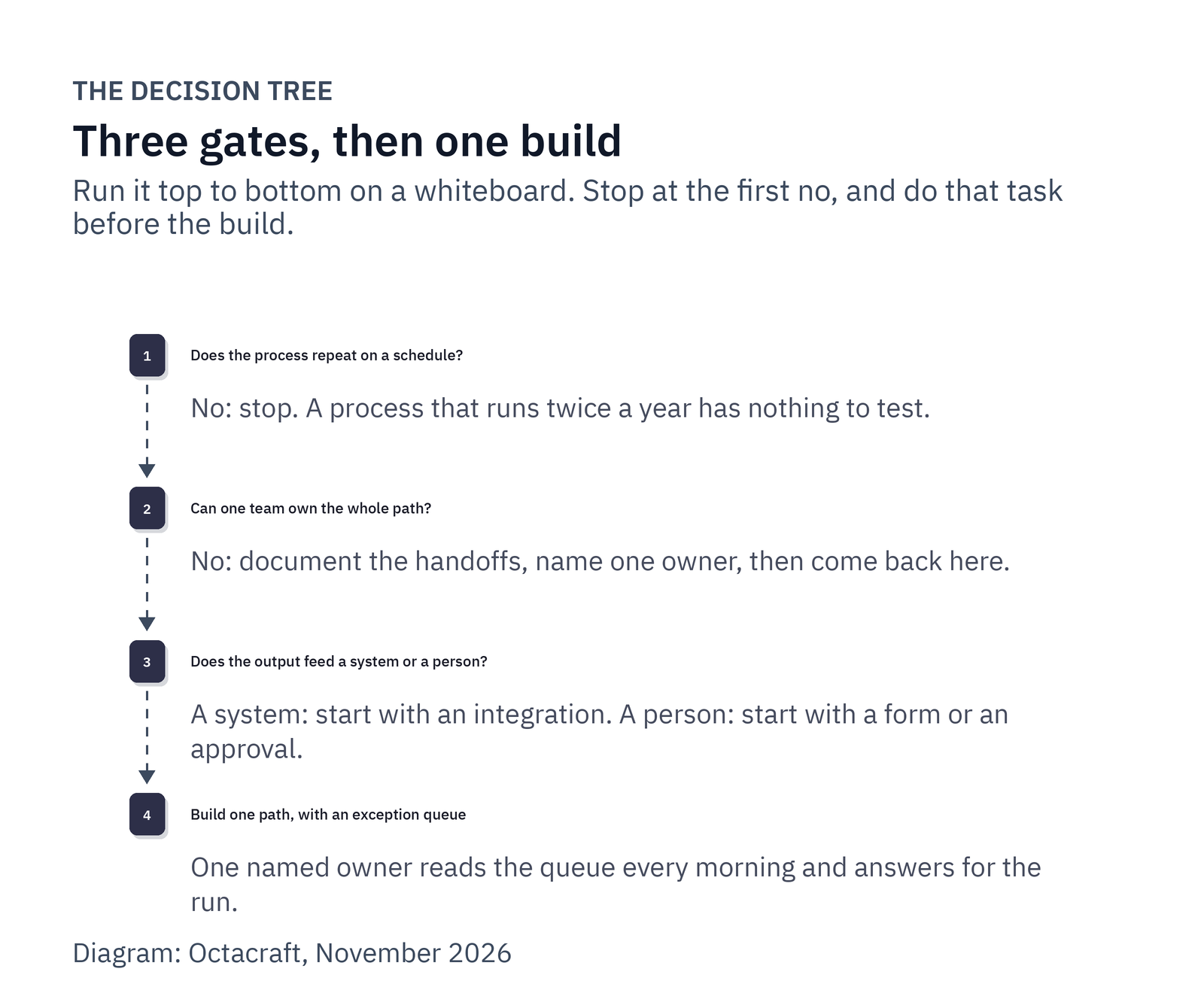
An automation strategy ranks on the scorecard and decides on the tree. Run it in order and stop at the first no.
Each gate is a yes or no. A no is not a rejection of the process. It is a task to finish before the build, and usually cheaper than the build.
Branch 1: does the process repeat on a schedule?
If it does not repeat, stop. There is nothing to automate yet, because automation needs a trigger and a trigger needs a cadence.
Ad hoc work can still be helped, with a template, a form or a checklist rather than a flow. A flow for a process that runs twice a year is something a team maintains and never tests. An automation strategy that lists those processes as builds is a list of hopes.
Branch 2: can one team own the whole path?
If not, do not build yet. Document the handoffs, name one owner for start to finish, then come back to this branch. An automation strategy that builds here pays for the missing owner later.
Ownership means accountability, not effort. The owner may perform two of nine steps and still be the person who answers when the process fails at six in the morning.
A process with three owners has no owner. It also has three exception paths, and each lands in a different inbox. That is the handoff problem described in business process automation for operators.
Branch 3: does the output feed another system or a person?
The answer changes the first build by weeks. If the output feeds a system, you are building an integration, and the hard parts are field mapping and access. If it feeds a person, you are building a form, a notification or an approval.
Approvals are a first class object in these tools. Power Automate’s approvals action starts a request and waits for a named person to respond, so the flow holds a human decision inside the automated path (Microsoft Learn, accessed 2 November 2026). That is the honest shape for anything that commits money or makes a promise to a customer.
A system output usually means the process already has a schema. A person output usually means it ends in judgement, which is fine as long as the judgement has a queue and a name.
Business process automation examples, scored against the tree
Four common candidates show how an automation strategy separates a buildable process from an attractive one. Supplier invoice intake scores 6. A monthly board pack scores 1. Client onboarding scores 3, and it is usually the first process a team names.
| Process | Cadence | Owner | Customer sees failure | Score | First build |
|---|---|---|---|---|---|
| Supplier invoice intake | Daily | Finance, one team | Supplier chases payment | 6 | Scheduled flow with an exception queue |
| Weekly sales report | Weekly | Sales operations, one team | No | 4 | Scheduled flow from one export |
| Client onboarding | Ad hoc, about 12 a month | Sales, legal and finance | Every new client sees the delay | 3 | Form plus approval, then integration |
| Monthly board pack | Monthly | Finance plus every department head | No | 1 | Nothing yet: fix the handoffs |
Invoice intake wins on all three conditions. It runs daily, finance owns both ends, and a supplier notices a missed payment inside a week.
Client onboarding is the one teams name first, because it is visible and because sales complains about it. It runs when a deal closes, three teams touch it, and every new client feels the wait. One condition of three is met. The fix is not a bigger tool but a named owner and a written sequence, which is where an automation strategy earns its keep.
These scores are our rubric applied to four ordinary cases. They are not a survey, and your candidates will score differently.
What a wrong first pick costs, even when nothing breaks
The cost of a wrong first pick is not the licence. It is the quarter, and the belief the team forms while the quarter passes. An automation strategy that misses here costs more than the software.
A cross team first project spends its opening weeks on access, sign-off and a data question nobody owns. The build slips. The sponsor asks for a status, and the status is a diagram.
Six months later the tool is live and half used. The path it automated is still finished by hand at month end, because nobody built the exception route. The second cost is the abandoned half build: a script or a flow nobody asked for, failing without telling anyone.
We will not put a number on this. We have no measured comparison of a cross team first project against a single team one, and an estimate would read as a finding. The mechanism is enough: permission, access and unclear ownership arrive before the first rule.
Before you build: three things that must exist
Three items, and none of them is a tool. One named owner. One page of steps in order, including the exception. A written definition of done.
The definition is the item teams skip. “Invoice paid” is not a definition. “Invoice matched to a purchase order, posted to the ledger and notified to the supplier” is one, because a test can check each part.
Without the written steps, the person building it writes the process down for you, and their version becomes the process. The exceptions then live in one head. That is how most first builds end, and no automation strategy survives it.
If the page is hard to write, that is the finding for the automation strategy. Once it exists, what the first automated process looks like is the next read.
Process automation tools: what the branches decide
An automation strategy narrows the tool class before any vendor is compared. A scheduled repeat wants a scheduler with connectors. An event wants a webhook trigger. A human decision wants an approval or a form.
Most comparisons start with connectors and price. Start with the trigger, because the trigger is the part you cannot change later without a rebuild.
Power Automate documents three trigger types: automated on an event, instant from a button, and scheduled on a recurrence (Microsoft Learn, updated 25 September 2026). Most tools in this market mirror that split.
Read the branches as a shopping list. A scheduled process with a system output needs a scheduler and a connector. The same process with a person output needs a form or a notification. A process that fails branch 2 needs no tool, because the missing piece is ownership. A process ending in an approval needs a tool that holds approvals natively.
Business process automation solution: build, buy or borrow
Solution is a vendor word, and an automation strategy hides three purchases behind it.
Configure a tool when the process is standard: invoice intake, report distribution, document chasing. Build when the process is how you compete, because a standard tool will fit most of it and the rest is your advantage. Borrow, meaning a service with a handover, when you need it in six weeks and lack the skill in house.
The test is short. If two competitors could run the same set-up, configure it. If the process encodes a decision only your firm makes, build it.
Business process automation service: four questions before you sign
We sell this kind of work, so read the list as a buyer’s list.
- Who owns the exception queue on day 31, and what is their name?
- What does handover include: the documentation, the credentials, the runbook?
- What happens when the process changes: hourly, or included in the retainer?
- How do we leave: which data do we get back, and who rotates the credentials?
A service that answers all four in writing is worth comparing. One that answers three is selling a pilot with a support contract attached. A business process automation service should make the exit as clear as the entry.
Digital transformation tools: the ones that come first
The phrase usually means the platform layer: identity, data, integration and document management. Three of those matter for a first build.
Single sign-on, so every run carries a person’s name in the audit trail. A system of record you can write to, so the output lands where reports read it. An integration layer, so the second process does not need a fresh point to point connection.
Buying the platform before the process is the expensive order. The platform is chosen by the processes it has to carry. Until you have one, you are guessing at the load.
What working looks like 30 days in
Thirty days in, working looks like three things: fewer manual touches per run, an exception queue someone checks each morning, and one person who can explain yesterday’s failure. An automation strategy is judged here, not at go live.
Count the touches before and after. A touch is a person opening, retyping or moving a record. If the count has not fallen, the process moved rather than changed. An automation strategy that cannot count touches is measuring mood.
A touch carries a loaded rate, not a wage: US private industry employers paid $46.89 an hour worked in June 2026, and benefits were 30.0% of that (US Bureau of Labor Statistics, 9 September 2026).
The exception queue is the part teams cut to hit a deadline, and it is the part that keeps the thing alive. Power Automate turns off a cloud flow whose trigger or actions fail continuously for 14 days, and it can suspend one that has not been triggered in 90 days (Microsoft Learn, updated 17 July 2026). A quiet automation is not always a healthy one. An automation strategy that stops at go-live is half a strategy.
One named owner closes the loop. Somebody has to read the queue, decide the exceptions and answer why the six o’clock run produced nothing. That is the same queue discipline that makes response time a queue problem in support.
Which process to build first, in one rule
If one candidate runs weekly or better, sits inside one team and shows up in front of a customer, build that one. If no candidate meets all three, the first project is not automation. It is ownership.
That is the automation strategy in a sentence. Everything above is the reasoning that makes the sentence defensible in a room where three managers each have a favourite.
Frequently asked questions
How do I choose the first process to automate?
Score every candidate on three questions: how often it runs, whether one team owns the start and the finish, and whether a customer would notice a week of failure. Each answer scores 0, 1 or 2. Build the highest scorer, and fix the blocking condition before any tool is bought.
Is an automation strategy different from digital transformation?
Yes. An automation strategy picks which process to change first and how to build it. Digital transformation changes the platform layer underneath: identity, data, integration and document management. The order matters, because a platform chosen before the first process is a guess at the load it will carry.
What if two teams own the process?
Fix the ownership before you build. Write the handoffs down, name one person accountable for the start and the finish, and give that person the authority to change the rules. Two willing managers are not one owner. A build that needs both of them stalls at the first change request.
How long should the first automation take?
For a weekly process owned by one team, days to a working path and a few weeks to a trusted one. An automation strategy that runs past a quarter on its first build usually has a scope problem or an ownership problem, not a technology problem. Shorten the path before you extend the deadline.
If you have a list of nine processes and no order, send us the list. We will score it against the three questions in this automation strategy and say which one we would build first, including the case where the answer is none of them.
Philip Bassey is Octacraft’s Chief of Staff. As part of his responsibilities, he oversees the interdepartmental activities to see that our processes are documented and those that need publishing are published. He writes about the work between a system going live and a team trusting it.

Philip Bassey is Chief of Staff at Octacraft, where he oversees the interdepartmental activities that keep our processes documented and the ones worth publishing published. He writes about operations that are engineered into systems instead of held together by memory.



One Comment