
What AI agents can run in a business today, and what stays human
The short version
- AI agents for business can own three kinds of work today: reading and routing what comes in, turning documents into records, and drafting the reply that stops short of a signature.
- They fail at the edges, not in the middle. The expensive failures are an exception nobody wrote down, a system the agent is not allowed to touch, a handoff between two teams, and a confident answer nobody checked.
- The difference between an agent and the chatbot your team already uses is the loop. The agent calls a tool, reads what came back, and can stop halfway through a job. That is what creates the review work.
- Short and checkable beats long and important. METR measured a 50% success horizon of about 50 minutes for frontier models in March 2025, and Carnegie Mellon‘s simulated office work put the best agent at 24% of tasks.
- One rule covers the whole article: hand over the task, keep the signature.
In June 2025, Carnegie Mellon put ten AI agents to work inside a simulated company. They answered chat messages, filled in forms, filed documents, the ordinary grain of an office day. The best of them finished 24% of the tasks. One agent could not close a pop-up window. Another renamed a colleague to match a name it was looking for.
That result is the most useful thing on this page, because it marks the line. Simulated offices are unforgiving. The failures they expose are the same ones that show up in production six weeks later. Which means the interesting question is not whether AI agents for business work. It is which work is short enough, checkable enough and boring enough to hand over today. It is also which work will hurt you if you try. Everything below is written for AI agents for business as they exist in October 2026, not as they are promised.
The short answer on AI agents for business
An AI agent can own bounded, rules-heavy work that starts with text or a record and ends in something a person can check. That means intake and triage, record creation and updates, and first drafts that wait on a human signature. It cannot own judgement, liability, or the exception rules that live in one person’s head.
An AI agent is software that pursues a goal by calling tools and checking its own results, rather than producing a single answer. That second half of the definition is where the risk lives, because software that acts can also do damage. A chatbot that gets something wrong wastes thirty seconds of somebody’s afternoon. An agent that gets something wrong writes a wrong record into a system the business runs on. Somebody finds it in a reconciliation four months later.
The boundary below is where most conversations about AI agents for business should start. Run your own process list against the left column. If a task is not there, nothing further down this page will make it fit.
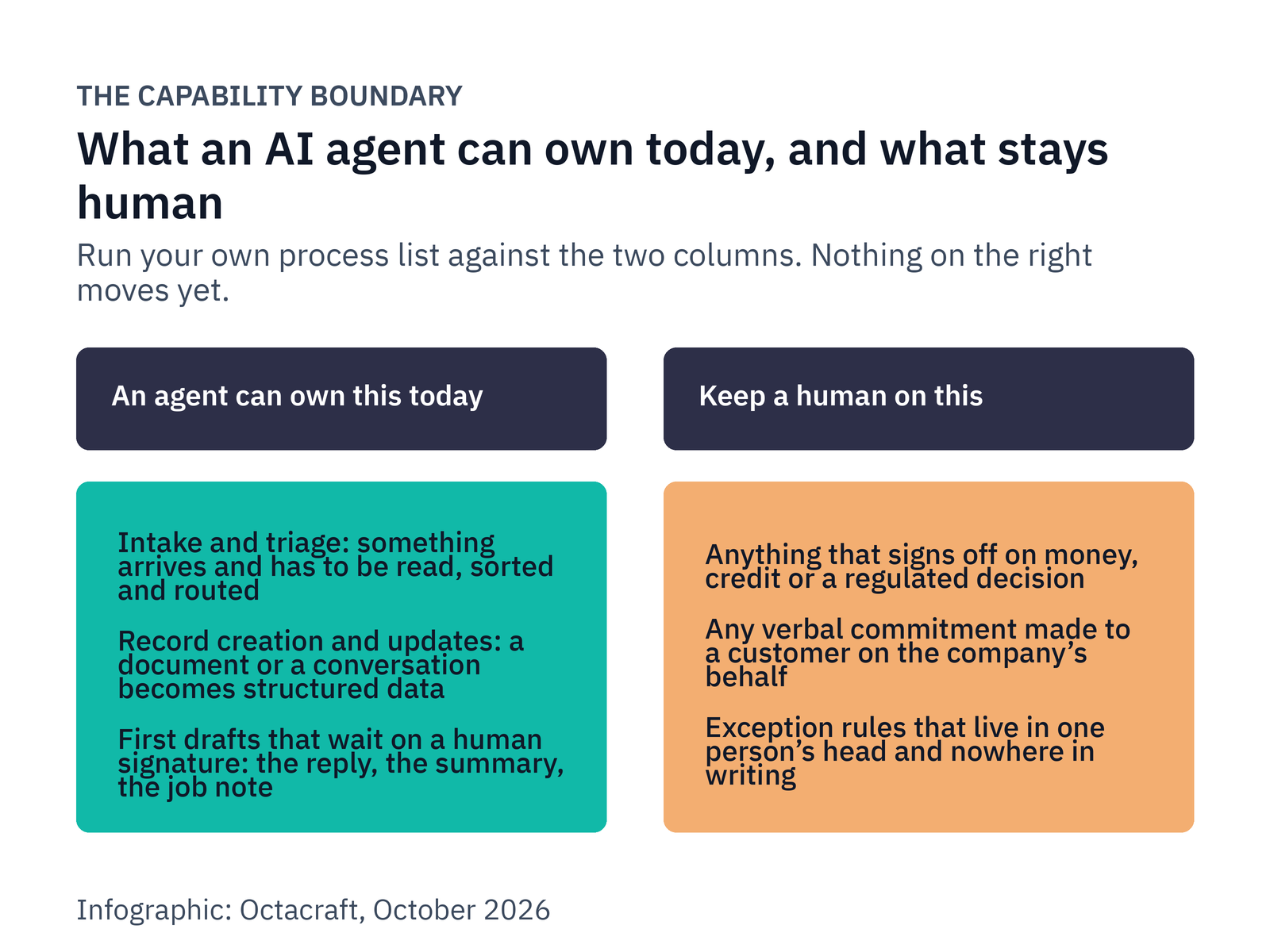
Two things follow from that split. The useful unit of work for AI agents for business is a task, not a department. Nobody hands over accounts payable, but plenty of teams hand over invoice intake. And the boundary is drawn by consequence rather than difficulty. Parsing a supplier invoice is harder than approving it, and approval is the part that stays with a person.
The loop is the difference
Your team probably already uses generative AI: someone pastes a paragraph into a chat window and gets an answer back. Agentic AI goes one step further and acts, calling tools and writing into the systems it can reach. Anthropic’s engineering write-up, published December 19, 2024, draws the same line from the other direction. It separates workflows, where the code paths are fixed in advance, from agents. In an agent, the model decides its own steps and its own tool calls. The write-up also notes what that flexibility costs: latency, tokens, and supervision.
Read that as a budget line rather than a technical footnote. For most AI agents for business, supervision is the line that gets underestimated. The loop means a run can end in a state nobody designed.
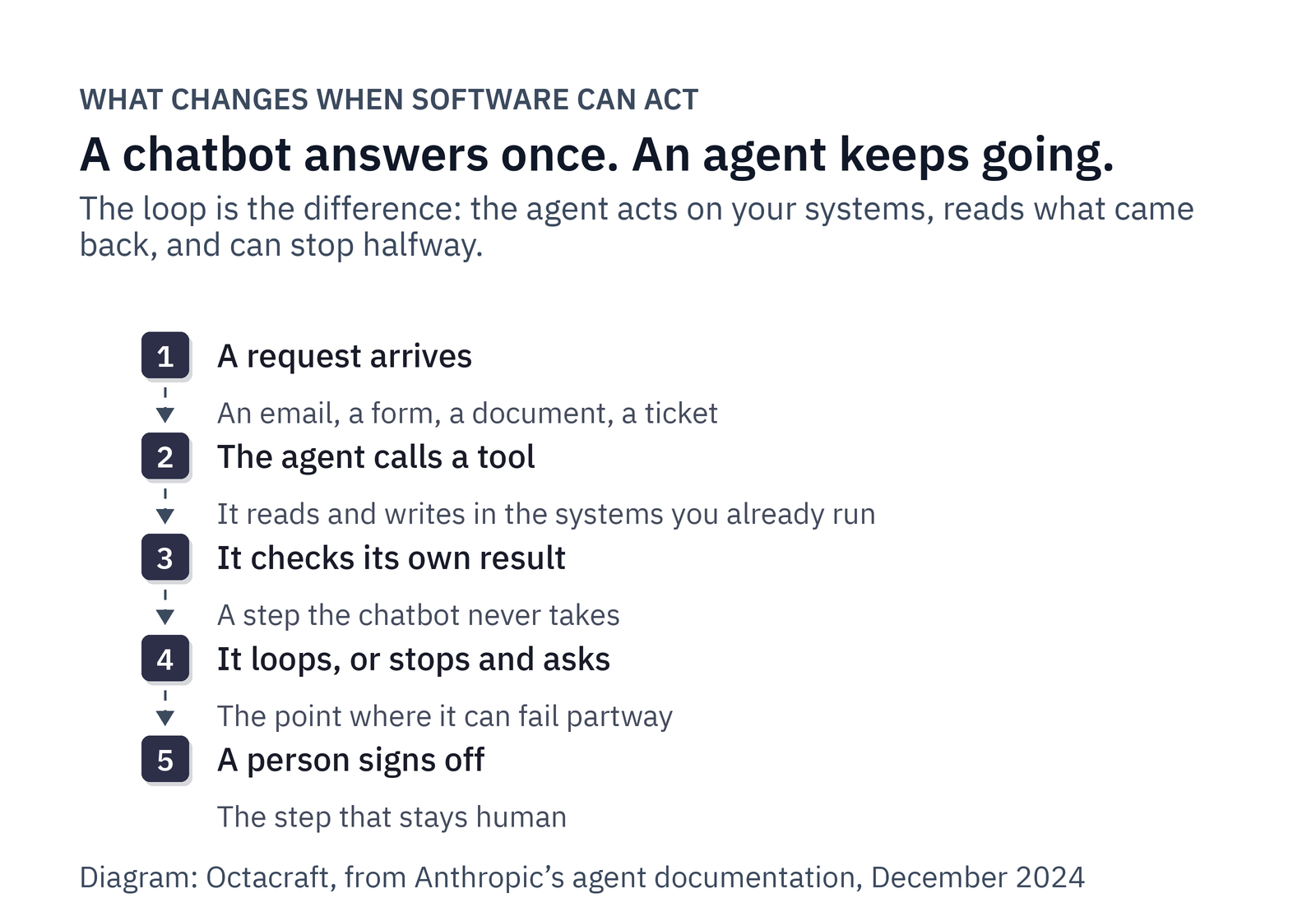
A chatbot takes an input and stops at an answer. An agent takes a goal and runs a loop until the goal is met, the loop gives up, or a person steps in. That is the real line between the assistant your team already uses and the AI agents for business a vendor is selling.
Four things change once software writes to your systems. For AI agents for business, it needs credentials that read and write. Somebody has to scope, rotate and revoke a non-human identity. It has a blast radius: a misfiled record or a wrong price field creates cleanup work that can exceed the hours it saved. It needs an audit trail. Without a log of what it read and wrote, small errors stay invisible until a reconciliation months later. And somebody has to read the exception queue, which is a real job with real hours attached.
The security field has started naming these problems. OWASP’s Top 10 for Agentic Applications 2026 was published on December 9, 2025 and reviewed by more than 100 practitioners.
It puts agent goal hijack first, then tool misuse, then identity and privilege abuse. Its argument is that autonomy should be earned by scope rather than granted by default.
The three jobs worth handing over first
Three job families hold up in production for AI agents for business, and each holds up for the same reason. Every one of them starts with text or a document and ends in something a person can check in under a minute.
Intake and triage is the safest first job to hand to AI agents for business. Something arrives: an email, a form submission, an uploaded invoice, a support ticket. It has to be read, classified and routed with the right priority. The volume is high, the judgement is low, and the check is cheap. A person looks at a routing decision for two seconds and knows whether it was right. The output is a decision rather than a commitment, which keeps the blast radius small.
This is also the easiest place to measure the quality of the AI agents for business you are running. Sample the routed items, compare the agent’s classification against a human’s, and watch the disagreement rate. If you cannot measure that rate, you cannot claim the agent works.
Record creation and updates is where the arithmetic for AI agents for business usually looks best. The manual version is expensive, dull, and wrong in ways nobody measures. The risk lives at the edges: the supplier who invoices in another currency, the customer with two accounts, the contract with a hand-edited annex. Design the exception queue before the happy path, or the first month of production will design it for you. That queue is where most AI agents for business earn or lose their keep.
First drafts with a human signature are where AI agents for business earn the best ratio of time saved to risk taken. That ratio only holds while the review stays real. Writing the proposal, the reply, the summary or the job note is genuinely useful work for an agent. The signature is a natural stopping point. If the review turns into a rubber stamp within three weeks, you have not automated the work. You have automated the liability.
Four ways this breaks
The first failure mode for AI agents for business is the exception nobody documented. A process passes every test when the test cases come from the written process. Production is full of inputs that violate rules nobody wrote down. The customer pays twice, the address does not exist, and the supplier sends a credit note where an invoice was expected. Agents do not fail gracefully here. They decide and move on, and every one of those decisions lands in a queue somebody has to work.
The second failure is the system the agent is not allowed to touch. It kills otherwise sound AI agents for business projects late. Some boundaries were never technical. ICO guidance on automated decision-making sets out the UK position. Decisions made solely by automated means, with a legal or similarly significant effect, are restricted. People have a route to ask for human involvement. Article 14 of the EU AI Act requires high-risk systems to be built so people can oversee them. No amount of testing moves that line, and a project scoped across it fails late and expensively.
The third is the handoff at the edge of a process, which is where most AI agents for business stall. Agents are strong in the middle and weak at the seams. When work crosses between two systems, two teams or two departments, an agent either stops and asks or continues with a partial picture. It continues politely. Week three is when that shows up, once everybody has stopped watching closely. Nothing failed loudly enough to interrupt anyone. If a task crosses a boundary like that, the seam is the project, not a detail of it.
The fourth is the confident wrong answer in a quiet moment, and it is the one the published benchmarks measure. Carnegie Mellon built a simulated company with internal sites, chat and documents, then put ten agents through ordinary office work. The best agent finished 24% of the tasks. The failures were mundane. One agent could not close a pop-up, and another renamed a colleague to match a name it was looking for.
The AgentCompany paper describes agents inventing shortcuts that omit the hard part of a task. The arXiv evaluation, revised September 10, 2025, reports 30% for the strongest agent. That moves the number without changing the shape of the problem.
Reliability has a horizon, and that horizon is the useful part when you are deciding what to hand over. METR’s work, published March 19, 2025, measured how long a task can be before a frontier model has a 50% chance of finishing it. The answer was about 50 minutes, doubling roughly every seven months since 2019.
A task that occupies a person for half a day sits well beyond that line. This is the single most useful filter for AI agents for business: the work worth handing over is short and checkable, not long and important.
The fifteen-minute test
Before any build, score the task against four questions. This is the test I would run on any of AI agents for business before a line of code is written. A single no is not a veto, but it tells you where the project will need its attention.
- Is the input bounded? If the task starts with “it depends what arrives”, it is not ready.
- Is the output checkable in under a minute? If a person needs ten minutes to verify the result, the saving is gone.
- Are the exceptions written down? Not the common ones. The awkward ones, in a document somebody other than the person who wrote it can follow.
- Is the cost of a mistake tolerable? If a wrong answer creates a regulatory problem or a customer promise, the task needs a person in the loop by design, not by policy.
Run that test on a real example, because the answers are rarely all yes. Take a 120-person distributor with about 900 supplier invoices arriving each month. Input: yes, they arrive as email attachments and portal downloads. Output: yes, a person checks a coded invoice against the purchase order in about forty seconds.
Exceptions: partly. The currency mismatches, the partial deliveries and the invoice-versus-credit-note case lived in one person’s head. Writing them down is the actual project. Cost of a mistake: tolerable, because a wrong coding is caught at payment. Four answers, one of them qualified. That is what a good first project looks like. It is small enough to finish in a month. It is dull enough that nobody fights you for it, and measurable enough that you will know whether it worked.
What it costs to run one agent for a month
The monthly cost of AI agents for business has four parts, and teams usually budget for one. Model and API spend is the part everybody counts. Tooling and integration is the second. It is usually larger than expected the first time a task needs to read a system with an awkward interface. Supervision hours are the third, and they are the part that decides whether the project pays. The fourth is the review the vendor never mentions. It is the occasional audit of what the agent decided, and it is what keeps a sampled check meaningful.
Compare those four lines against the loaded cost of the hours displaced. That comparison settles the business case for AI agents for business, not a salary figure. A task that consumes six hours a week of a person costing forty dollars an hour loaded is a $12,000 line over a year. A project that costs $9,000 to build, run and supervise is worth doing. A project that costs $20,000 to save the same hours is a hobby with a dashboard.
We run agents ourselves, and this is where I have to be careful. Our own build log is not long enough yet to be worth publishing, so there is no table of our intervention counts in this article. A table full of estimates would look more authoritative than the arithmetic above and be worth less. That is the trade AI agents for business writing should refuse. When the instrumented run has enough weeks behind it, it will be worth reading. It will be published with its dates attached.
The questions that come up every time
These are the five questions that arrive in nearly every conversation about AI agents for business. They are answered in the order they usually get asked.
Agentic AI vs generative AI: what changes when software can act
Generative AI produces an answer. Agentic AI acts to pursue a goal, calling tools and writing into the systems it can reach. The practical difference for anyone buying AI agents for business is access. A writing assistant needs none, while an agent needs credentials, logging and a person who gets called when it stops at 2am. The two are layers rather than competitors. Most teams already run the first layer without thinking of it as a decision.
How many types of AI agents are there?
Five, in the taxonomy every practitioner learns from: simple reflex, model-based reflex, goal-based, utility-based and learning agents. The count comes from Russell and Norvig’s standard text. It is defined by how a decision gets made, not by what the software can do for you. Vendors who count four types, or three, usually merge the last two into one. The taxonomy is thirty years old and still accurate. It is also silent on the only question that matters at work: which of your tasks a machine can own end to end. Answer that with the four tests above rather than a category name.
Do small businesses need different AI agents for business?
They need a narrower agent, not a smaller one. Fewer processes are written down, so the exception rate runs higher, and the check matters more than the throughput. That changes what the best AI agents for small business look like in practice. You want a single bounded task and a documented exception list. Keep a manual lane open for the cases you already know about. What you do not want is a platform licence bought before the first task is stable.
The adoption data says the same thing from two directions. The US Census Bureau measured AI use at 19.8% of businesses in the week ending May 3, 2026. Firms above 250 employees sat at 37%, while the smallest firms barely moved across the six months studied. The UK’s Office for National Statistics, released July 20, 2026, reports 28% of firms with up to nine staff using at least one AI technology. Among firms with 250 or more, the figure is 49%.
Treat every adoption statistic about AI agents for business with care, including the flattering ones. Surveys of senior executives report far higher figures than function-level surveys. One counts a licence, the other counts work being done. When a claim about AI agents for business arrives without a date and a method, it is a brochure.
What separates the best AI agents for business from the rest
Choosing among the best AI agents for business is rarely about the model. The best AI agents for business differ in three ways. The first is how narrowly the task is scoped. The second is whether the exception rules are written down somewhere a new hire could follow. The third is how good the check is. Feature lists for AI agents for business look alike because they are written from the same vendor vocabulary. A feature comparison therefore tells you very little about two AI agents for business that both look impressive in a demo. A boundary does not look alike, and it is the thing you can actually test.
Where AI voice agents for business fit, and where they do not
For AI agents for business, voice fits intake, routing and confirmation. Answering a call, taking a message, confirming an appointment, reading an order status. They do not fit negotiation or any commitment made to a customer on the company’s behalf. Speech remains the hardest surface for placing AI agents for business. A misunderstanding on a screen arrives as a wrong record. A misunderstanding on a call arrives as a promise the customer heard. For AI agents for business, the awkward case is a call that ends in a decision with a legal effect. The automated route is the one regulators scrutinise, which puts the commitment back on the human side of the boundary.
What to do on Monday
Pick one task for your first deployment of AI agents for business, and pick one that is short. That is the whole deployment plan for AI agents for business, and it is deliberately unglamorous. Write down its exceptions, including the ones you think are obvious, in a document somebody else can follow. Build the exception queue before the happy path and decide who reads it.
Then put a number on the hours you expect to save. Run it for a month with a sampled check, and compare the disagreement rate against those hours. Teams that deploy AI agents for business this way end up with a small, boring, profitable system. It is also the most reliable predictor of AI agents for business that survive their first quarter. Teams that start with a platform end up with a licence and a review meeting. Our other notes on smart systems and automation collect the same kind of material.
The whole approach to AI agents for business fits in one sentence. Hand over the task, keep the signature. If you want to see how that plays out on an operations team’s desk, our Timeback page shows the pattern in practice.
Frequently asked questions
What can AI agents do for a business?
For AI agents for business, the work that holds up is bounded and ends in a checkable result: reading and routing incoming requests, turning documents into records, updating existing records, and drafting replies or summaries for a person to approve. It cannot own judgement, liability, or rules that were never written down, which is what most AI agents for business are really limited by.
Are AI agents reliable?
On short, checkable tasks, AI agents for business are reliable enough to run with a sampling check. On long tasks they are not. METR measured a 50% success horizon of about 50 minutes for frontier models in March 2025. Carnegie Mellon’s simulated office benchmark had the best agent finish 24% of tasks.
What should I not automate with an agent?
Anything that signs off on money, credit or a regulated decision. Anything that makes a verbal commitment to a customer. And any process whose exception rules live in one person’s head. The agent meets those rules on day one and has no map for them.
How is an agent different from a chatbot?
A chatbot answers and stops. An agent pursues a goal, calls tools, reads what came back and repeats. It stops when the job is done, the loop gives up, or a person steps in. The loop is why an agent needs permissions, an audit trail and a rollback path.
What does one agent cost to run for a month?
Three lines: model and API spend, tooling, and the supervision hours for the exception queue. The third line is the one most business cases leave out. Compare the total with the loaded cost of the hours displaced, not with a salary figure.
Related reading: before an agent can act on a message the queue has to be sorted, which is covered in what to automate in support first. What one agent costs to run for a month, across model usage, platform, review of exceptions and monitoring, is priced line by line in what it costs to run an AI agent. Where an agent stops at a handoff rather than on the task itself, the edges are mapped in why AI agents for business operations stall at a process edge. What the first month after go-live looks like when the demo answers and production does not is in the five failures of month one, ranked by damage. The four numbers that show whether an agent improved support rather than just answering faster are in four customer support metrics to track.

Philip Bassey is Chief of Staff at Octacraft, where he oversees the interdepartmental activities that keep our processes documented and the ones worth publishing published. He writes about operations that are engineered into systems instead of held together by memory.
4 Comments