What an AI agent costs to run each month, from our own builds
The short version
- AI agent pricing comes down to four lines: model and API usage, the platform it runs on, human review of exceptions, and monitoring.
- Usage is the smallest and most variable line. Review is usually the largest, and it is the line most AI agent pricing leaves out.
- The same 2,000 documents cost $3 of tokens on a cheap model and $124 on an expensive one. A person checking the output costs about $1,160.
- Price the work per item. A monthly total hides the only number that survives a change in volume.
- Put a ceiling on the bill before it caps you: a step limit per task, an alert on the worst month, and one named owner.
The build quote arrives with a number on it. The monthly bill turns up a month after go-live, and it rarely matches the estimate. That gap is where AI agent pricing gets decided.
The gap matters because the build is a one-time number and the bill is monthly. A build that looks cheap can lose to one that costs more once review is priced in. This piece sets out the four lines, prices them, and works one monthly example in full. Every figure is a rate with a date or an assumption labeled as one.
The four lines on an agent’s monthly bill
An agent’s monthly bill has four lines. They are model and API usage, the platform it runs on, human review of exceptions, and monitoring. Usage is the smallest and most variable. Review is usually the largest, and buyers forget it.
Token spend is the line people expect. A token is a piece of text, and the model bills per million of them. Input tokens are what you send: instructions, tool definitions, retrieved records and the document. Output tokens are what the model writes back, reasoning included.
Orchestration is where the agent runs. That is a workflow platform, a container, or a server you own. It is billed by the seat, the execution or the hour. This line is flat and easy to forecast, and it is the one vendors quote as the monthly plan.
Exception review is a person checking what the agent got wrong or could not finish. It is billed in minutes of a salary, so it behaves like payroll. One extra minute per item is worth about $0.58 at the wage below.
Monitoring keeps the other three standing. It is drift checks, regression checks after a prompt change, and reading the bill against the run log. Small in money, large in consequence, and the line AI agent pricing estimates skip first.
How AI agent pricing is usually quoted
Three shapes dominate the quotes: a monthly platform fee for the seat or the workflow tool, a price per conversation or resolved outcome, and a build fee on top.
None of the three is your monthly bill. The platform fee is one of four lines, the per-outcome price bundles usage and review into a number the vendor controls, and the build fee does not recur. Most AI agent pricing you get quoted covers the platform line and calls it the monthly cost. The first and third lines are yours to measure, and they are where the argument with finance happens.
AI agent pricing: what the bill looks like once the pilot ends
AI agent pricing gets clearer with an example. A supplier document arrives, the agent reads the fields and writes them into a record. Assume 12,000 input tokens and 700 output tokens per item, and 2,000 items a month. Those token counts are a planning shape, not a measurement. Replace them with your own.
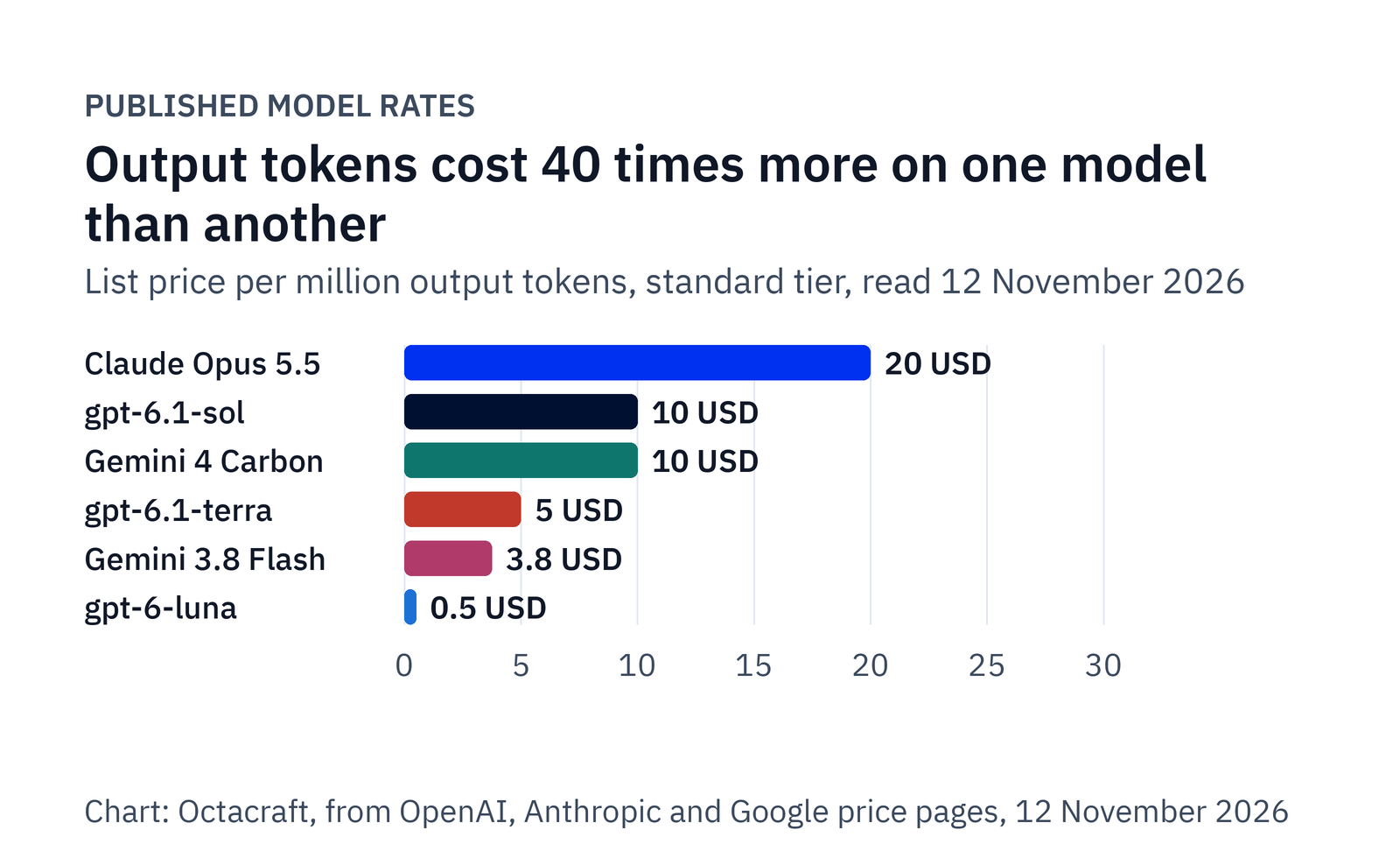
gpt-6.1-sol is priced at $2.00 per million input tokens and $10.00 per million output tokens on 12 November 2026 (OpenAI API pricing). The tokens cost $0.031 an item. Two minutes of review costs $1.16. The item costs $1.19, and 97% of it is the person.
At 2,000 items the monthly bill is about $2,380. Review time is $2,320 of that. Tokens are $62. A pilot never shows you this shape, because a pilot is small enough for the review to hide in somebody’s week.
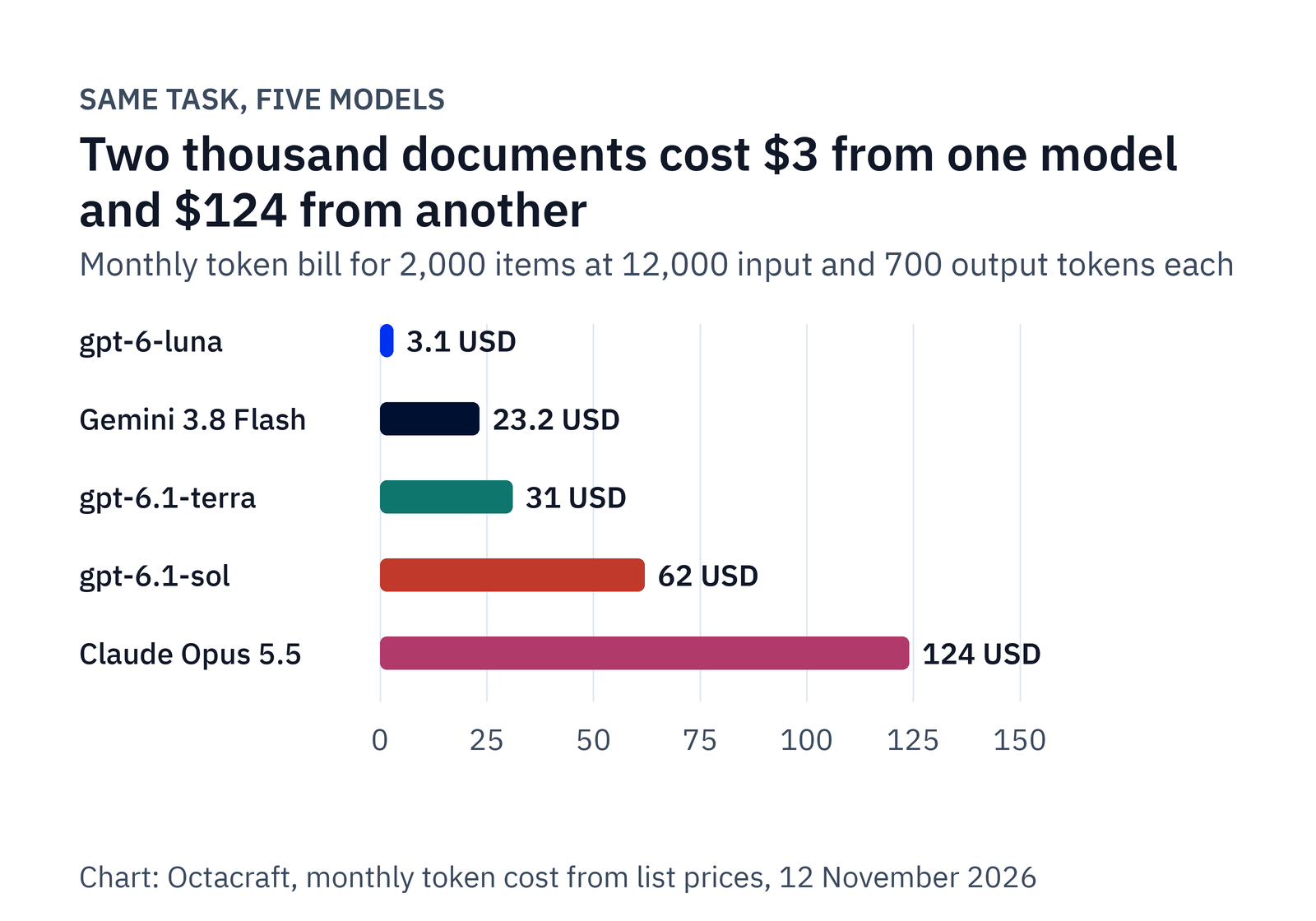
The same documents cost $3.10 of tokens on gpt-6-luna and $124.00 on Claude Opus 5.5. That is a 40 times spread for identical work. Next to the review line it barely moves the total. At ten times the volume it would, and that is when AI agent pricing becomes a board conversation.
Three task shapes show the same AI agent pricing arithmetic. The table uses the same rates and a loaded reviewer cost of $34.80 an hour.
| Task shape | Tokens in / out per item | Token cost per item | Review minutes | Review cost per item | Total per item |
|---|---|---|---|---|---|
| Document extraction | 12,000 / 700 | $0.03 | 2 | $1.16 | $1.19 |
| Support triage | 40,000 / 900 | $0.09 | 1 | $0.58 | $0.67 |
| Cross-system reconciliation | 150,000 / 4,000 | $0.34 | 5 | $2.90 | $3.24 |
Read the last column against the second. The token bill is never the decision. Support triage looks cheap because one minute of review beats two. Cross-system reconciliation looks expensive, and it is. The AI agent pricing question is a per-item question.
What makes an agent cheap or expensive to run?
Four things move the bill. They are context size per call, calls per task, retries, and how much output a person checks. Only the first is visible in a price list, which is where most AI agent pricing arguments start.
Context is the driver buyers underestimate, and the one most AI agent pricing tables never show. Every call carries the instruction block, the tool definitions and any retrieved records. A task that looks like one question can send 40,000 tokens before the model reads the document. Anthropic also notes that its newer tokenizers produce about 30% more tokens for the same text (Anthropic pricing).
Calls per task is the second. A single extraction is one call. An agent that plans, calls a tool, reads the result and decides next is five or ten. Each one re-sends part of the conversation.
Retries are the quiet one. A failed parse, a timeout, a tool that returns nothing: each retry repeats the task at full price. Retries rarely appear as a line item, which is why they matter, and why AI agent pricing built on the rate card misses them.
Review is the fourth, and it never appears on the model invoice. That is why AI agent pricing built from the invoice alone comes out low. It is also why the first live month is a surprise.
Where AI business process automation changes the bill
AI business process automation is long-running and multi-step. A request arrives, three systems are queried, a document is written, a record is updated. Every step re-reads a transcript that has grown, so the input side scales with steps rather than with the first document.
Cost per item is the number that survives a change in volume
A monthly total is a snapshot of one month’s volume. When volume moves, the total moves with it and you learn nothing. Cost per item holds still, so a change in it means the work changed. AI agent pricing belongs per item.
It also gives you the AI agent pricing comparison that decides the project. At three minutes a document, a bookkeeping clerk costs about $1.74 of loaded time. Our extraction example comes to $1.19. The honest saving is 32%, not the 97% the token bill suggests.
Loaded means wage plus benefits. The median wage for bookkeeping, accounting and auditing clerks was $24.36 an hour in May 2025 (BLS Occupational Outlook Handbook). Wages were 70.0% of private industry compensation in June 2026, which puts loaded time at $34.80 (BLS Employer Costs for Employee Compensation).
That 32% is still a real saving on 2,000 items, and it is the number for a business case. The rest of the 97% is a person’s cost moving to another desk. AI agent pricing should say that before the project is approved.
Why intelligent business process automation costs more per item than a rules engine
A rules engine costs almost nothing per item. It decides with conditions somebody wrote. Intelligent business process automation pays a model to decide, so each decision carries its tokens and a person’s check.
The trade is honest. The rules engine is cheaper and blind to what its author did not anticipate. The intelligent one handles those cases and charges per case. Our piece on AI agents against RPA and Zapier sets out where the line falls.
Where the bill surprises people
Most AI agent pricing work stops at the rate card. Four surprises turn up in the first year, and all four are design decisions rather than vendor faults.
A prompt change that was never tested. Someone tightens an instruction to fix one field. Extraction fails on a format nobody checked, and every failure retries at full price.
A model upgrade that moves the price on a set date. Gemini 4 Carbon is $2.00 and $10.00 per million tokens through 30 November 2026, then $4.00 and $20.00 from 1 December. Gemini 3.8 Flash doubles on 1 January 2027 (Gemini API pricing). That is AI agent pricing moving under a signed contract.
A loop with no step limit. The OpenAI Agents SDK raises a MaxTurnsExceeded error after the turn limit you set. Passing max_turns as None removes that limit, so the agent keeps calling tools and keeps billing (Agents SDK: running agents).
Transcripts kept forever. OpenAI prices file search storage at $0.10 per GB per day. That is $3 a month for one gigabyte, and $36 a year for text nobody reads (OpenAI API pricing).
What AI procurement tools add to the platform line
AI procurement tools meter seats, contracts and approvals. They are built to buy software, not to read a token invoice. The platform line ends up looking governed while usage and review stay unowned. Use them for the platform, and measure the rest yourself.
Are the best AI agents for small business the cheapest ones?
No. The cheapest model usually wins on tokens and loses on review, and review is the larger line. A small firm does better with a model that returns fewer exceptions than with one that costs a tenth as much.
Run the arithmetic before switching. Moving from $62 a month of tokens to $3 saves $59. One extra minute of review per item costs $1,160 over 2,000 items. A saving on AI agent pricing has to survive the queue that follows it.
The better question is which model holds its accuracy on your worst document. Our piece on what AI agents can run in a business today covers where accuracy tends to break.
How to put a ceiling on the bill before it puts one on you
Five controls, in the order they pay off. None needs a new vendor. A ceiling is the part of AI agent pricing most builds skip, and the cheapest part to add.
Set a step limit per task, and let the agent fail loudly at the limit. It is one line of configuration in most frameworks.
Set a monthly spend ceiling with an alert. Base it on the worst month you have seen plus a margin. An alert on the average fires after the damage.
Cache repeated lookups. Cached input on gpt-6.1-sol is $0.10 per million tokens against $2.00 fresh. Anthropic prices a cache hit on Sonnet 5.5 at $0.10 against $2.00. Anything the agent re-reads every call belongs in a cache.
Batch what nobody is waiting for. OpenAI and Google both price batch work at half the standard rate. It is the largest discount on the list that needs no model change.
Name one person who reads the bill every month, with authority to pause the agent. The other four controls work because somebody is looking.
How we set the monthly spend ceiling
We take the worst month observed, add a margin for volume growth, and alert at that number. The alert has a named recipient and a written first action: pause the agent, read the run log, find the task that repeated. That routine is AI agent pricing in practice.
What we can and cannot show you from our own builds
We run agents that read documents, sort inbound mail and reconcile records. This piece comes from the bills and the queues those agents produce. What we cannot show you today is a table of our own per-agent bills, split into the four lines, month by month. We have not kept them in that shape, and AI agent pricing built from estimates would be worse than none.
So the arithmetic stands on its inputs: rates with a date, a wage with a source, and token counts stated as an assumption. When we have a year of separated bills, the table belongs here. Until then, replace our 12,000 tokens with your own.
The same discipline applies to the build. A cheap build with heavy exception review is the more expensive project over a year, which is the argument in what custom software costs in 2026. For the document side, the invoice workflow teardown prices the queue in minutes, and what manual data entry costs per year does the annual version.
Frequently asked questions
How much does it cost to run an AI agent each month?
It depends on volume and on how much a person checks. A document agent handling 2,000 items a month costs about $2,380 at the rates in this piece, of which $2,320 is review time and $62 is tokens. Change the volume and both parts move together.
Which line of an AI agent bill is usually the largest?
Exception review. It is paid in minutes of a salary rather than per token, so it grows with the share of items the agent cannot finish. AI agent pricing built on the model invoice alone misses it entirely.
Is a cheaper model always cheaper to run?
No. A cheaper model can save $59 a month on tokens and add $1,160 of review time if it raises the exception rate by one minute per item. Compare the total per item, not the rate per million tokens.
How do I stop an agent running up a bill overnight?
Set a step limit per task and a monthly spend ceiling with an alert. The OpenAI Agents SDK stops a run once it passes a turn limit you set, and that limit can also be switched off, so check your setting.
What is a normal cost per item for an agent?
Cents on the token line and dollars once review is included, for document work. Cost per item is the only AI agent pricing figure that survives a volume change. The useful comparison is the loaded cost of the person doing the task today: about $1.74 for three minutes of clerk time at the wage used here.
Price your own process before you sign
Take one task, count the items it handles in a month, and write down the four lines. If the review minutes are a guess, test that first. It decides the bill, and no vendor can quote it for you. That is also how AI agent pricing stops being a guess.
Walk us through the process you want to price

Philip Bassey is Chief of Staff at Octacraft, where he oversees the interdepartmental activities that keep our processes documented and the ones worth publishing published. He writes about operations that are engineered into systems instead of held together by memory.