AI consulting for business: what a scoping week should deliver
The short version
- A scoping week is five working days of paperwork. It ends in one page: process, tasks, exceptions, cost range, owner.
- AI consulting for business earns its fee at three points. The data is a mess, the process crosses three systems, or nobody inside can write the task list.
- Price the run before the build. On 2,000 supplier documents a month, review costs about $2,320 and tokens cost $62, at rates we published in November 2026.
- The exception list decides the build. Agents stop at the edge of a process, not inside the model.
- Name the person who can approve the spend on Monday. Otherwise the page you produce on Friday cannot be approved.
The proposal arrives with a price, a delivery window, and one line near the bottom. “Final scope to be confirmed during discovery.” Most AI consulting for business quotes carry that line. It is also where the money sits, because the scoping week is the work behind it.
You can run that week yourself. This is the version we run, day by day. It names the five answers to produce and the one page to leave behind. It is also the test for any AI consulting for business proposal on your desk. If the quote cannot name those five answers, the week has not happened yet.
What should a scoping week deliver?
One page. It names the process, the tasks the agent runs, the exceptions that stop it, a cost range and the person who can approve the spend. Five working days is enough. That is what an AI consulting for business engagement sells as a discovery phase. A consultant can shorten the week. Nothing else needs one.
The page is the deliverable, not a slide deck. It fits on one side of a sheet, and somebody can act on it without you in the room. That is the document to hold an AI consulting for business firm to.
What counts as an agent, a script and a chatbot
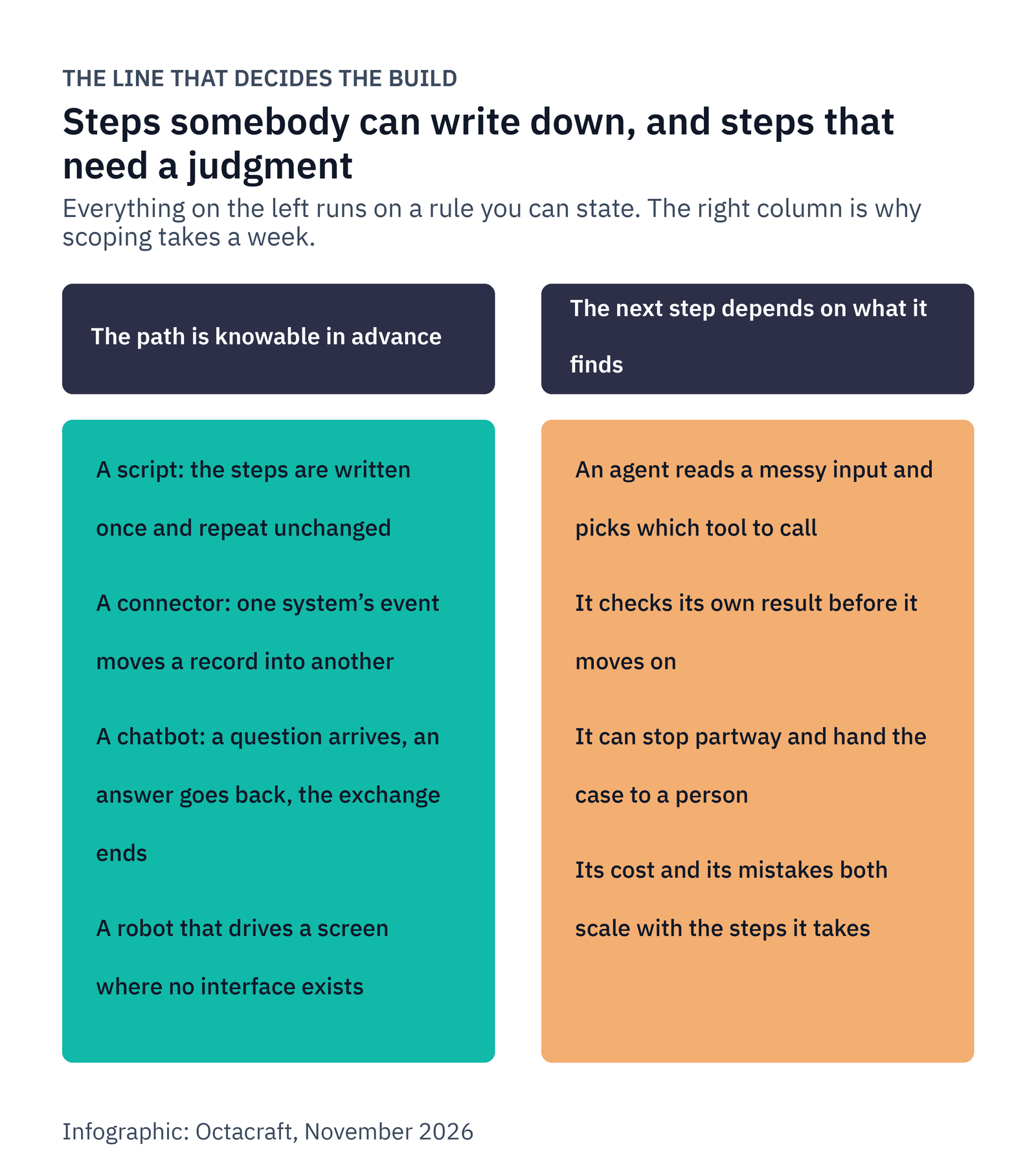
A script follows steps somebody wrote in advance. A chatbot takes a question and returns an answer. An agent pursues a goal by calling tools and checking its own results. Only the third decides what to do next. That decision is why AI consulting for business takes a week rather than an afternoon. Most AI systems a firm already runs follow rules: a bank feed matcher, a routing rule in a help desk, a form that files itself. Those are not agents. The question for the week is narrower. Which tasks need a decision nobody has written down?
Agentic AI vs generative AI, in one sentence each
Generative AI produces content: a paragraph, an image, a summary of a file. Agentic AI decides and acts across steps. It calls a tool and reads the result before it continues. NIST’s AI Risk Management Framework assesses an AI system rather than a model on its own, which is the right unit here (NIST, AI RMF 1.0).
The difference changes what a scope must contain. A generative task needs a prompt and a document. An agentic task needs permissions, a tool list and an exception path. Tooling covers the first case. AI consulting for business covers the second.
Where an AI virtual assistant stops
An AI virtual assistant answers inside a channel: a chat window, a phone line, a help widget. It stops at the edge of the conversation. Ask it to change a record and one of two things happens. It cannot, or it can, and now you own a permission model and an audit trail.
The five answers a scoping week has to produce
Which process, which tasks, which exceptions, what it costs, and who approves it. Put the five on a blank page on Monday. Fill one line under each before Friday. You then hold a scope rather than an intention.
- The process: one process, named, with a start, an end and an owner.
- The tasks: what the agent does at each step, in five fields.
- The exceptions: the cases that stop it, written by the people who handle them today.
- The cost: a range for the build and a monthly run figure, each with hours or items attached.
- The approver: the person who can sign the spend, named, not a department.
Each answer belongs to a day, so the week is a schedule rather than a checklist. The five are also the questions to put to any AI consulting for business firm before it writes a proposal. A firm that cannot answer them in a week is quoting a longer project.
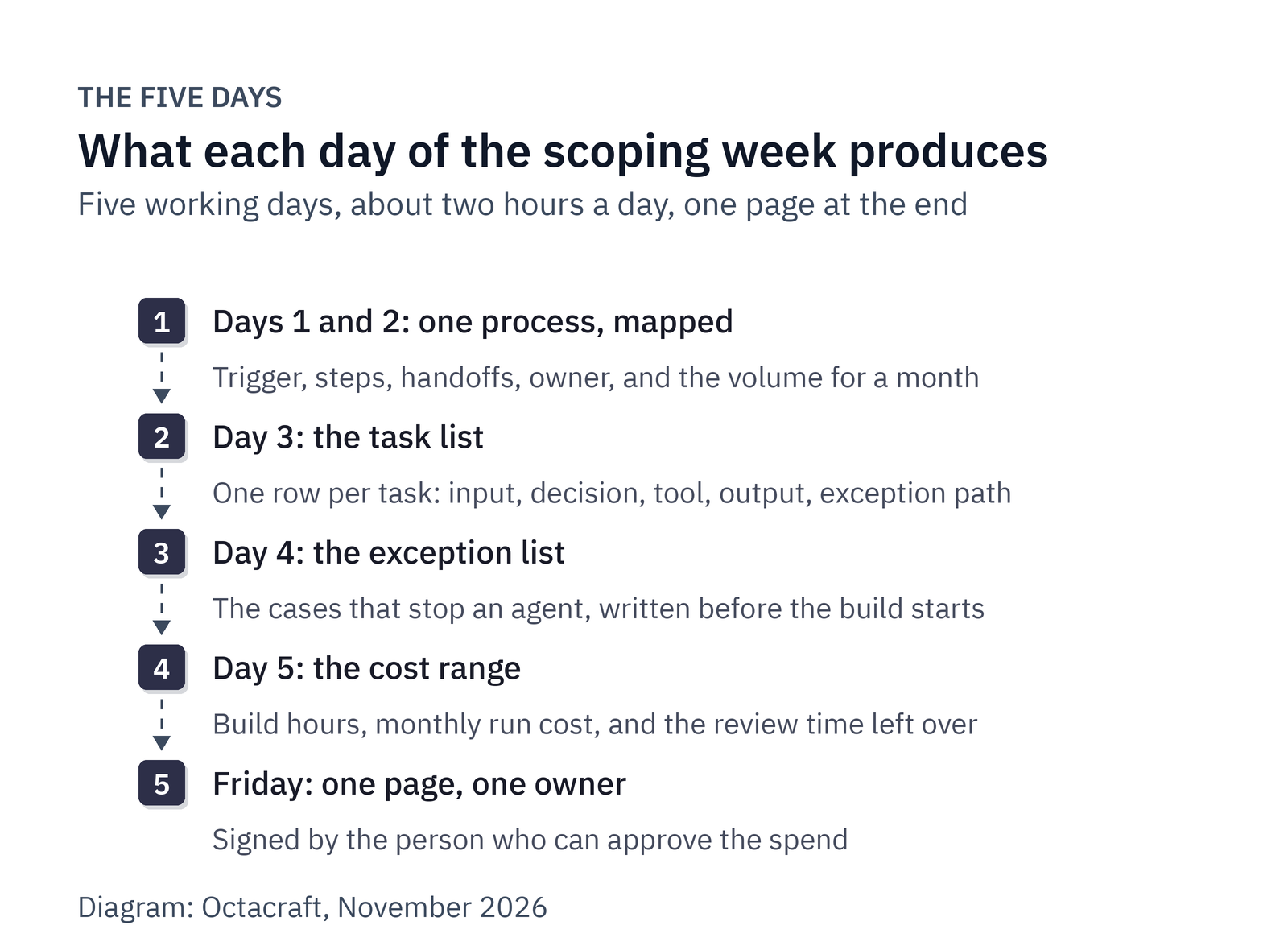
Days 1 and 2: pick one process and map it
A process qualifies when it repeats, runs on rules, can be measured, and belongs to one team. Invoice intake, order entry, first-line support, quote assembly. Pick one, not a portfolio. Any AI consulting for business week that starts with a department-wide assessment has started too wide.
Map the process as it happens, not as the manual describes it. Five boxes: trigger, steps, handoffs, approvals, output. Time each step in minutes and count a month of volume. If the map needs more than one page, stop. Automating a process you cannot draw makes the mess arrive faster. An AI consulting for business engagement would spend its first two days on this map.
Handoffs matter most. A handoff adds waiting rather than work, and waiting is where the week disappears. We run the same session before quoting any build, and its five questions surface the process instead of the software, which is the whole job of the week (the requirements session we run before quoting a build).
Day 3: write the task list the agent will run
One row per task, five fields: input, decision, the tool it calls, output, and the exception path. The row is the unit a build gets priced on. It is also the first thing an AI consulting for business partner asks for. A task with no exception path is not scoped.
| Input | Decision | Tool it calls | Output | Exception path |
|---|---|---|---|---|
| A supplier invoice arrives as a PDF | Does it match a purchase order within 2 percent? | Purchase order lookup in the finance system | An approval record in the ledger | No matching order, so the case queues for a person |
| A customer asks where an order is | Is the order number present and valid? | Order system lookup | A draft reply carrying the delivery date | No order number, so the agent asks one question and holds |
Write the rows in the order the work happens. Where two rows disagree about who owns a field, the map is wrong. Go back a day rather than forward.
This table doubles as the handover document. A firm quoting AI consulting for business work can price each row, so you check the price against the row and not against the total.
Day 4: find the failure cases before you build
List what stops the agent. Missing data, a rule two people apply differently, a decision that needs approval, an input from a stranger. AI consulting for business proposals often arrive without this list. Each case gets a destination and an owner, and the list goes into the page.
The published evidence points the same way. A benchmark built on real domain rules and APIs tested function-calling agents. The strongest finished under half the tasks, and a task repeated eight times in retail succeeded under a quarter of the time (Yao et al., tau-bench, June 2024).
Security guidance names the fault from another side. Excessive agency is a risk category in its own right in the 2025 Top 10 for LLM applications. Narrow what the agent may call rather than trusting the model more (OWASP, 2025). It is also the risk an AI consulting for business scope tends to leave for the build.
So the exception list is the scope. AI consulting for business proposals that leave it out are pricing a build nobody has described, and that gap gets paid after go-live in review hours.
Day 5: price the build, the run and the review
Three lines: hours for the build, a monthly run cost, and the review time the agent does not remove. An AI consulting for business quote usually names the first two. Multiply hours by a loaded rate you can defend, and price the run per item, so a change in volume does not change the answer.
A wage is not a rate. Private industry employers spent 30.0 cents of every compensation dollar on benefits in June 2026, when compensation averaged $46.89 an hour worked (Bureau of Labor Statistics, 9 September 2026). Divide the wage by 0.70 to reach the cost of paid time. An AI consulting for business quote built on a bare wage looks about 30 percent cheaper than it is.
Then price the run and watch which line dominates. Take 2,000 supplier documents a month, at 12,000 input tokens and 700 output tokens each. List prices on 12 November 2026 put the tokens at $62. Two minutes of review per document, at a loaded $34.80 an hour, costs $2,320. We worked the arithmetic line by line in what an agent costs to run each month.
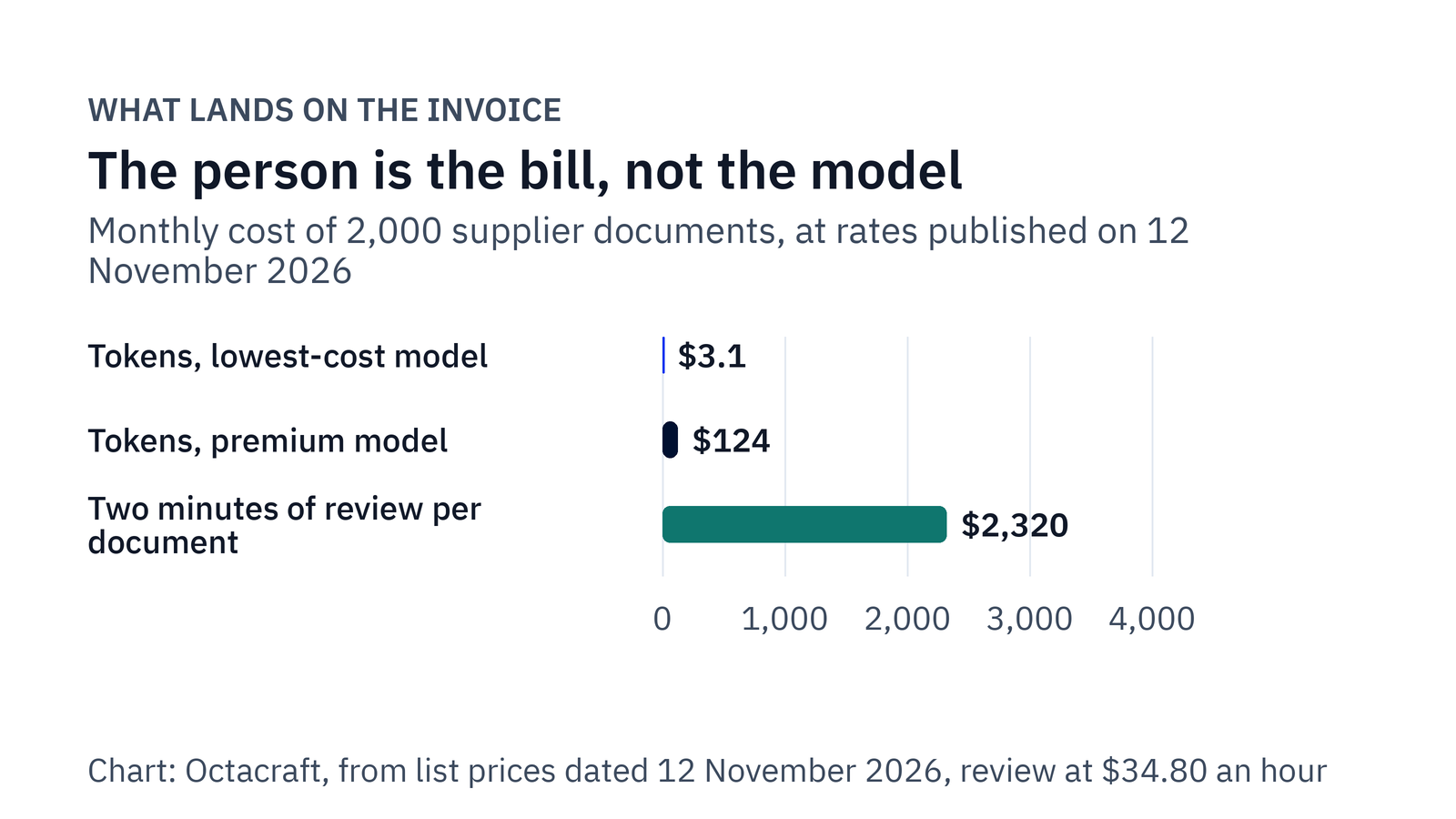
The model moves the token line by 40 times and barely moves the bill. An AI consulting for business quote that leads with model costs leads with the small number, because the review hours were never counted.
Design the review hours down. Every exception you delete from the task list cuts them. None of them appear on a model invoice.
What does scoping an AI agent project ask of your team?
About two hours a day from one operations person for five days, read access to the systems the process touches, and one decision maker who can approve the spend. That is the resourcing an AI consulting for business week assumes. No engineering time is needed to produce the page.
Two hours a day from one operations person
The person who does the work today, or supervises it, can write the map and the exceptions. An AI consulting for business engagement charges roughly those hours. The difference is who spends them, and who keeps the knowledge afterwards.
Read access, not a migration
You need to see records, fields and volume. A read-only export covers a week of scoping. A proposal that opens with migration is pricing another project.
One decision maker who can say yes
Name the approver on Monday. A scope that ends at a committee is a scope that waits. A waiting scope is what a vendor fills in for you.
When AI consulting for business is worth paying for
Pay for the week in three cases. The data is a mess. The process crosses three or more systems. Or nobody inside can write the task list. Run it yourself when one team owns the process and someone can describe the work out loud.
What the money buys is the Friday page, written with the people who will run the work. Ask any AI consulting for business firm for the five answers before the proposal. Ask who signs off on the spend. A week of interviews that ends in a deck has not produced a scope.
The week is not the hard part. Deciding what to hand over is. That decision starts earlier, with which operation pays off first. One more check belongs here. If the task could move between two systems with a connector, an agent is the wrong purchase. Settle which tool the process needs before the week starts.
What you should have on Friday
One page with six lines. The process, the tasks, the data needed, a cost range, the risk list, and the named owner. That is the page AI consulting for business should hand over. If a line is blank, the week is not finished.
The page is not a pitch. Attach it to a budget request, hand it to a builder, or use it to decide to wait a quarter. A year from now it is also how you check whether the build delivered the scope.
Hold it to one test. Could a person who was not in the room build from it? If not, the exceptions are still in somebody’s head, and an agent will find them later at a moment you do not choose (why agents stall at a process edge).
That is the whole offer of the week. Five days, five answers, one page, and a decision somebody can defend. AI consulting for business is the version where you pay someone else to hold the pen. Either way, the page is the thing to ask for.
Frequently asked questions
How long does it take to scope an AI agent project?
Five working days for one process, at about two hours a day from one operations person. That is the whole of an AI consulting for business scoping week, done in house. It produces the map, the task list, the exception list, the cost range and the approver. A second process usually adds two days rather than another week.
Do you need AI consulting for business to scope an agent?
No. AI consulting for business shortens the week or takes it off your desk. It earns the fee when the data is a mess, the process crosses three systems, or your team has never written a task list. One team that owns one process can produce the page itself.
Does an agent need a different scope from a chatbot?
Yes. A chatbot needs a channel, a knowledge source and an answer policy. An agent also needs permissions, a tool list, a step limit and an exception path, because it acts on systems rather than only answering. Scope the second set, or the build discovers it after go-live.
How much does it cost to run an AI agent each month?
For 2,000 supplier documents a month, tokens cost $62 and two minutes of review per document costs $2,320 at rates we published in November 2026. The review line dominates. It grows with the exception rate, not with the model price.
Is AI training part of the scope?
Partly. The scope should name who is trained, on what, and which review habit the agent depends on. AI training for a wider team is separate work. It lands better after the first task list exists, because the list says what people need to know.
If you want the five answers checked before you sign anything, bring us the process and the quote.
Philip Bassey is Octacraft’s Chief of Staff. As part of his responsibilities, he oversees the interdepartmental activities to see that our processes are documented and those that need publishing are published. He writes about the work between a system going live and a team trusting it.

Philip Bassey is Chief of Staff at Octacraft, where he oversees the interdepartmental activities that keep our processes documented and the ones worth publishing published. He writes about operations that are engineered into systems instead of held together by memory.