Business process automation software or a custom build: how to choose
The short version
- The rules decide this, not the price. Business process automation software rents you its rule engine. A custom build gives you your own.
- For one process, the tool path costs about $12,100 over three years. A build costs $93,700, at list prices read 16 November 2026.
- Four questions settle it: how often the process runs, how much it varies, how many systems it touches, and what a wrong action costs.
- A build earns its place when the process is what customers pay you for, or when a system in the chain has no API.
- For most firms of 100 to 500 people, business process automation software covers the glue and a build covers the margin.
The flow had run since March. On the first Monday of the month it stopped.
The invoice portal added a field. The step that copies the amount began copying nothing instead.
The workflow reported success on every run for six days. Then someone in accounts found forty invoices with no value against them.
No purchase decision prevents that Monday. What changes between a tool and a build is who sees the failure, how fast, and who pays.
The short answer
For one process that runs on fixed rules, buy business process automation software and configure it. Commission a build when the process is what customers pay you for. Commission one when more than one case in five needs a human decision, or when a system in the chain has no API.
Price rarely decides it. A platform costs less at every volume you will reach. Business process automation software wins the price argument, so the case for a build has to be about rules.
Two mistakes account for most of these choices. One is business process automation software bought for rules the tool cannot express, so the team keeps a spreadsheet beside it. The other is a build for a process the market already solves for $12 a month.
What business process automation software actually sells you
Business process automation software is a hosted service. It runs your process as steps between systems you already own. You buy the runs, the builder and the logs. The vendor keeps the engine that decides what a step means.
That split is the product. A step is a fixed action: create this record, send that message, copy this field. The engine decides when to fire it, retry it or fail it. Business process automation software needs your process described as fixed actions in a set order.
Where it is not, you add branches. Business process automation software treats each branch as configuration you own inside someone else’s engine. That configuration is readable mainly to the person who built it.
No-code business process automation: what the entry tier buys
No-code business process automation is a builder for people without a development background. Zapier is the clearest example, and its task rules explain most surprise invoices here. Each successful standard step uses one task. Filters and formatters cost nothing. AI steps cost one, three or five tasks (Zapier, pricing and task rates, read 16 November 2026).
The entry prices are small. Zapier’s Professional plan starts at $19.99 a month. Make’s Core plan is $12 a month on annual billing for 10,000 credits (Make, pricing, read 16 November 2026). A three-step flow on 1,000 documents a month is 3,000 tasks. That fits under both.
At this tier, business process automation software buys speed. There are no servers and no developers. The bill tracks volume.
Low-code business process automation: when a developer joins
Low-code business process automation keeps the visual builder. It expects code for the parts the palette cannot express. Microsoft sells Power Automate this way. Premium is $15 per user a month on an annual plan, with cloud flows and attended desktop flows included. Unattended RPA costs $150 per bot a month, or $215 if Microsoft hosts the machine (Microsoft, Power Automate pricing, read 16 November 2026).
That shape suits a process that is mostly fixed rules with two awkward steps. The awkward steps go into a script. The rest stays visible to the ops team. Business process automation software on this plan splits maintenance in two, because the script needs a developer and the flow needs an owner.
What a custom build sells you instead
A custom build is software written for your process. It owns its rules. The branching, the exceptions and the order of approvals live in code you control.
You pay once to write it and every year to keep it. Our model puts one workflow with one integration at 400 hours. At the $146.06 an hour floor we published in October, that is $58,424. The retainer is 120 hours a year, or $17,527, and hosting is $72 (Octacraft build model, October 2026).
Business process automation software spreads that cost across every month. A build concentrates it in month one. After that it behaves like a subscription you own.
Which one does your process need?
Most buying meetings answer a different question: which product is better. The question that decides the outcome is which path fits this process. Those two answers come apart often.
Four questions about the work settle it, and the cut-offs below are ours rather than a vendor’s. Two answers pointing at a build usually mean a build. None pointing at one means business process automation software is the right purchase.
The four questions, as a scoring framework
Run this table against a real process. The cut-offs come from published list prices and from our own build model. The reasoning sits underneath each question.
| Question | What to count | Our default cut-off | What the band implies | What it points to |
|---|---|---|---|---|
| How often does the process run? | Runs a month, and steps per run | 3,300 runs at a three-step flow on the entry tier | Above it, price the tier before you compare a build | Volume picks the platform, not the path |
| How much does it vary? | Share of cases needing a human decision | 1 in 5 | Above it, exceptions become branches inside the tool | Tool below, build above |
| How many systems does it touch? | Systems in the chain, and how many have no API | Any system with no documented API | That system needs RPA or a custom connector on either path | Tool only when every system is covered |
| What does a wrong action cost? | Cost to undo one wrong automated action | The annual subscription, $144 at the entry tier | Above it, gate the action behind a human approval | Tool with an approval step, or build |
Question 1: how often does the process run?
Volume decides the tier, not the path. Make’s Core plan includes 10,000 credits a month at $12. A three-step flow spends three credits a run, so that covers about 3,300 runs before the tier changes.
Above that line, price the tier before you compare a build. Below it, volume is close to irrelevant. That is where most processes sit, and it is why business process automation software keeps winning on price.
Question 2: how much does it vary?
Variance is the gate, and it is the first thing business process automation software cannot fix. Count the cases that need a human decision. Treat one in five as the line.
Below it, the process is mostly fixed rules and a tool fits. Above it, the exceptions are the work. Each exception becomes a branch, and branches are configuration that only the builder reads. Business process automation software does not price that maintenance, so the tier never shows it.
A demo skips this question, because a demo runs the happy path.
Question 3: how many systems does it touch?
Count the systems. Then check each one for a documented API, because the second half moves budgets more than the first.
Connector libraries are large. Zapier lists 9,000+ app integrations and Make lists 3,500+. Microsoft’s own connector reference lists 1,681 connectors, which I counted on 16 November 2026.
Coverage is not the problem for common systems. It is the problem for the system the firm has run since 2011. No library covers a client with no API and no vendor who will add one. That system needs RPA on the screen or a custom connector. Business process automation software can drive that screen, and so can a build, but neither connects for free.
Question 4: what does a wrong action cost?
Put a number on one wrong automated action. The refund sent twice. The order cancelled. The customer emailed the wrong price. Then compare that with a year of the subscription.
At Make’s Core price, the line sits at $144 a year. Above it, the flow needs a human approval step on the risky action. That step is where business process automation software stops being configuration and starts being software. The same question sets the maintenance budget, because expensive errors need somebody reading the logs.
Where workflow management tools win
Workflow management tools win on three conditions, and all three are common in mid-size firms.
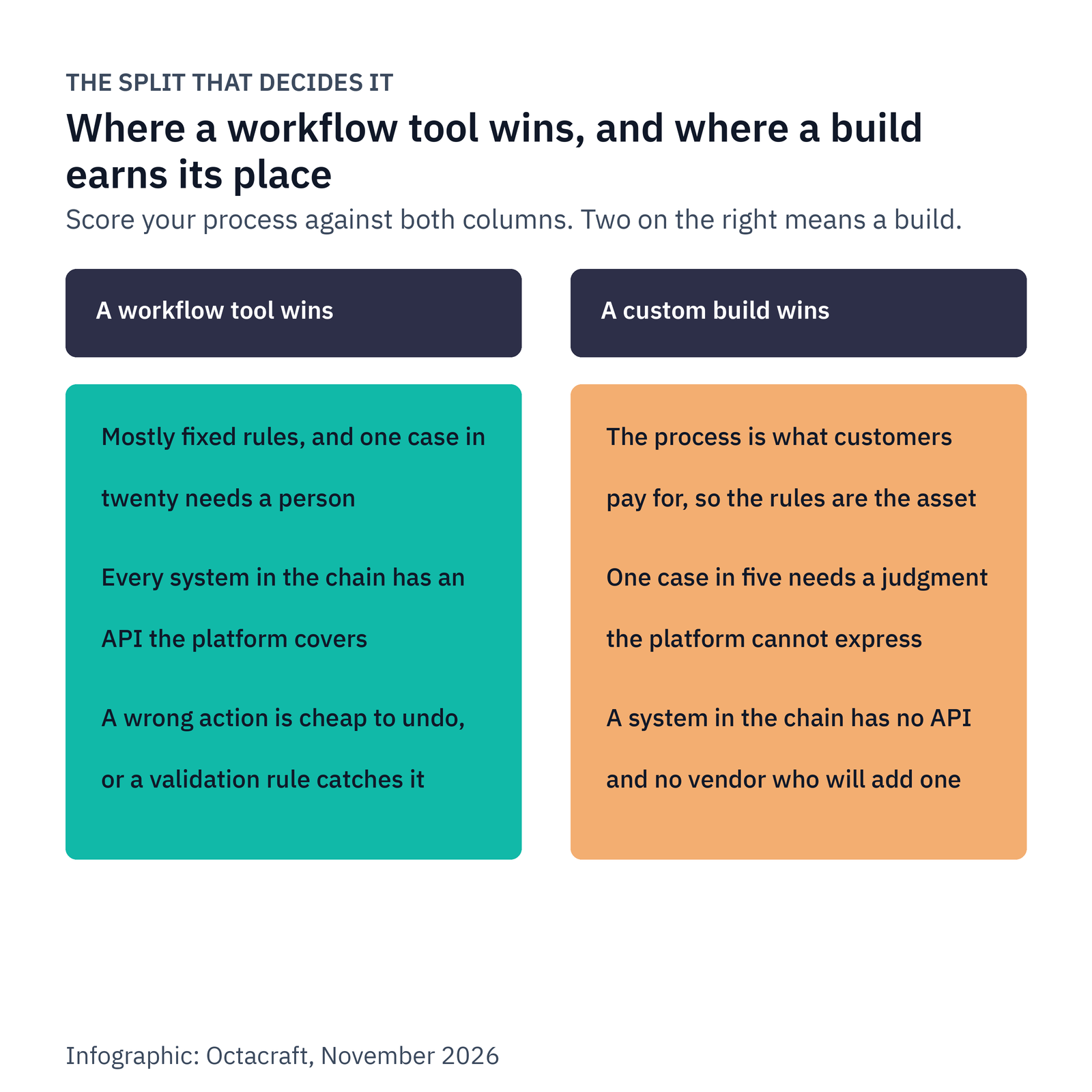
- The process is mostly fixed rules, and roughly one case in twenty needs a person.
- Every system it touches has an API the platform already supports.
- A wrong action is cheap to reverse, or a validation rule in the target system catches it first.
Under those three, business process automation software is not a compromise. It is the better engineering choice. You get error handling, retries, run history and a builder without hiring anyone. Its first-year cost is smaller than the first invoice for a build.
Workflow automation examples that belong on a tool
Three workflow automation examples from the work we see, all of which should stay on a platform.
- A client record copied from the sales tool into finance, with owner and payment terms attached. Three steps, two documented APIs, and a schema that rejects a wrong field.
- A weekly report assembled from three exports and posted to a channel. The rules do not change between one week and the next.
- A form submission that creates a task, assigns it by team and sends a receipt. Every branch is known in advance, and the worst result is a duplicate task someone closes.
Each of those has a measurable volume, a fixed rule set and a cheap failure. None needs code written for it, which is the test for staying on business process automation software.
Where a custom build wins
The mirror conditions. The process is what customers pay you for. More than one case in five needs a decision the platform cannot express. Or a system in the chain has no API and no plan to get one.
The first is the one buyers underrate. If the process is the product, the rules are the asset. Running that asset on business process automation software puts your differentiator in a subscription you can lose, with a roadmap you do not control. Firms in that position build the core step and buy everything around it.
The other two are technical, and they are where a tool quote becomes a second project. A flow with forty branches is code with a visual editor. The person maintaining it is a developer who would rather be writing something testable. Here is the same split as a picture, for the wall beside the process list.
The gray zone: hybrid
Most honest answers are hybrid: business process automation software for the glue, a build for the core step. Glue moves data between systems that already agree on what it means. Core is where your judgment sits: pricing, eligibility, allocation, the decision a customer pays for.
The split has a price of its own. Two systems now need an owner, and the boundary between them has to be written down or it drifts. Business process automation software will not document that boundary for you.
Cost of both paths for one process, side by side
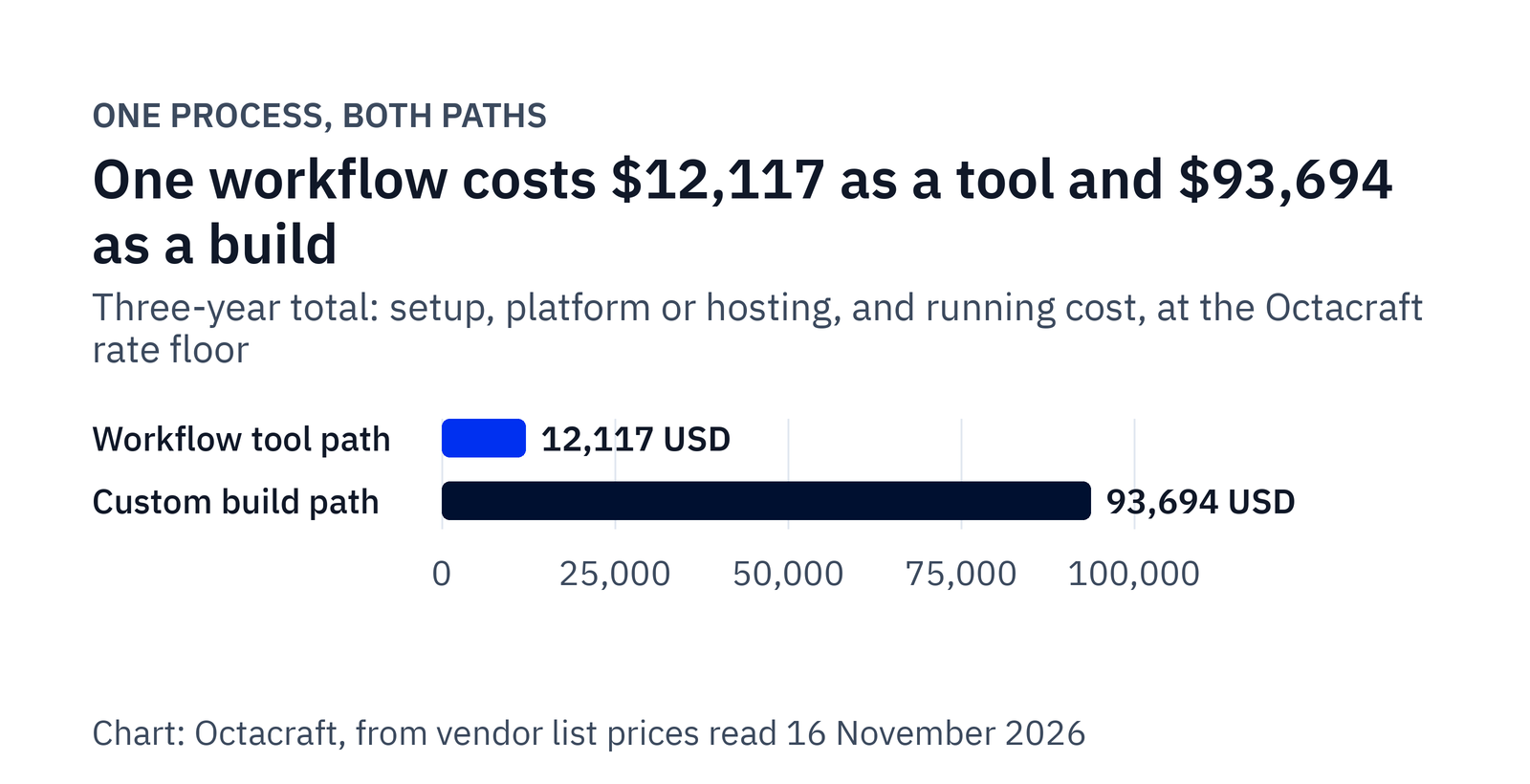
Both columns price the same process: one workflow, one integration, no portal, run by forty people. The tool column prices business process automation software at Make’s Core list rate, with a 40 hour setup. The build column uses our 400 hour band. Hours are planning bands, not measurements, and neither column is a quote for your firm.
| Cost line | Workflow tool path | Custom build path |
|---|---|---|
| Setup or build | $5,842 (40 hours at $146.06) | $58,424 (400 hours at $146.06) |
| Hosting and platform, year one | $144 (12 months at $12) | $72 |
| Year one total | $5,986 | $58,496 |
| Year two running cost | $3,065 ($144 platform plus 20 repair hours) | $17,599 ($17,527 retainer plus $72 hosting) |
| Year three running cost | $3,065 | $17,599 |
| Three-year total | $12,117 | $93,694 |
| One eight-hour change request | About two hours of the flow owner’s time | $1,168 at the floor rate |
The build costs 7.7 times the tool over three years. That gap is why a cost comparison is the wrong instrument here. Business process automation software wins the price column by default. The argument for a build has to be that the rules in it are yours.
What per-task pricing does at scale
Does volume ever flip the answer? In theory yes, and vendors use the arithmetic to sell an enterprise tier.
A build at $93,694 over three years costs $31,231 a year to own. At Make’s $1.20 per 1,000 credits, that buys about 26 million credits a year. That is 2.2 million a month. No single process in a firm of 100 to 500 people runs that often, so business process automation software stays the cheaper path.
Volume bites on per-step platforms with heavy documents. Zapier’s task tiers reach two million tasks a month. A three-step flow on 100,000 documents is 300,000 tasks. Volume decides which platform you buy, and rarely whether you buy. Business process automation software stays cheaper at any volume one process in a firm this size reaches.
How business process automation tools count a month
The counting rule matters more than the headline price, and every business process automation software vendor counts something different. A task tier counts steps. A credit counts module actions. An execution counts a whole run. n8n prices per execution, with unlimited steps on hosted plans: $20 a month for 2,500 runs, or $50 for 10,000 (n8n, pricing, read 16 November 2026).
Ask one question before signing. What does one run of this process cost in your unit? Multiply it by the monthly volume. If the vendor cannot answer in one sentence, the bill is not predictable. Unpredictability is the risk you were buying business process automation software to remove.
Where we fit
We build and run custom systems where the process carries the margin and no platform can express the rules. One process, several systems, a decision that has to be checkable a year later. Business process automation software handles the rest of the estate, and we say so on most calls.
We are the wrong call on a fixed-rule process between two modern systems. Buy the tool, configure it, keep the $81,000 difference. We are also the wrong call when the process has never been written down, because the first job there is documentation.
We are the right call when a flow has outgrown its platform. We are also the right call when one step needs to be code while the rest stays on business process automation software. That second case is most of our work.
Related reading: if the process is not documented yet, eight fields a tool can run is where that starts. If you are still choosing between a connector, RPA and an agent, those four questions are a separate decision. The build side is broken open line by line in what custom software costs in 2026. The wider build-or-buy question is scored in custom software against off-the-shelf, and an unchosen first process starts at the decision tree. Where the process crosses two vendors’ systems, the connector work carries its own contract: eight clauses to insist on in an API integration contract. When three vendors quote middleware, an iPaaS subscription and an API management platform for the same link, the three names compared on who operates the link and what one unit of work costs is the decision underneath the connector choice.
Frequently asked questions
Is business process automation software cheaper than a custom build?
Yes, at every volume one process in a firm of 100 to 500 people will reach. Business process automation software is priced per run, so one workflow costs about $12,117 over three years against $93,694 as a build, at list prices read 16 November 2026 and our published rate floor. A build is bought for fit, not for savings.
How long does each path take to work?
A platform flow is usually live in days, and our planning band for setup, testing and handover is 40 hours. A single workflow build runs about a quarter on the 400 hour band. Pay that lead time only when the rules are yours to keep.
Can we start on a tool and move to a build later?
Yes, and it is often the right order. Configure the flow first and let the run history show which branches the process actually takes. Business process automation software logs the exceptions a demo hides. Move the core step to a build when the branch count stops fitting.
What happens when the process changes?
On a tool, a change is configuration by whoever owns the flow, and the cost is their hours. On a build it is a change request priced in engineering hours. At our $146.06 rate an eight hour change is $1,168, against roughly two hours inside the tool.
Do we need a developer to run a workflow tool?
No for a fixed-rule flow. Yes once the flow carries code steps, custom connectors or more than about forty branches. Low-code plans expect a developer for exactly those parts, so answer the owner question before the purchase.
Is a custom build ever cheaper?
When the process runs at document scale on a per-step platform, or when the alternative is several tools plus a license per seat. A build also wins when an existing flow needs rewriting every quarter, because the repair hours cost what the retainer costs.
If you are holding a platform quote and a build quote for the same process, send us both. We will say which path we would take, including the case where the answer is neither.
Philip Bassey is Octacraft’s Chief of Staff. As part of his responsibilities, he oversees the interdepartmental activities to see that our processes are documented and those that need publishing are published. He writes about the work between a system going live and a team trusting it.

Philip Bassey is Chief of Staff at Octacraft, where he oversees the interdepartmental activities that keep our processes documented and the ones worth publishing published. He writes about operations that are engineered into systems instead of held together by memory.