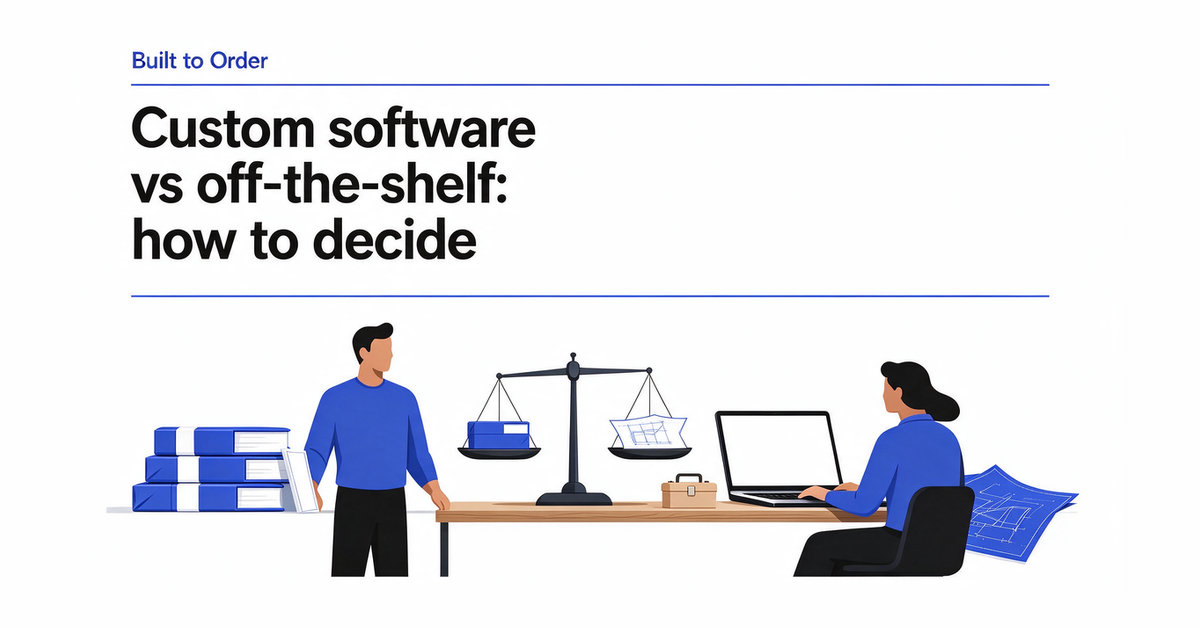
Custom software vs off-the-shelf: how to decide
The short version
- The licence and the build are not competing for the same job until the scope matches. Forty seats of finance software is a bigger purchase than one workflow.
- For 40 users and one workflow, the licence path costs $152,555 over three years. A build of that workflow costs $93,694.
- Priced at the same scope, the build costs $175,272 to $262,908, and the licence wins. Scope decides this, not price.
- Vendors reprice at renewal: Business Central Essentials went from $70 to $80 a user in November 2025, and Salesforce list prices rose 6 percent in August 2025. A custom software development company cannot reprice you.
- Score the seven criteria with weights before you compare totals, or the cheapest first invoice wins by default.
The demo works. Ten seats cost $9,600 a year and the integration is quoted separately. The person who runs the process says the tool will fit. Six weeks after go live, two teams keep their own spreadsheet for the one step it cannot do.
That gap between the demo and the Monday morning decides the purchase. A custom software development company is usually called after it appears. Most of those calls could have been avoided by one afternoon of scoring.
This piece scores both paths on the same seven criteria. It prices one workflow over three years at published list prices. It ends with a rule you can run in ten minutes. I work for a custom software development company, so read the section on when to buy twice.
The short answer
Buy off-the-shelf when the workflow already works the way the market works. Build when the workflow is what customers pay you for. Build too when three tools and a spreadsheet hold one process together, or when per-seat licences pass the cost of owning the code. Score fit before price.
The rule turns on two facts: what the workflow is worth to you, and what the alternative costs once the renewal lands. A custom software development company that scores fit first will often tell you to buy.
At 100 to 300 people, most firms should buy the ledger and payroll and build the one process that makes them different.
What I compared, and how I scored it
The case is a 120-person equipment services firm quoting and invoicing service jobs. Forty people create and edit quotes. Twenty approve them. One integration reaches the finance ledger.
The off-the-shelf option is Microsoft Dynamics 365 Business Central at list price. The build is one workflow at our October rate floor, which is what a custom software development company would quote for the same job. Neither number is a quote for your firm.
Seven criteria decide it. Each is scored from 1 to 5 for both paths, then weighted by how much it matters in this firm. The weights are the argument. Change them and the answer changes. A custom software development company should hand you the scorecard rather than the verdict.
| Criterion | Weight | Build | Off-the-shelf | Why the score |
|---|---|---|---|---|
| Fit to your actual process | 5 | 5 | 2 | The build follows the quote as sold. The licence follows its own model. |
| Total cost over three years | 4 | 4 | 3 | The licence is cheaper in year one. The build is cheaper by year three. |
| Time to a first working version | 3 | 2 | 5 | A licence is live in weeks. A build takes a quarter. |
| Run cost after go live | 3 | 4 | 2 | A maintenance retainer is flat. A licence rises with every renewal. |
| Integration burden | 4 | 3 | 3 | Both need the same endpoint work. The build keeps the mapping. |
| Ownership and exit | 3 | 5 | 1 | Code and data stay with you. The licence leaves with the contract. |
| Support and pace of change | 3 | 4 | 2 | One named developer against a release wave every six months. |
Weighted, the build scores 98 out of 125 and the licence scores 64. The gap is not cost. It is fit, run cost and ownership.
Custom software development company vs off-the-shelf: the three-year cost
Both totals come from published prices and one stated assumption. Microsoft lists Business Central Essentials at $80 a user a month, paid yearly, and its Team Members tier at $8 (microsoft.com, read 4 November 2026).
The build uses our floor of $146.06 an hour, which adds benefits and unpaid time to the federal median wage. Maintenance is 120 hours a year at the same rate. Any custom software development company will have its own rate, and the arithmetic travels.
Implementation is the assumption here. Partners quote it separately, and 60 percent of the first year licence is the middle of what we see.
| Line | Off-the-shelf | Custom build | Note |
|---|---|---|---|
| Year one | $64,512 | $58,496 | Licence plus implementation against build plus hosting |
| Year two | $42,739 | $17,599 | Renewal with a 6 percent uplift against maintenance |
| Year three | $45,304 | $17,599 | Second uplift against the same retainer |
| Three-year total | $152,555 | $93,694 | The build is cheaper at this scope |
| What the money buys | Finance, sales, purchasing and inventory for 40 people | One quote to invoice workflow | The scope gap is the decision |
Year one favors the build by $6,016, and that is the only year it does. From year two the licence carries a renewal, and the build carries a retainer that does not move. A custom software development company quotes the build once.
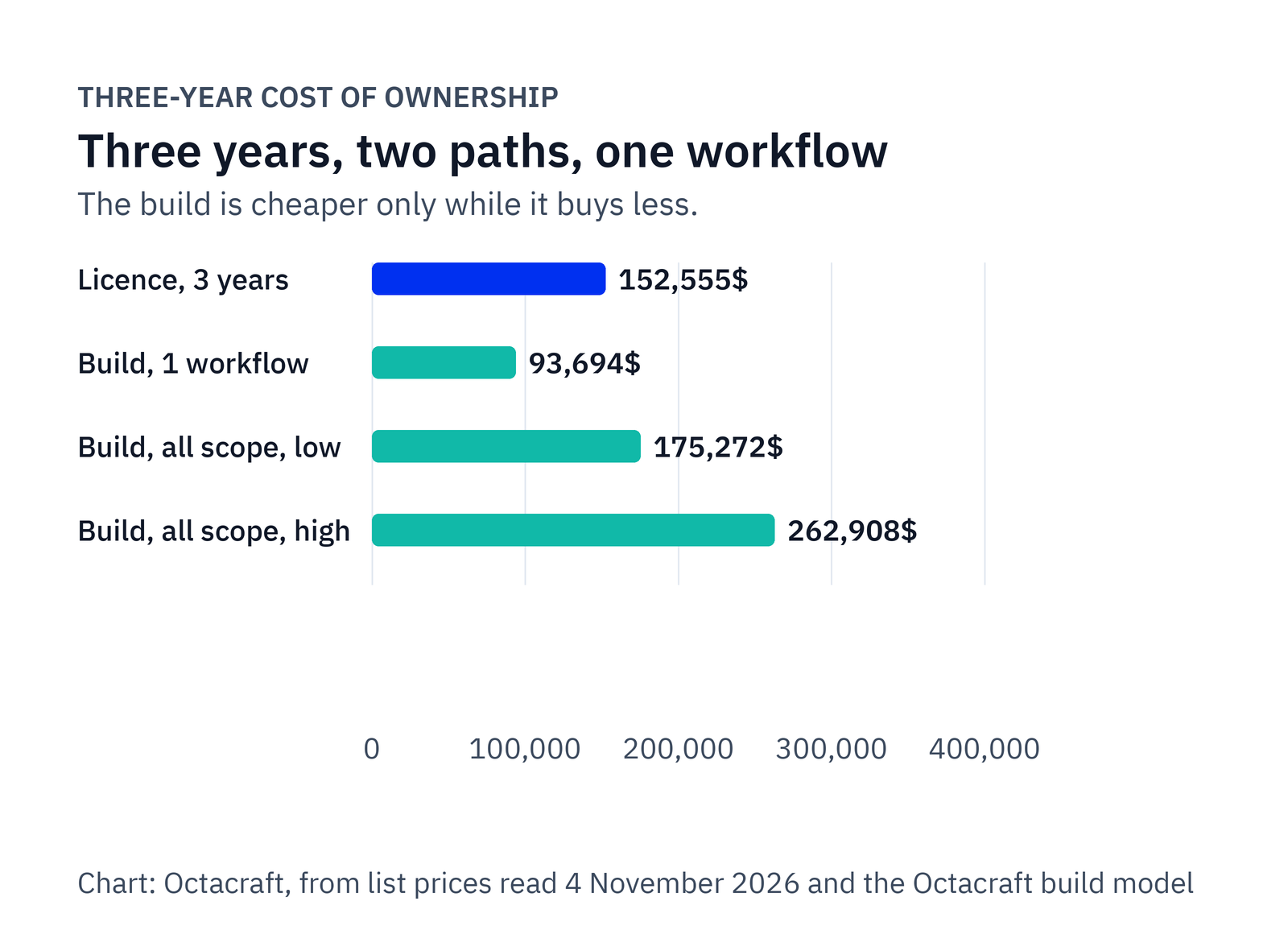
The uplift matters more than the seats. Salesforce applied 6 percent to its list prices in August 2025. At that rate, $40,320 of licences becomes $45,304 by year three. A custom software development company that quotes a flat retainer is quoting a number you can hold.
That is why the same scope test matters. A build of the full finance scope prices 1,200 to 1,800 hours, or $175,272 to $262,908 before maintenance. At that scope the licence is the cheaper three-year total, and the build has to earn its place on fit.
How much does it cost to develop custom software?
Between $36,000 and $450,000 for most business systems in 2026. A single workflow tool runs 250 to 400 hours. A system with three integrations and a customer portal runs 1,200 to 1,800. At our $146.06 floor, that is $36,515 to $262,908.
The range is wide because the work is hours multiplied by a rate, and a custom software development company prices both. Our 2026 cost breakdown, line by line opens seven lines: discovery, backend, front end, quality assurance, deployment, integration and project management.
Ask any custom software development company for hours, rate and assumptions per line. A lump sum hides all three, and the cheapest lump sum usually carries the smallest scope.
The wage floor is public, which makes the arithmetic checkable. The Bureau of Labor Statistics put the median annual wage for software developers at $135,980 in May 2025 (BLS, Occupational Outlook Handbook). That is $65.38 an hour across 2,080 paid hours.
Where each path wins outright
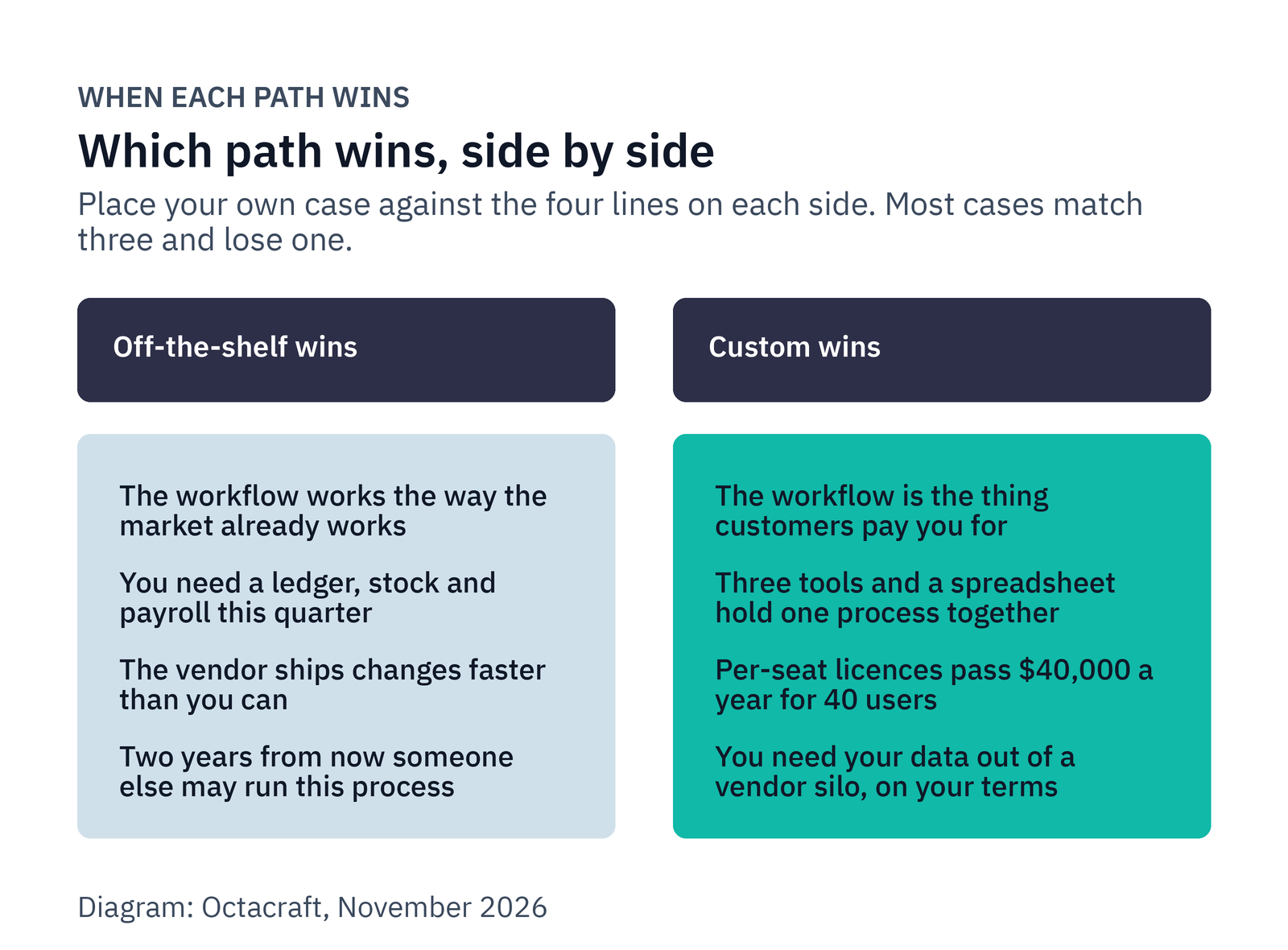
Off-the-shelf wins on commodity workflows and on a deadline this quarter. It wins where the vendor ships changes faster than you can. Custom wins when the workflow is the product. It wins too when three tools hold one process together, or when per-seat licences pass the cost of the code.
The four lines on each side are a test, not a verdict. Most firms match three and lose one, and the line they lose usually decides the answer. A custom software development company should ask you to fill it in before the first call.
Paying to rebuild a general ledger is paying twice for the same answer. The vendor already amortized that work across thousands of firms. A custom software development company that suggests otherwise is selling hours.
The three hidden costs in an off-the-shelf quote
The seat you buy for someone who only approves. The renewal that arrives with a new price list. The integrator you hire to make the tool fit. None of the three appears on the first invoice, and a custom software development company will show you all three before you sign.
The seats you pay for and never use
Vendors price access, not people. Business Central charges $80 a user a month for full access. A Team Members licence is $8, and it reads data and approves workflows. A custom software development company prices the same access as part of one build, and the seat count stops mattering.
Forty full seats at $80 is $38,400 a year. Twenty approvers on the lower tier is $1,920. Put those twenty people on the wrong tier and the bill rises by $17,280 a year. A custom software development company sells no seats at all, which is why the line disappears from its side of the table.
The renewal that reprices in year two
Microsoft raised Business Central Essentials from $70 to $80 a user in November 2025, and Premium moved from $100 to $110 (Microsoft, 6 May 2025). That is 14 percent on the largest line.
Salesforce lifted list prices by an average of 6 percent on 1 August 2025 (Salesforce). Its list now runs from $25 to $195 a user a month (salesforce.com, read 4 November 2026).
Ask for the uplift clause in writing before you sign. Six percent on $40,320 is $2,419 in year two, and the clause applies to every seat you add. A custom software development company sells you a number that cannot reprice itself. That is the whole advantage.
The integrator you hire to make the tool fit
Custom API integration services are the line most often quoted outside a licence deal. The tool talks to your ledger through an endpoint, and that work is priced by the hour. A custom software development company quotes the same work as one build line, with the endpoint count in it.
Ask for the endpoint count before the price. A quote that names four endpoints and a quote that names fourteen are not the same project. The second one is usually the real one.
The vendor’s release cycle sets the pace you have to keep. Business Central ships two major releases a year, in April and October, each with a five-month update window. An on-premises version stays supported for about 18 months (Microsoft Learn, 2026).
ERP software examples: what the licence actually replaces
An ERP licence replaces a general ledger, a purchasing system, a stock system and a sales ledger in one subscription. Business Central covers finance, sales, purchasing and inventory. NetSuite and SAP Business One cover the same ground.
A custom software development company is sometimes asked to replace that whole set. The honest answer is no, and the reason is scope rather than skill.
ERP software examples matter here because the scope is the price. If you need finance, stock and purchasing, the licence does four jobs at once and the per-seat rate is a bargain. If you need one workflow, you pay for three systems you will not use.
The honest test is a list. Write down every system the licence would let you retire. Three names on the list and you should buy. No names on the list and you are buying scope. A custom software development company should be the one telling you to run that test.
Business process automation software vendors: the third path
Business process automation software vendors sell the middle path: a workflow tool that connects the systems you already own. It costs less than a build and arrives faster than a licence. It stops working when the process needs a rule the tool does not have.
The middle path fits when the process mostly moves data between systems that already work. It fails when the process needs its own screens, approval rules and audit trail, which is where business process automation stops being enough.
A custom software development company will quote the build. A vendor will quote the licence. Neither will tell you the connector is enough. For one process in three it is the cheapest answer on the table.
Software pricing strategy: what to put in the contract
Price the whole life, not the first year. For a licence that means the uplift clause, the tier map and the exit terms. For a build it means a fixed maintenance number, source ownership and a named delivery lead. A custom software development company should volunteer all three.
Software pricing strategy is where most of the money is decided, and it is decided before the first invoice. Every number here holds only if the contract holds.
What to insist on if you build
Four terms carry the build. Source code ownership on payment. A fixed maintenance number for year two. An exit plan that names what you receive. One named delivery lead who answers for the run.
Ask the custom software development company to write the maintenance number into the contract. A retainer quoted as about 15 percent is not a number you can budget. It is the line that decides your year two.
How to decide in ten minutes
Run the five steps on the two quotes already on your desk. The first step is the one most firms skip. A workflow nobody can name in one sentence is not ready for either path.
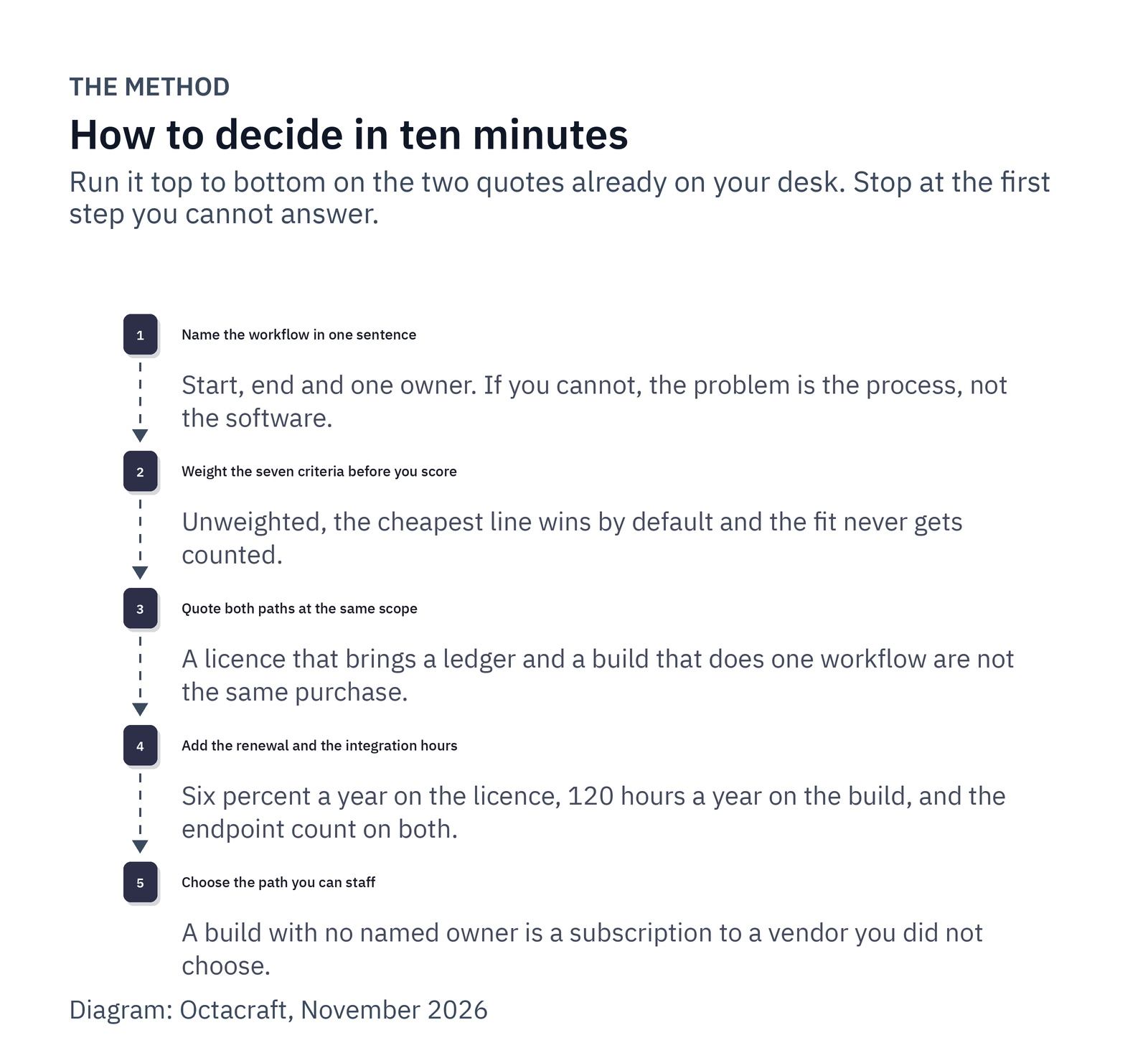
Step three is where comparisons go wrong. A licence quote and a build quote at different scopes will always produce a winner, and it will be the wrong one. The decision tree for a first process runs the same logic on automation.
A custom software development company will usually quote the workflow and leave the ledger alone. That is the honest division of work.
At the end the answer is usually a split. Buy the ledger, build the workflow, and keep the two decisions in separate budgets. A custom software development company that wants the ledger too is selling maintenance, not advantage.
Software solutions that need neither path
Sometimes the right answer is a spreadsheet and a part-time hire. Software solutions already in the building cost nothing to buy and a lot to maintain. That is still cheaper than a $58,424 build for 200 records a month.
Test the volume first. Two hundred quotes a month is about 13 hours of keying, or $1,900 at our rate. No build pays back against that, and the arithmetic on manual data entry shows why. A custom software development company should run that test before it quotes.
Where we fit
We build custom software, so the build column is our business. We are the wrong choice for a general ledger, a payroll system or a stock system, and we say so on the first call. A custom software development company that claims all three is a reseller with a build team.
We are the right choice when the process is the product. A custom software development company is a poor fit for anything the market already sells. Without a named owner for the system in year two, buy instead.
Frequently asked questions
Is custom software cheaper than off-the-shelf?
Rarely at the same scope, and often at a smaller one. A 40-user licence for one workflow costs $152,555 over three years. A build of that workflow costs $93,694. A build of the full finance scope costs $175,272 to $262,908, which makes the licence cheaper.
How much does it cost to develop custom software?
Between $36,000 and $450,000 for most business systems. Hours times rate decides it. One workflow runs 250 to 400 hours and three integrations with a portal run 1,200 to 1,800, at a floor of $146.06 an hour for 2026.
How long does a custom build take to work?
A single workflow usually reaches a working version in one quarter, which is what a custom software development company will quote. A licence is live in weeks. That lead time is real, so pay it only when the workflow is not something the market already sells.
What happens to an off-the-shelf price at renewal?
It usually rises. Microsoft moved Business Central Essentials from $70 to $80 a user in November 2025, and Salesforce raised list prices by an average of 6 percent in August 2025. Ask for the uplift clause in writing before you sign.
Should we build or buy our ERP?
Buy it. A general ledger is a solved problem, and a custom software development company that offers to rebuild one is selling a decade of maintenance. Build the process that makes you different, and keep the ledger on a licence.
If you are holding two quotes and want a third read, send us the workflow and both numbers. We will say which path we would take, including the case where the answer is neither.
Related reading: neither quote is worth much until the scope is settled in the requirements session we run before quoting a build.
Philip Bassey is Octacraft’s Chief of Staff. As part of his responsibilities, he oversees the interdepartmental activities to see that our processes are documented and those that need publishing are published. He writes about the work between a system going live and a team trusting it.

Philip Bassey is Chief of Staff at Octacraft, where he oversees the interdepartmental activities that keep our processes documented and the ones worth publishing published. He writes about operations that are engineered into systems instead of held together by memory.