Employee onboarding paperwork: from three days to one
The short version
- Most of the three days in employee onboarding is waiting, not typing. The forms take minutes. The handoffs between them take days.
- Only one employee onboarding step carries a legal clock that runs to three days: the employer’s review of work documents. It is a deadline for that check, not a schedule for the rest.
- Start the paperwork before the start date. US rules let a new hire complete the employee section of the work eligibility form as soon as they accept. UK employers must hand over the written statement on day one.
- Automate the intake form first. Every later step reads the same details, so one structured form removes three re-keys.
- Three changes take employee onboarding from three days to one: a single form, a single completion event, and a status board that chases for you.
The new hire starts on Monday. By Wednesday they still cannot log in, and employee onboarding has stalled in three inboxes at once. Payroll has no bank details, and the signed contract is sitting in somebody’s mailbox.
Nobody is being careless. The work is queued behind the next handoff. Employee onboarding is one of the few processes where the trigger is a person arriving rather than a system firing, so nothing moves until somebody remembers.
Employee onboarding paperwork runs in sequence. One person collects the details. A second keys them into payroll. A third raises the IT ticket. Each step waits for the one before it to finish.
None of that takes three days of effort. It takes three days of elapsed time, which is a different problem with a different fix. This teardown separates the work from the wait and names the three changes that get a new hire from three days to one.
Where the three days go
Three days is not how long the forms take. In most employee onboarding flows the forms take minutes. Three days is how long the handoffs take, because each one sits in an inbox until its owner starts work.
The first handoff waits even longer. It waits until the new hire walks through the door. That single choice, collecting nothing before day one, is what puts employee onboarding on the clock at nine in the morning instead of the week before.
Queue time and touch time are different numbers, and most reporting on employee onboarding only counts the second one. Queue time is the hours an item waits for attention. Touch time is the minutes somebody spends working on it. Lean practice counts both in lead time, the span from request to finished work (Lean Enterprise Institute).
The gap between those two numbers is widest where the trigger is a person. Employee onboarding is that case. The clock runs on attention instead of on work, and attention is the scarcest thing in a small operations team. Most employee onboarding reports stop at touch time, which is why the delay looks like a mystery.
Why employee onboarding takes three days
Employee onboarding takes three days because the chain starts on day one. Nothing is collected before the start date. The contract, the tax form, the document check, payroll and the IT accounts then queue behind each other.
US rules do not require that sequence. A new hire can complete Section 1 of Form I-9 any time after accepting the offer, as long as it is done by the first day of work (USCIS, accessed 17 November 2026).
The employer then has three business days from the hire date to examine the documents and sign Section 2 (USCIS, accessed 17 November 2026). Three business days is a ceiling on that check. It is not a reason to start the forms late.
The UK runs the same logic in the other direction. An employer must give the written statement of employment particulars on the first day (GOV.UK, accessed 17 November 2026). The wider statement follows within two months.
A document that must exist on day one has to be prepared before it. That alone means the contract cannot be the step that starts the clock. Employee onboarding is front-loaded by law, and then delayed by a process that ignores the law’s own timing.
That distinction matters. A process problem is yours to fix. A legal one is not.
The nine handoffs between offer accepted and accounts set up
Draw the flow and the shape becomes obvious. Nine steps sit between a signed offer and a working login, and each one hands off by email.
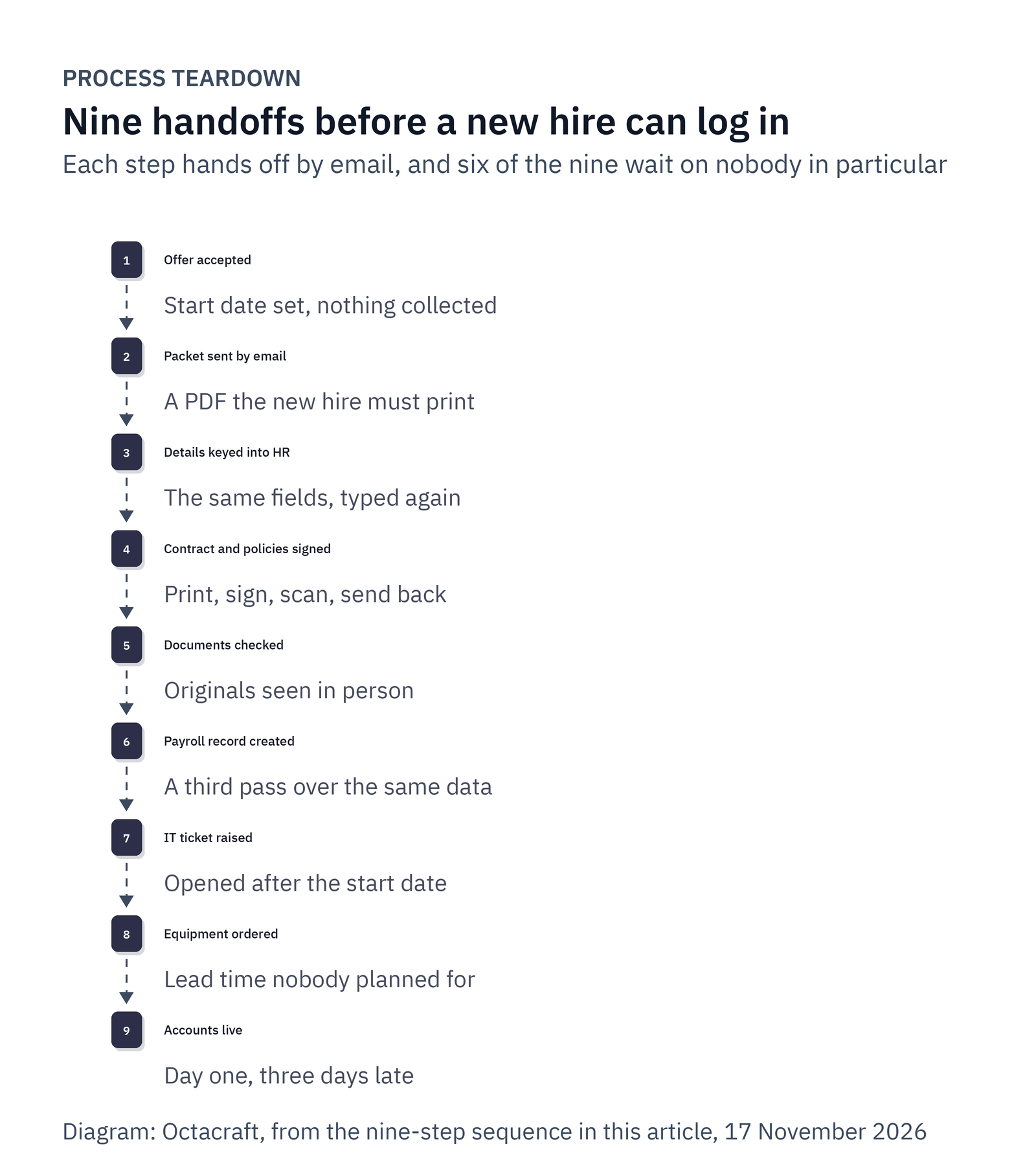
Look at where the waits sit. Three of the nine steps end in a signature or a document check. The other six end in an email that nobody owns.
Who owns each step, and what each one waits on
The table below sets out the employee onboarding steps as they usually run. The last column is the one to argue about.
It separates the steps that must wait for a person from the steps that wait only because nobody moved them earlier.
| Step | Who owns it | What it waits on | When it can happen |
|---|---|---|---|
| Offer accepted | Hiring manager | Nothing | Before the start date |
| Details collected | HR or office manager | An email reply with a PDF attached | Before the start date |
| Details keyed into the HR system | HR | Somebody reading the PDF | Before the start date |
| Contract and policy pack signed | HR, then the new hire | A printer, a signature, a scan back | Before the start date |
| Right to work or eligibility check | HR | The original documents, in person | Offer stage or day one |
| Payroll record created | Payroll | The same details, keyed a second time | Before the first pay run |
| IT accounts requested | Hiring manager | A ticket raised after the start date | Before the start date |
| Equipment ordered | IT or facilities | The start date being confirmed | Before the start date, with lead time |
| Accounts live | IT | Every step above | Day one |
Eight of the nine rows can be finished before the person arrives. Only the document check needs the person, and even that can happen at offer stage or on the morning of day one.
Employee onboarding that takes three days is not following a rule. It is following a queue that nobody drew.
What is the first thing to automate in employee onboarding?
Automate the intake form first. Payroll, IT, the document check and the contract all read the same details, so one structured form removes the re-key that every later step repeats.
Starting anywhere else automates a step that still waits on the form. A team that buys a platform before it defines its intake ends up with a digital packet. That is the same delay in a nicer wrapper.
Employee onboarding automation benefits
The benefits are specific and countable. One entry instead of four. A record of who changed what, and when. Fewer chase messages, because the status lives in one place. And a day one where the laptop, the payroll record and the accounts are ready before the person sits down.
The last one is the benefit people feel. A new hire who spends the first morning on forms learns that the company runs on forms. A new hire whose first morning is a meeting learns something else.
The cost of manual data entry is usually counted in admin hours. In employee onboarding the bigger bill is the first impression, and nobody puts that line in a business case.
Electronic onboarding of new employees
Electronic onboarding of new employees means collecting and signing hiring documents in a digital system instead of on paper.
In the US the signature is ordinary. A signature or contract may not be denied legal effect solely because it is electronic (15 U.S.C. 7001, the ESIGN Act of 2000, US Code).
The document check is the part teams assume cannot move. In the UK an employer must check the right to work before employing someone. That check can be done online, with a share code, before the start date (GOV.UK, accessed 17 November 2026).
Copies and the date of the check are kept for two years after employment ends. That is a record-keeping job, and record keeping is what software is good at.
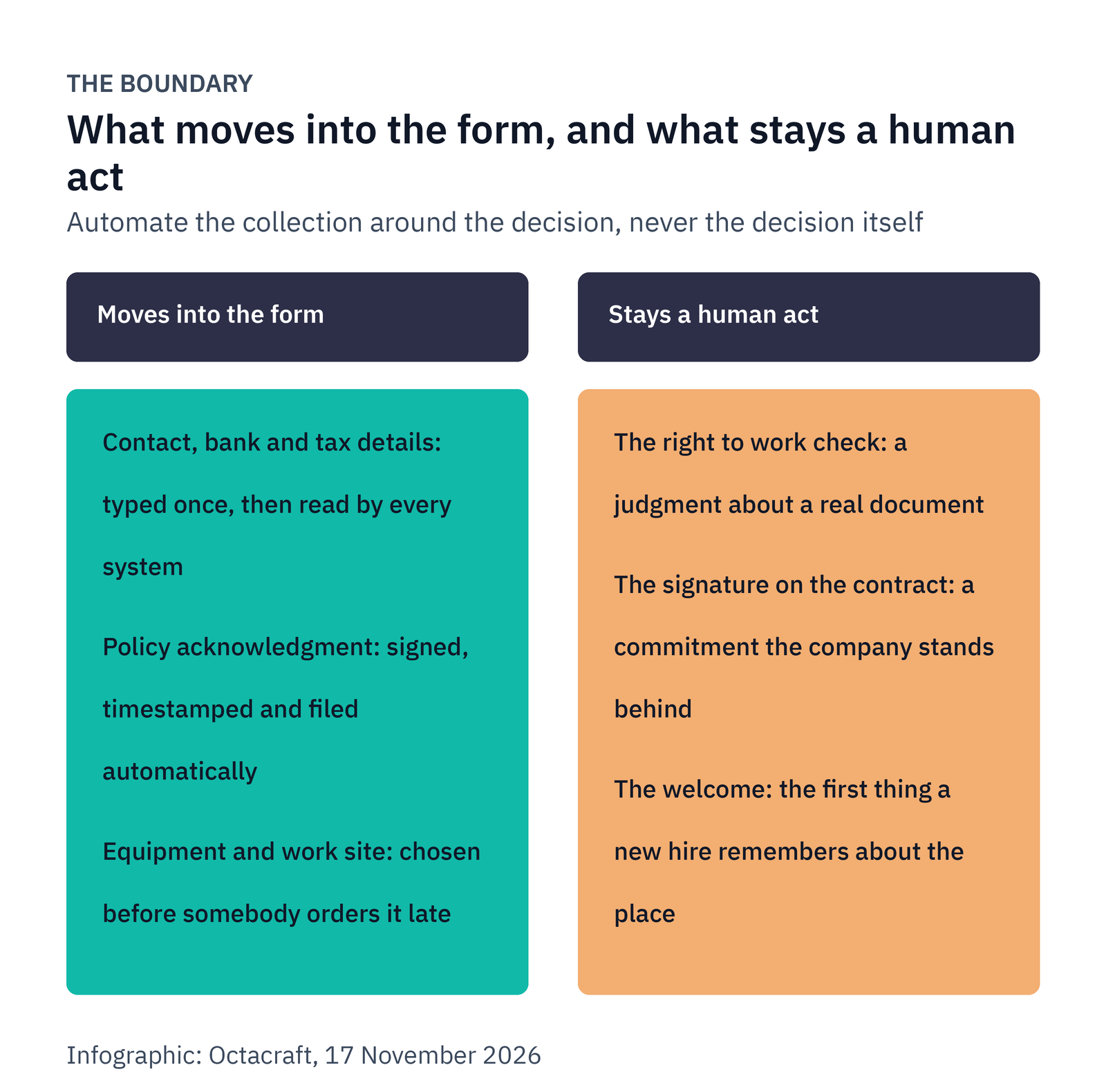
What moves online is the collection, the signature, the timestamp and the file. What does not move is the judgment about whether the document is genuine. That judgment is the next section.
The paperwork that must stay human
Three things stay human: the identity and right to work check, the signature on the contract, and the manager’s own welcome. Automate the collection around them. Do not let a workflow imply a decision it did not make.
What employee automation should not touch
Employee automation is safe where the rule is fixed and the input is structured. It is unsafe where the rule lives in one person’s head, or where the output is a commitment the company has to stand behind.
Three categories stay with a person. A check that carries a legal penalty if it is wrong. An exception, such as a candidate who cannot produce the usual document. And anything a new hire will remember as the company’s first act toward them.
The same boundary shows up in what AI agents can run in a business today, and it has not moved. The paperwork around a decision can be automated. The decision stays where the liability is.
Step 1: replace the packet with one structured form
Structured intake is a form whose fields write into systems, not a document that somebody re-keys. The form becomes the system of record for the hire. Every later step reads from it rather than asking again.
Most employee onboarding packets collect more than they need and store it where nothing can read it. Ten fields cover almost every downstream system:
- Legal name, preferred name and the start date
- Home address, personal email and mobile number
- Bank details for payroll
- Tax withholding choices
- Emergency contact
- Job title, team and manager
- Equipment needed, and the site they will work from
- Work eligibility answers, with document type
- Policy acknowledgment
- A photo and a short introduction for the team
Two rules keep the form honest. Every field must have an owner and a destination, or it comes out. And the form must be sendable at offer stage, because that is the only point where collecting it costs nobody a day. Most employee onboarding delays trace back to this one omission.
The eight fields a tool can run in a documented process are the same eight that make this form work. If a field cannot be written to a system, it is a note, not an intake field.
Step 2: trigger payroll, IT and accounts from one completion event
An event-driven handoff is one completion signal that starts every downstream task at once, instead of an email chain that starts them one at a time. Payroll, IT and facilities receive the same event, with the same data, and none of them waits for the other two.
This is the step that removes the days. In employee onboarding the completion event is the form’s submit, and everything downstream can start from it. In the manual flow, the IT ticket is raised after somebody notices the new hire has no laptop. In the event-driven flow, the ticket opens when the form is complete, which can be a week before the start date.
Two failure modes are worth designing out. First, a partial submission firing the event, which creates a payroll record with no bank details. Second, the same event firing twice, which creates two accounts for one person.
Trigger on a validated, complete submission. Make the trigger idempotent, so a repeated signal changes nothing. Employee onboarding is one of the few processes where a duplicate record is expensive to unpick, because payroll has already run.
Step 3: track employee onboarding completion without chasing people
A status board turns the flow into something a manager can read in ten seconds. Each hire sits in a column. Each step shows a state. The overdue ones are visible without a meeting.
Reminders do the chasing. One message when a step goes overdue. One escalation to the manager after a set interval. No message at all when a step is on time.
The point is not more notifications. It is fewer, aimed at the one person who can unblock the hire. A manager who is the reminder system will eventually stop sending reminders, and the queue will grow back.
This is the same discipline as any approval bottleneck. Give every step a clock and an owner, then measure the queue rather than the work.
What three days to one means in practice
We have not measured a client flow for this article, so we will not publish a benchmark and call it a result. What follows is arithmetic on the model above, with every assumption named.
Take the nine steps. Four of them wait on a person being present: the form, the signature, the document check, and the accounts. Run them in sequence after the start date and each costs about a day of elapsed time. That is where three days come from in most employee onboarding flows.
Three of those four do not need the person at work. They need the person reachable. Move them to offer stage, and day one holds only the accounts and the welcome.
That is one day of elapsed time, and most of it is IT provisioning, which can be triggered in advance. The one-day version is not a faster version of the same sequence. It is a shorter sequence, because three steps left the critical path.
What a one-day flow still waits for
Three waits do not disappear. Equipment has a lead time you do not control. A background check returns when the provider returns it. A document check can stall on a genuine exception, such as a name that does not match across two documents.
The honest promise is narrower than the headline. Employee onboarding can be complete on day one when the equipment is ordered early and the check is clean. When it is not, the flow should say which step is holding and who owns it.
What the manual version costs per hire
The cost has two parts and most teams count only the first. The first is admin time in employee onboarding: hours per hire, multiplied by a loaded hourly rate, multiplied by hires per year.
The second is idle pay: days of delay, multiplied by a day of salary, multiplied by hires per year. That is the number that gets a change approved, because it is paid to somebody who cannot yet do the job.
Four inputs make the calculation yours rather than ours. Hours of admin per hire, taken from a time log rather than an estimate. The loaded hourly rate, including overhead. Hires per year, from the hiring plan. And days from offer to a working login, measured from three real hires.
Run that for one quarter and the case usually makes itself. If the idle pay line is larger than the admin line, you are not buying software to save typing. You are buying days back.
Employee experience platform software: where it fits
Employee experience platform software is the front door a new hire walks through. It holds the welcome page, the task list and the first-week content. It is not the engine.
The platform reads from the HR system, so a weak intake produces a weak experience, however good the front door looks. Buy it after the intake is defined and the completion event exists.
Before that, it digitizes a packet. Employee onboarding then looks modern and still takes three days, which is the most expensive outcome available.
Employee communication platforms and the first week
Employee communication platforms are where the reminders and the welcome belong, because that is where people read.
Keep two things out of them: the record of completion, and the approval. Chat is a channel, not a system of record.
The split is simple. Employee onboarding status and documents live in the HR system. Reminders and the human part live in the channel people already use: the welcome, the first-week check-in, the answer to a nervous question.
A team that runs approvals in chat spends the following week reconstructing what was agreed. Employee onboarding is where that habit costs most, because the agreement usually concerns pay.
Short answer: the three steps and the intake-first rule
Employee onboarding loses its days in the handoffs, not in the forms. Collect the details once in a structured form at offer stage, fire payroll, IT and facilities from a single completion event, and let a status board do the chasing.
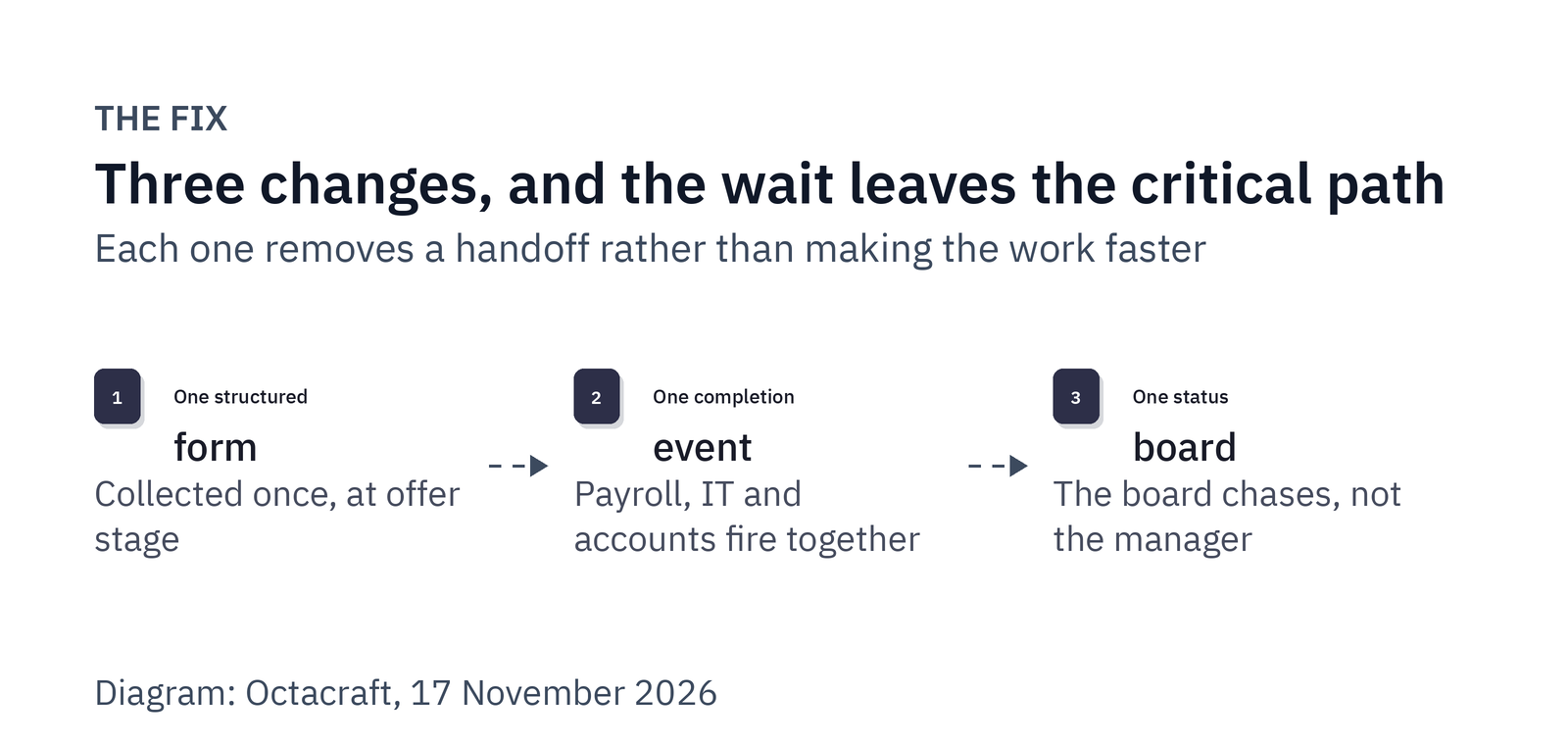
Automate the intake first. Keep the document check and the signature with a person. Employee onboarding goes from three days to one because three steps leave the critical path, not because anyone types faster.
If your new hires still wait two days for a login, the fix is usually the first handoff rather than the fifth. Find the step that only starts when somebody remembers, and give it a trigger.
How long should employee onboarding paperwork take?
The forms take minutes, not days. Most of the elapsed time is queue time between handoffs. A flow that collects details at offer stage and triggers payroll and IT from one completion event can finish in a day, provided equipment is ordered early and the document check is clean.
Can a new employee complete paperwork before the first day?
Yes. In the US a new hire can complete Section 1 of Form I-9 any time after accepting the offer, as long as it is done by the first day of work. Contracts, tax forms and policy acknowledgments can be signed before the start date, and electronic signatures have the same legal effect as ink.
What is the first thing to automate in employee onboarding?
The intake form. Every other step reads the same name, address, bank and tax details, so one structured form removes the re-keying that happens three or four times in a manual flow. Automating a later step first leaves it waiting on the same form.
Do we need an employee experience platform to fix this?
No. A platform improves the front door, but it reads from the HR system, so a weak intake produces a weak experience. Define the intake and the completion event first, or the platform digitizes a slow packet and the delay survives the purchase.
What should stay manual in employee onboarding?
The identity and right to work check, the signature on the contract, and the manager’s welcome. Each carries a judgment or a legal consequence that a workflow cannot absorb. Automate the collection and the reminders around them, and keep the decision with a named person.
Related reading: the handoff problem is older than the software, and it shows up the same way in business process automation for operators. If the queue sits on a person’s desk rather than a form, the fix starts with the intake, not with a bigger platform. And if you are weighing a platform against a small custom tool, the same trade-off is set out in custom software versus off-the-shelf.
Where the same collect-then-trigger pattern has to survive a handover, the documents themselves are in process documentation template: 5 that survive turnover: eight sections, five templates and three review triggers.
Where a step stops being paperwork and becomes a decision about a person, the three-tier test is in HR automation: what’s safe to automate and what stays human.If new hires in your company still wait days for a login, tell us where the queue starts. We will say which of the three steps is missing and what the first fix is, before you spend anything on software.
Philip Bassey is Octacraft’s Chief of Staff. As part of his responsibilities, he oversees the interdepartmental activities to see that our processes are documented and those that need publishing are published. He writes about the work between a system going live and a team trusting it.

Philip Bassey is Chief of Staff at Octacraft, where he oversees the interdepartmental activities that keep our processes documented and the ones worth publishing published. He writes about operations that are engineered into systems instead of held together by memory.