What to automate in support first: triage, not answers
The short version
- An AI chatbot for customer service is usually bought to answer. The better first job is sorting: tagging, prioritizing and routing each ticket before anyone replies.
- Sorting is a classification job. It is testable on your own tickets, and a wrong call costs minutes rather than a customer.
- Replying is a judgement job. It needs grounded content, a refusal path, an audit trail and one named owner before a model speaks.
- Score triage on a labeled sample of your tickets, against your team’s own routing. If it cannot beat them, it is not ready.
- Expect month one to fail on labels that drift and tickets that fit no category. Plan a weekly review for both.
The demo goes well. A customer asks about a refund and gets a polite answer in four seconds. Someone in the room says the queue problem is solved.
Then the same system answers a question about a damaged delivery with a policy the company retired last year. It sounds equally confident. An AI chatbot for customer service states an answer whether or not the content under it is current. Sorting a ticket has no such failure mode.
This is about the first thirty days of support automation, spent on triage rather than replies. You are weighing options rather than shopping for features, so it is written to that question: what to hand over first. It is written for the head of support at a firm of 150 to 400 people, where the inbox grows faster than the team and an AI chatbot for customer service has already been pitched by someone.
Should an AI chatbot for customer service answer, or sort the queue first?
Automate triage first. Sorting, tagging and routing a ticket is a classification job: it is testable, it fails visibly, and a wrong route costs minutes. Writing the reply is a judgement job with brand exposure. Earn the routing data before an AI chatbot for customer service speaks for your company.
The urge to buy the answerer is easy to understand. Replies are the part customers see, the part vendors demonstrate, and the part a board can picture. Sorting is invisible, and no one films a ticket being tagged. Most purchases of an AI chatbot for customer service therefore start with the answer.
The sort still decides how long the customer waits. An AI chatbot for customer service that answers well on top of bad routing sends the refund request to the sales queue. The customer gets a fast reply to the wrong question, then waits again.
What triage means in a support queue
Ticket triage is the step that decides what a ticket is about, how urgent it is and which team owns it. Customers never see it. It sets how long they wait, and it decides whether the first reply comes from the right person.
Your queue already triages. The work happens in the first ninety seconds, inside a supervisor’s head, and it leaves no record. The rules were never written down, so nobody can test them. The same ticket can be sorted two ways on two days.
That makes triage a useful first target. It is a decision with a checkable answer, made hundreds of times a week by people who are also answering the phone. It is also the work an AI chatbot for customer service does well, and the work people do badly under time pressure.
The three decisions on every inbound ticket
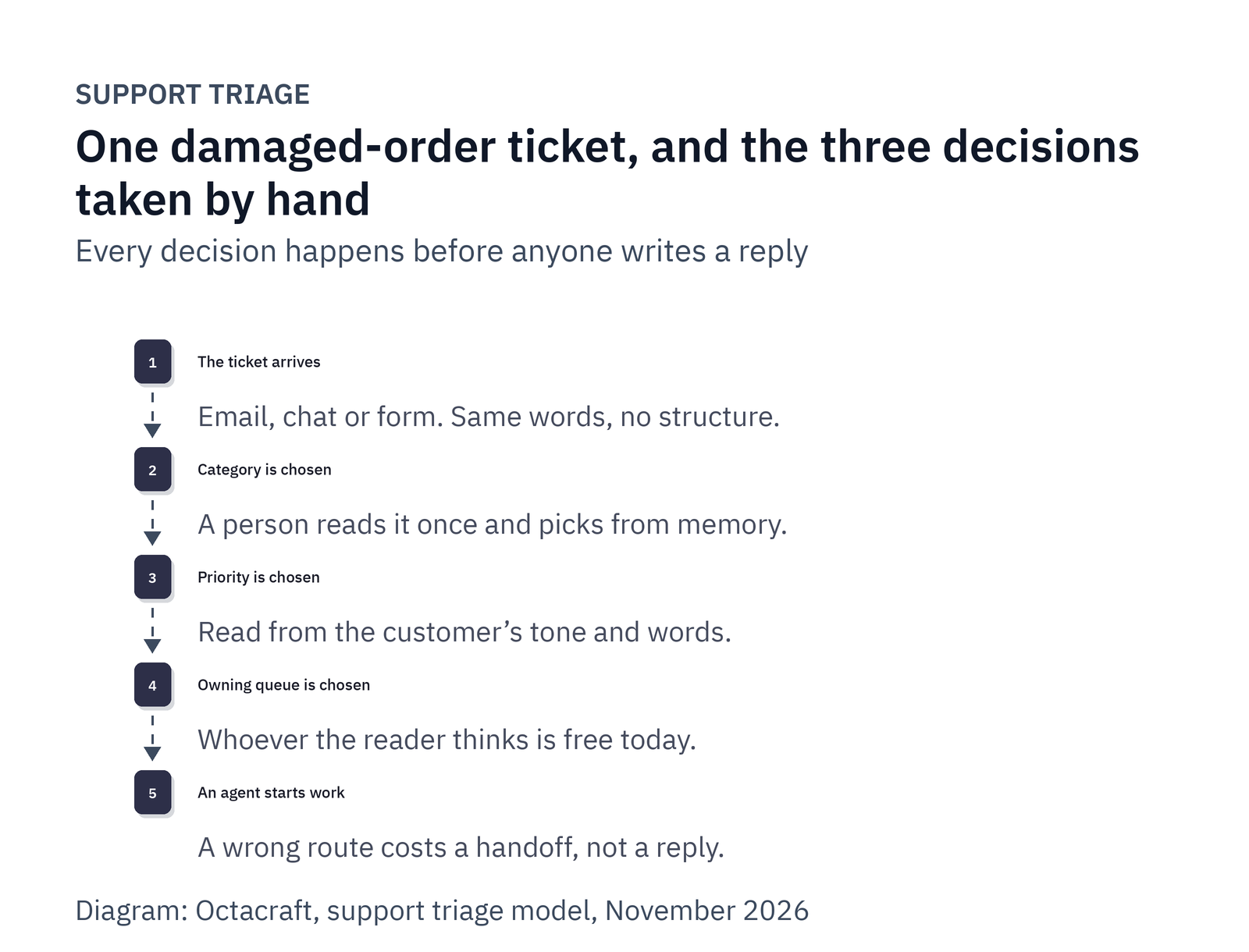
Take one anonymized ticket. A customer writes that an order arrived damaged and that this is the second time. Three decisions follow before anyone replies.
- Category: delivery damage, not a billing question and not a product fault.
- Priority: high, because money is involved and it happened before.
- Owning queue: returns and replacements.
Each decision is made by hand. A supervisor reads the message once, tags it from memory and assigns it. When the route is wrong the ticket is reassigned, and the clock keeps running. Three chances a day for an AI chatbot for customer service to be more consistent than a tired supervisor.
Why answering is the harder half of support automation
A wrong route is corrected inside the building. A wrong answer reaches the customer. That one difference sets the order of work: the error you can absorb comes first. An AI chatbot for customer service that sorts first absorbs its own mistakes.
The answering side is where the money has moved, and the vendors say so plainly. Intercom reports that its Fin agent holds a 76% resolution rate across more than 12,000 customers (Intercom, November 2026). It charges $0.99 per resolution and nothing when a customer asks for a person (Intercom Fin pricing, November 2026).
That second clause is the useful one. The refusal is a product feature, priced in, not an admission of failure. An AI chatbot for customer service sold without a refusal path is a demo with a price list.
What a wrong answer costs: the Air Canada ruling
The cost of a confident wrong answer is on the record. In Moffatt v. Air Canada, 2024 BCCRT 149, the Civil Resolution Tribunal of British Columbia found that a chatbot on Air Canada’s website told a traveller they could claim a bereavement fare after travelling, while the airline’s own bereavement page said the policy did not apply once the trip was complete. The tribunal rejected the argument that the airline was not responsible for the chatbot’s words and, on 14 February 2024, ordered it to pay $812.02: $650.88 in damages, $36.14 in interest and $125 in tribunal fees (Moffatt v. Air Canada, 2024 BCCRT 149).
Read that as a triage argument rather than a legal one. The system answered a policy question with no current page behind the sentence, and the answer became the company’s position. Routing the same question to a person, or to the page that governs it, would have cost one handoff. Sorting the queue is the cheap half of support automation because a wrong route is corrected inside the building, while a wrong answer is evidence.
What an AI chatbot for customer service needs before it speaks
Four things, and most support floors have none of them in place at the start. First, source content that is current, owned and written for customers. Second, a refusal path, so a question without a source produces a handoff rather than a guess. Third, an audit trail that stores each reply beside the page it came from. Fourth, one person whose name sits on the output.
An AI chatbot for customer service without all four is a reply engine with no brakes. Answering content is a publishing job with an owner, a review cycle and a retirement date, and in most firms it is nobody’s full-time work. That is why an AI chatbot for customer service usually exposes a content problem rather than a technology one.
Standards work treats the oversight question as a risk in its own right. NIST’s generative AI profile names human-AI configuration as a distinct risk category and asks organizations to document ownership and the roles responsible for human oversight (NIST AI 600-1, July 2024).
Regulation is arriving on the disclosure question. Article 50 of the EU AI Act requires that people be told when they are interacting with an AI system, and that provision applies from 2 August 2026 (EU AI Act, Article 50). If you sell into the EU, an AI chatbot for customer service that answers silently creates a compliance problem.
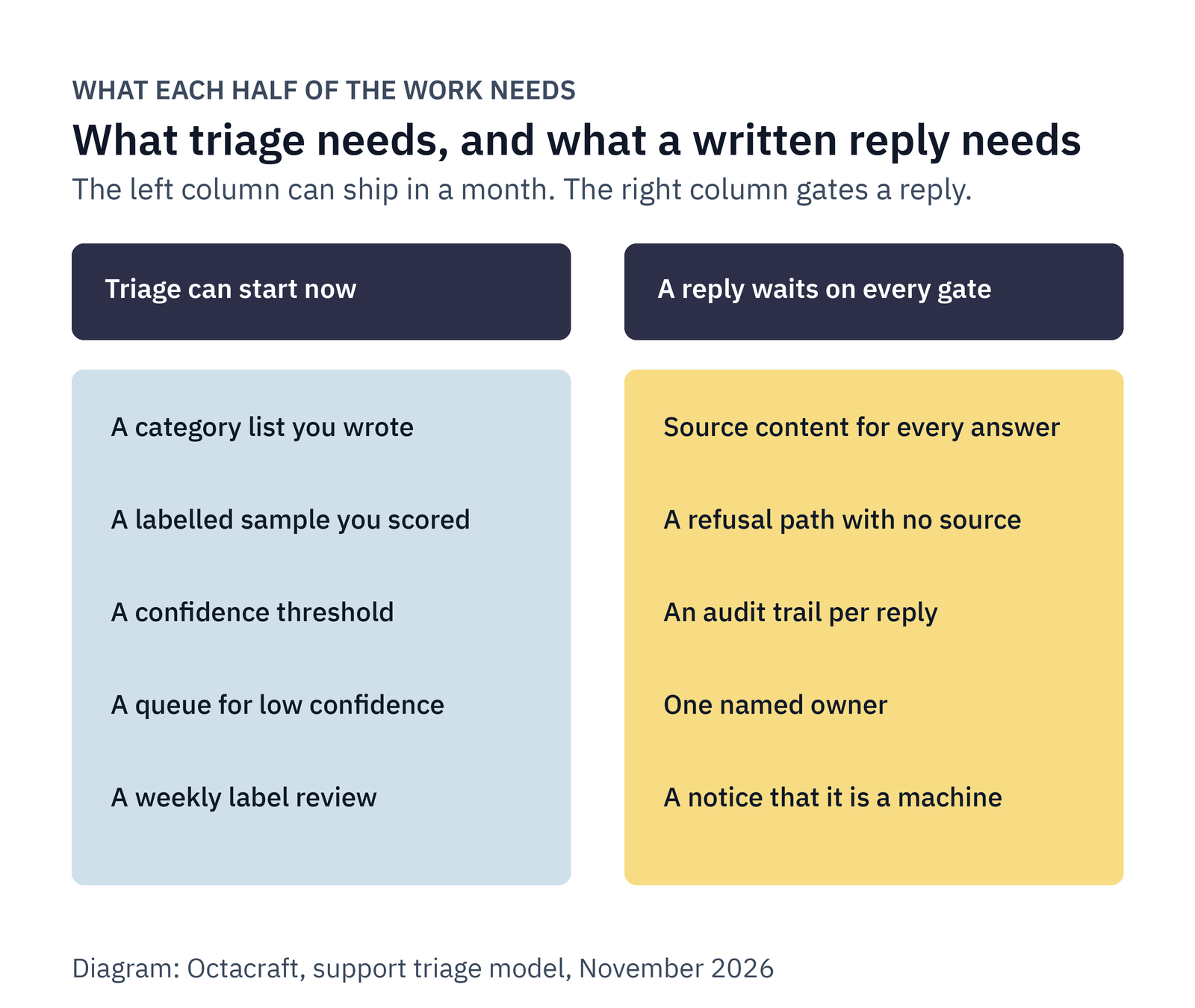
None of this argues against replies. It argues for sequence. The four gates are a month of content work on their own, and they get easier once triage labels show which questions arrive.
How accurate does triage have to be before you trust it?
It has to beat your own team on your own sample, and its failure mode has to be chosen on purpose. Low confidence should route to a person, never to a guess. An AI chatbot for customer service can score well overall and still fail where it matters.
A public benchmark tells you little. Most AI chatbot for customer service accuracy claims come from public benchmarks, not from your inbox. Your categories, your product names and your customers’ vocabulary are specific to you. NIST warns against judging a system from narrow or anecdotal assessments rather than from the setting it will run in (NIST AI 600-1, July 2024).
Measure on your own tickets instead, in three passes.
- Label a sample by hand twice, on different days. Where the two passes disagree, the category is not defined well enough to score against.
- Score your team on the same sample. Count a route as correct when it matches your label, and note where two labels were defensible.
- Score the model on the same tickets. Compare the two error sets, not only the two totals.
The shape of the mistakes matters more than the headline number. Errors that cluster in one category mean that category needs a rule before it needs a model. Errors that scatter mean the taxonomy is the problem, and an AI chatbot for customer service will only make the mess arrive faster. A public benchmark never saw your refund policy.
Set the threshold with the failure in mind. High confidence routes automatically. Medium confidence routes with a flag. Low confidence goes to a human queue that exists before go-live, staffed by someone who knows why it exists. An AI chatbot for customer service with no low-confidence route is a coin flip with a brand on it.
What does a customer service automation platform need to do triage well?
Four things: a short topic list you control, a confidence value on every prediction, routing rules that act on that value, and a per-ticket override a person can use without editing the model.
Zendesk’s documentation is a useful checklist because it states the mechanics plainly. Its intelligent triage classifies a new ticket by topic, sentiment, language and custom entities, and each field carries a confidence value that agents can override (Zendesk, October 2026). It covers roughly 150 languages and can re-check topic and sentiment on each reply (Zendesk, October 2026).
Ask three questions in any demo. Can I read the confidence value in the API, or only on the agent screen? Can I route on it without buying a higher tier? When an agent overrides a label, is the override stored with the ticket? Most AI chatbot for customer service demos show the answer and skip all three.
A customer service automation platform that answers all three can be tested inside a month. One that answers two will be tested by hand, and the test will stall. The confidence value is the part most AI chatbot for customer service pitches leave out.
Where does triage sit in your customer experience software?
Between intake and assignment. The helpdesk holds the ticket, the model adds fields, routing rules read those fields, and reporting scores the result. If any of the three cannot read the prediction, the model changes nothing.
Picture four layers. Intake brings the message in from email, chat, form or phone. The helpdesk stores it. A triage layer adds category, priority and confidence. Routing rules turn those fields into an owner.
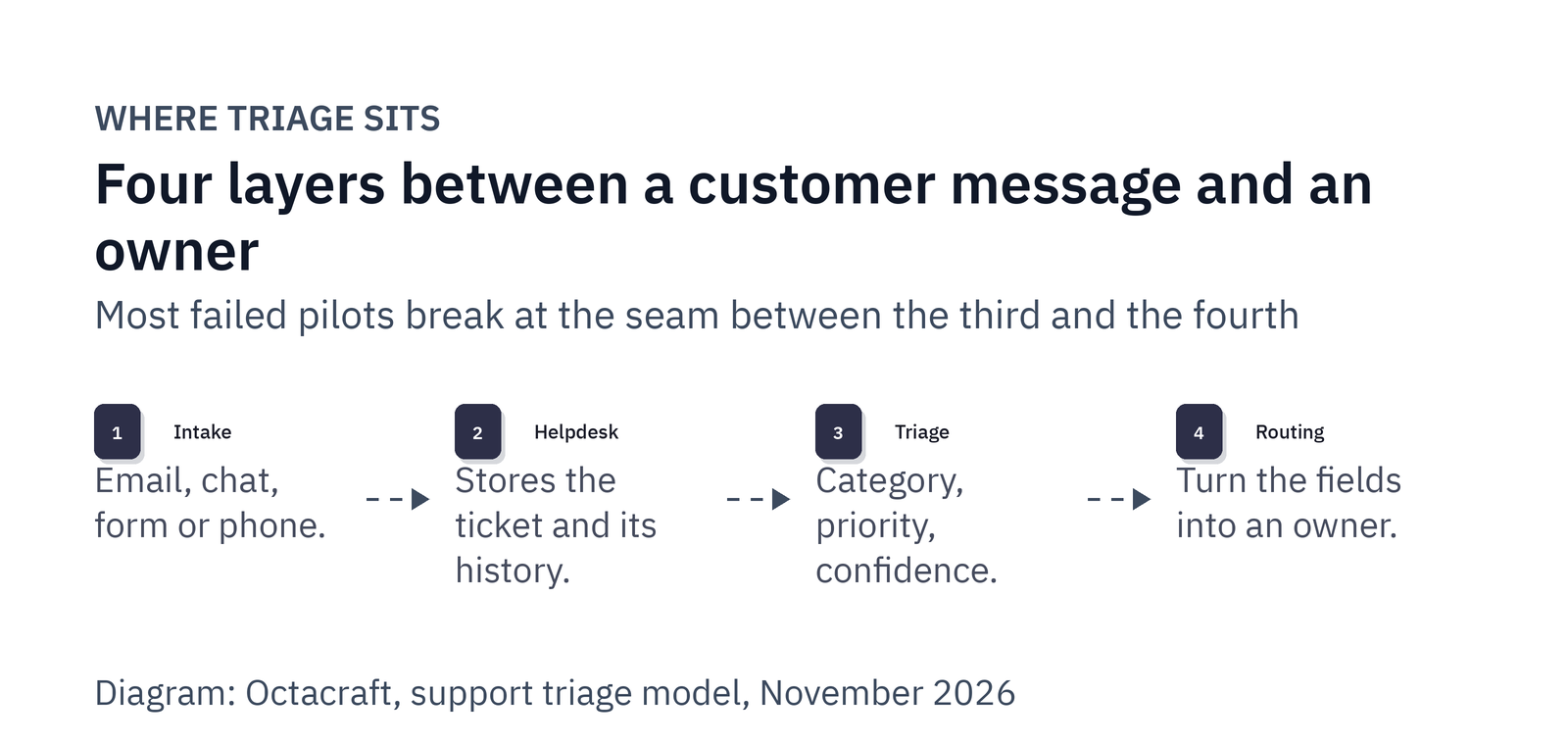
Most failed pilots break at the seam between layer three and layer four. The model predicts well and the rules read a stale field, because the helpdesk syncs custom fields on an hourly job. Nobody blames the seam. They blame the model.
Test the seam before the model. Send ten tickets through with routing off and confirm the fields arrive where the rules expect them, with the right names and value ranges. Where the seam is tested, an AI chatbot for customer service changes the queue within a week.
What does customer journey automation gain from clean labels?
Journey automation triggers on a label that means the same thing every time. Clean triage labels give you that: a delivery-damage ticket at renewal, a billing dispute during onboarding. Automate the message only after the label holds.
A journey tool that fires on sentiment alone will misfire. A customer angry about a late delivery and a customer angry about a price rise need different handling, and both look identical to a sentiment field. Triage supplies the missing half: what the message is about.
Ten categories are enough to build useful triggers. Twenty and the trigger logic becomes a second taxonomy that nobody maintains. Hold the journey work until routing is stable, because automating a message on an unstable label multiplies the error. That is where an AI chatbot for customer service earns its place: in the label under the reply, not in the reply.
Which customer service automation tools can run a shadow test?
The ones that pass have four things: a shadow mode with routing switched off, the confidence value in the API, an export of every prediction, and an override with an audit trail. Ask for all four in writing before the trial starts.
Shadow mode means the model predicts and the predictions are stored while a person keeps routing. Nothing the customer sees changes. Each week you compare model routes against manual routes, scored against labels you wrote.
Not every vendor sells that as a setting. Some sell it as a professional services engagement, which is a cost and a dependency. The export matters as much as the mode, because without a file of predictions matched to outcomes you cannot prove that the change is an improvement. Customer service automation tools differ most in that file. Ask an AI chatbot for customer service vendor for the export before you discuss price.
The playbook: five steps to automate triage in 30 days
The sequence assumes one queue, one named owner and thirty days. Move the dates if your volume is small. Keep the order, because each step produces the thing the next one needs. It works whether or not you ever buy an AI chatbot for customer service.
Step 1: export 30 days of tickets and split them by current queue (days 1 to 3)
Pull subject, first message, channel and the queue each ticket ended in. Split by queue to see where volume sits, which is rarely where the team thinks. Keep the file unchanged after day one, because it becomes the test set for everything that follows.
Step 2: define the categories you will route to, and keep the list short (days 3 to 6)
Write eight to twelve categories, one level deep, named in the words customers use. Test each against twenty real tickets. A category that holds fewer than one ticket in fifty is a report line, not a route.
Step 3: hand-label a sample and measure your own people on the same sample (days 6 to 12)
Label 300 tickets against your list. Then score what your team did with the same tickets. You now hold a baseline, and it is usually lower than the room expects. That number is the bar any AI chatbot for customer service must clear.
Step 4: run the model in shadow mode with routing switched off (days 12 to 26)
Turn predictions on and leave routing manual. Compare weekly, and fix the categories before the prompt, because most misses are taxonomy misses. Keep the threshold where low confidence still reaches a person.
Step 5: turn on one queue at a time, highest volume and lowest risk first (days 26 to 30)
Billing questions before complaints, and delivery status before refunds. Watch the first week of each queue for over-routing, where everything lands in one place because the model found an easy pattern.
If the order of handover still feels unsettled, our piece on the five operations to hand over first sets out the sequence we use, and the comparison of AI agents, RPA and Zapier covers which tool class fits which queue.
What changes when triage is automated
Four numbers move first: time to first assignment, backlog at the start of the day, escalation rate, and supervisor hours spent re-sorting. Record all four before you switch anything on. Resolution rate is not one of them, because triage does not resolve. A fifth, label agreement, decides when the model can leave shadow mode. An AI chatbot for customer service that moves none of the five has not changed the queue.
| Number | How to measure it | What it tells you |
|---|---|---|
| Time to first assignment | Median minutes from arrival to a named owner, business hours only | Whether the wait sits in sorting or in capacity |
| Backlog at 09:00 | Open tickets at the same hour each working day | Whether overnight volume is outrunning the team |
| Escalation rate | Share of tickets moved to a second queue after assignment | Whether the first route was right |
| Supervisor hours on re-sorting | Logged hours spent moving tickets between queues | The labour the model should be removing |
| Label agreement | Share of tickets where model and reviewer pick the same category | Whether the model can leave shadow mode |
Cost is the easier half to estimate. The US Bureau of Labor Statistics puts the median hourly wage for a customer service representative at $21.53 in May 2025, across 2,666,000 jobs (BLS Occupational Outlook Handbook, May 2025).
Run the arithmetic on your own volume. Four minutes of manual sorting on 1,200 tickets a month is 80 hours, or about $1,722 at that median before benefits. That is arithmetic on a published wage, not a measured saving. Whether those hours return depends on what supervisors do with them.
The BLS also projects a 5% fall in these jobs between 2025 and 2035, about 141,800 positions (BLS, May 2025). Read that as a slow change in the shape of the work, not a reason to plan a headcount cut on the strength of one pilot.
The response-time side of this has its own arithmetic, covered in our piece on why response time is a queue problem. Triage is the part of that queue you can test before you staff against it.
Where this breaks in the first month
Three things break: labels drift as products change, tickets arrive that fit no category, and someone lets the model answer one easy question. Each has a cheap fix if you plan for it in week one, and each is a reason a support automation pilot loses its sponsor.
Label drift is the quiet one. A category written in month one describes a product that ships a change in month four. The model keeps predicting the old label, the route keeps looking correct, and nothing alerts you until a customer complains about being sent to the wrong place twice. An AI chatbot for customer service keeps using last quarter’s categories until someone retires them.
Fix it with a monthly review of fifty random tickets, scored by hand against the current list. Retire a category when it stops earning its place. An AI chatbot for customer service inherits that list, good or bad, and it has no opinion about whether the list still describes the business.
The second break is the ticket that fits nothing. Give the model an escape label and a queue that receives it. An AI chatbot for customer service with no escape label guesses, and a model forced to pick between twelve wrong options hides its doubt inside a confident one.
The third break is human. Someone watches the bot handle a simple question well and turns on replies for that one category. The gates were never built, and the first wrong answer arrives within a week. Write the rule down before the temptation appears.
There is a wider version of that failure. A team automates the queue, watches volume fall, and stops asking why volume was high. An AI chatbot for customer service can route around a broken process for years while the product fault behind half the tickets stays in the product.
Where to start on Monday
- Export thirty days of tickets and count them by queue. That file is your baseline.
- Write the category list yourself, before a vendor shows you theirs.
- Label 300 tickets and score your team on the same ones. Expect the number to be lower than you guessed.
- Ask each shortlisted vendor for shadow mode, confidence in the API, a prediction export and a logged override, in writing.
- Do not buy an AI chatbot for customer service to fix a queue you have not measured.
Leave the replies alone until the gates exist. An AI chatbot for customer service is a reasonable second purchase and a poor first one. The routing data you earn in month one is what makes the second purchase testable, and it is the part of this work that gets cheaper the longer you wait.
If you want a second opinion on where your queue should start, tell Octacraft what your support inbox looks like. You will get a straight answer on whether triage can carry the first month, and on what stays with a person.
Philip Bassey is Octacraft’s Chief of Staff. As part of his responsibilities, he oversees the interdepartmental activities to see that our processes are documented and those that need publishing are published. He writes about the work between a system going live and a team trusting it.
Frequently asked questions
What should we automate first in customer support?
Triage. Sorting, tagging and routing a ticket is a classification task you can test on your own records, and a wrong route costs a few minutes. Replies need source content, a refusal path, an audit trail and a named owner, which is a longer build than a routing pilot for an AI chatbot for customer service.
How accurate does ticket triage need to be?
It should beat your team’s own routing accuracy on the same sample, with errors that fall where you can tolerate them. Low-confidence tickets must reach a person. A single overall score hides the one category where the model fails badly.
Can an AI chatbot for customer service answer tickets on day one?
Not safely. An AI chatbot for customer service can answer where content is current and owned, and hand off everywhere else. Most teams do not have that content mapped at day one, and a confident wrong answer costs more than a delayed correct one.
What is shadow mode in support automation?
Shadow mode runs the model on live tickets and stores its predictions while people keep routing by hand. Nothing the customer sees changes. You get a weekly comparison of model routes against human routes, scored against labels you wrote yourself.
Does an AI chatbot for customer service reduce headcount?
Not on its own, and the official projections are modest. The US Bureau of Labor Statistics expects customer service representative employment to fall 5% between 2025 and 2035. An AI chatbot for customer service changes the day before it changes the headcount.
How much does an AI chatbot for customer service cost?
Pricing is moving to outcomes. Intercom charges $0.99 per resolution for its Fin agent and charges nothing when a customer asks for a human. Budget for the content work behind it, which is usually a larger line than the software.

Philip Bassey is Chief of Staff at Octacraft, where he oversees the interdepartmental activities that keep our processes documented and the ones worth publishing published. He writes about operations that are engineered into systems instead of held together by memory.