
Parent teacher communication: what to send, what to record
The short version
- Parent teacher communication carries five kinds of traffic, and only three of them belong in a record.
- A message becomes a school record when the school keeps it, not when a parent sends it. Federal rule 34 CFR 99.3 draws that line.
- Chat loses on search, on retention and on handover. It wins on speed, which is why it stays for announcements and logistics.
- Texas keeps report cards for one year after the grades reach the permanent record, and daily attendance registers for five years. Your jurisdiction has its own numbers.
- The first change is a routing rule on one page, not a new app and not a migration.
A term of parent teacher communication now runs through four places at once. There is a class group on WhatsApp, the school email account, an SMS gateway, and a paper diary in the school bag.
Each channel works on its own. Parents read the group before they read the email. They answer the group first.
The trouble arrives in week nine. One message matters, and nobody can find it.
Below are the five kinds of traffic that parent teacher communication carries. Three of them belong in a record. The last part of this piece is a routing rule an administrator can put on one page.
Parent teacher communication, defined
Parent teacher communication is the traffic between a school and a parent about one child or a whole class. It covers notices, reminders, logistics, individual concerns and the record of progress. Three of those five kinds must survive the school year. Two should not be kept at all.
That split is the whole argument. Most schools set a parent teacher communication policy by habit. A record gets filed because the office already has a cabinet. A group message is left where it landed because nobody owns it.
Why the sorting got harder
The channels of parent teacher communication multiplied in the last decade. Each one keeps its own history in its own place. A parent can hold a message on a phone that the school cannot read. A teacher can hold a thread that nobody else can open.
Speed is not the problem. The fastest channel is also the one with no schedule and no school-wide search. It has no handover when a member of staff leaves.
The five kinds of traffic in parent teacher communication
Sort parent teacher communication by one question. What happens if this message is lost? That alone separates the five kinds.
Announcements go to everyone and ask for nothing back. Term dates, a closure, the trip letter, the dress up day. If one is lost, a parent misses a date and hears about it from a neighbour.
Reminders carry a deadline: the fee, the form, the parents evening slot. If one is lost, the office chases twice.
Logistics is same day traffic. Who collects a child, at what time, through which gate. It is one to one, it is urgent, and it changes hourly. Lost logistics becomes a call at 15:20, or a child standing at a gate.
Individual concerns are about one child, and they usually carry feeling. A behavior incident, a health note, a complaint, a grade that fell. If one is lost, the school cannot show what the parent was told or when.
The record of progress is the slow traffic: attendance, grades, report cards, fees paid. It is not really a message. It is the evidence the other four kinds refer back to.
Four of the five kinds of parent teacher communication travel as messages, and any channel can carry them. Only the fifth is a record by nature. So the useful question is narrower. Which of the four message kinds has to become a record too?
A parent teacher communication policy that skips that question keeps everything. Keeping everything is the same as keeping nothing.
Which of the five need a record
Three kinds of parent teacher communication need a record: attendance contacts, individual concerns and the record of progress. Announcements and logistics do not. Keeping them adds work without adding protection.
The legal test is narrower than the feeling. Under 34 CFR 99.3, an education record is information directly related to a student that the school maintains.
The same rule carves out notes kept in the sole possession of the person who wrote them. Such notes must serve only as a memory aid, and nobody else may read them.
A teacher who writes a note about a call and keeps it in a notebook sits outside the definition. The same note forwarded into a shared inbox is maintained by the school. It is then an education record, with the access rules that follow.
The channel decides, and it decides at the moment of forwarding. Parent teacher communication that stays in one hand is private. The same words in a shared thread are a record a parent may ask to see.
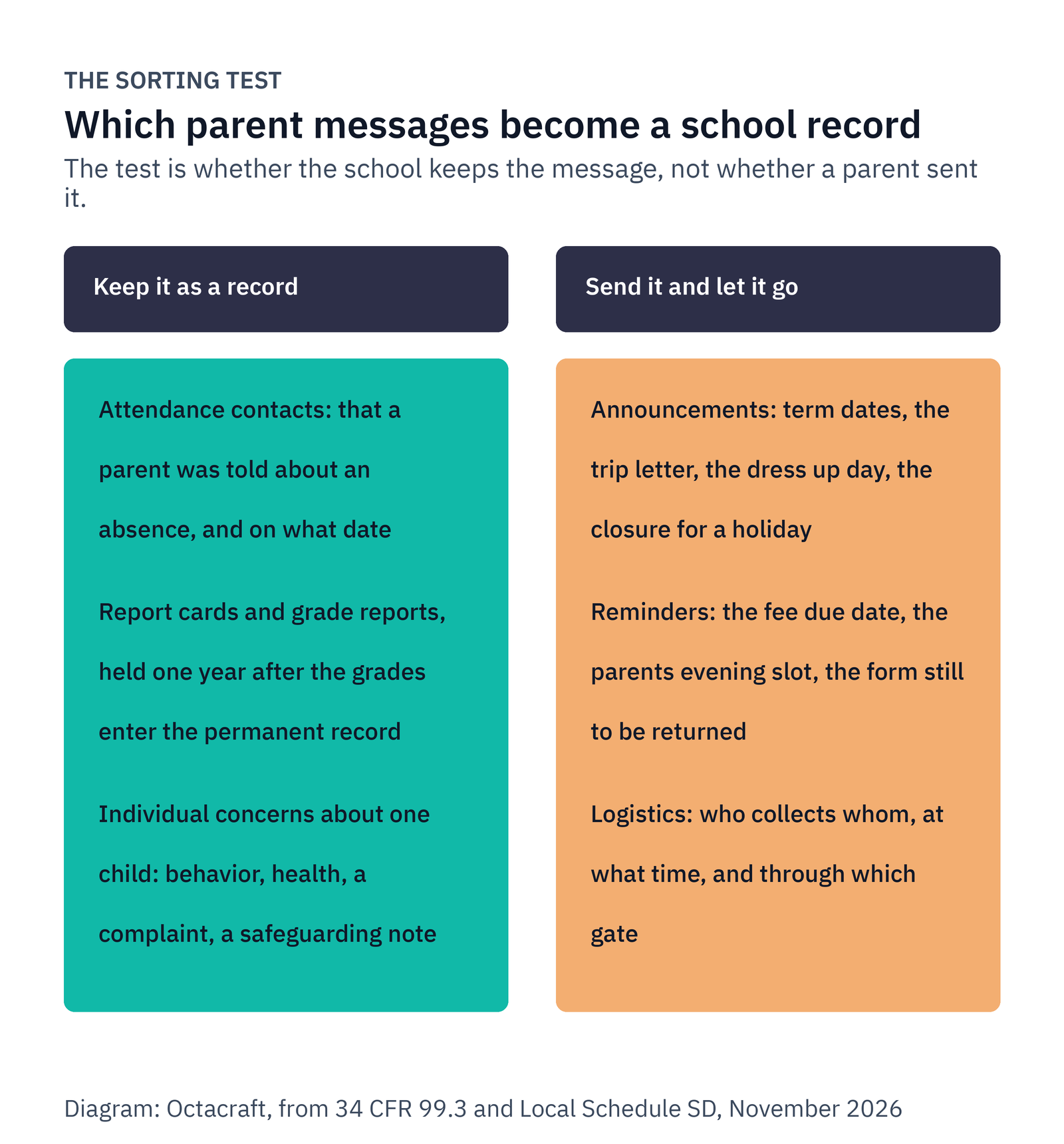
That gives the rule in one line. If the school keeps a message where a colleague can read it, file it as a record. If it exists only in the hands of the person who wrote it, it can go at the end of the day.
The volume shows in the survey data. A Pew Research Center survey of 2,531 public school teachers ran from 17 October to 14 November 2023. It was published on 4 April 2024. In it, 40 percent said parents at least sometimes communicate in a disrespectful way. Another 63 percent said parents do too little to ensure attendance.
Where chat fails the test
Chat fails parent teacher communication on three counts: search, retention and handover. It is fast and suits announcements and logistics. A group thread cannot produce a dated record for one child at year end.
Search comes first. An office cannot search four years of a staff phone for the date a parent was told about a suspension. The thread is ordered by time and mixed with uniform reminders.
Retention comes second. A retention schedule is a promise about a date, and chat makes no such promise. A message stays until somebody deletes it, and the phone decides when that happens.
Handover comes third. When a teacher leaves, the thread leaves with the number. The next teacher starts from nothing in the middle of a term.
None of that makes chat wrong. It makes chat a delivery channel for parent teacher communication, not a filing system. Most advice on parent teacher communication skips that distinction.
The strongest evidence on reaching parents concerns attendance. A randomized experiment was published in Nature Human Behaviour on 23 April 2018. It sent personalized information to the parents of 28,080 high-risk students in grades K to 12. The most effective versions cut chronic absenteeism by 10 percent or more.
Read the mechanism, because it supports the rule. The message worked because the school already knew the accumulated absence count. It put that number in front of the parent. The text carried a fact the school was keeping. Remove the register and the text has nothing to say.
A routing rule per kind, on one page
The table below is the whole parent teacher communication policy. Five kinds of traffic, four channels, one record column.
| Kind of message | Who sends it | Channel it uses | Where the record lives |
|---|---|---|---|
| Announcements | Office or head of year | Class group or SMS, one way | No record after the date passes |
| Reminders | Office | Same channel as the announcement | A list of who was messaged, filed with the date |
| Logistics | Class teacher or office | Direct message or a call | A line in the daily log, cleared at term end |
| Individual concerns | Class teacher, with the office copied | Call or meeting, then a written summary | A dated note in the child file within one working day |
| Record of progress | Office and teachers | Report card, portal or fee receipt | The permanent record, on the retention schedule |
Start with the fourth row. Individual concerns are the messages that hurt when they go missing. They are also the ones a teacher is most likely to handle verbally. A written summary within one working day is a small habit with a large effect at year end.
A worked example. A trip form goes home on Monday and comes back unsigned by Thursday. The office sends one reminder, then calls the parent. The call settles it, and the parent says the form never arrived.
Under the table, that sequence produces two things. The reminder list carries the date and the number. The call produces a dated note saying the parent was told about the form. The next term, when the same parent disputes the trip fee, the office has the note. Nothing about parent teacher communication here needed a new system.
What to keep, and for how long
Texas publishes the clearest example of a parent teacher communication schedule in the United States. Report cards are kept one year after the grades enter the permanent record. Grade books are kept one year. Correspondence with parents about absences is kept as long as it is administratively useful. Daily attendance registers are kept five years.
Those periods come from Local Schedule SD, issued by the Texas State Library and Archives Commission. The third edition took effect on 23 May 2018. It sets minimums that a district may not shorten.
The pattern is worth copying outside Texas. Short lived operational records get short periods. The academic achievement record for grades 9 to 12 is permanent, because it is the transcript a student carries for life. A cumulative record for the earlier grades is kept five years after a student withdraws.
A school elsewhere follows its own regulator, and the numbers will not match. Ask for the schedule in writing and note the date it arrived. A parent teacher communication rule that cites no schedule is a preference, and staff will treat it as one.
The count we are not printing
The plan for this article asked for a categorised sample of real messages from one school, anonymised, with a count for each kind and the period covered. We have not run that count, so no numbers from it appear here. An invented distribution would be worth nothing here.
The method is what we can stand behind. Pull one term of messages from each channel. Remove names and phone numbers. Code every message into one of the five kinds. Count each kind by week.
Then apply the record test to every item. Mark the ones that should have produced a record and did not. That gap is the finding, not the total.
The output is one page: a count for each kind, the share that needed a record, and the gap. It also shows which channel to retire first.
When a school shares an export we can anonymise, the count of parent teacher communication by kind will be published with its period named. Until then, the method is the artifact.
When this framework does not fit
A school with 60 families and one administrator does not need five channels for parent teacher communication. One shared inbox with five labels will hold all of it. The routing rule then collapses into a filing habit that takes a minute a day.
Safeguarding overrides the table. Where a concern touches safety, the formal note is written the same day. The conversation is not the record.
Attendance works the same way. Where a statute names a register, the register is the record. The text message that mentioned it is not.
The record also has to be usable, or the sorting was pointless. A dated note that says nothing specific is a filing exercise. The eight fields in process documentation are a fair test: who acted, what happened, when, and what comes next.
Fees are the other half of the same problem. The receipt has to reconcile with the ledger. Invoice processing covers that problem in a commercial setting.
Frequently asked questions
What counts as parent teacher communication?
Every message a school sends a parent about a child or a class: announcements, reminders, logistics, individual concerns and the record of progress. The term covers the channel as well as the words, so a text, a call and a report card all count as parent teacher communication.
Should schools use WhatsApp for parent teacher communication?
Yes, for announcements and logistics, where speed matters and nothing is filed. Do not use it for individual concerns. A thread cannot be searched by child and it leaves with the phone. Send the group message, then write the note that matters into the record.
What is the difference between a message and a record?
A message exists in the hand of the sender. A record is held by the school where a colleague can find it. Under 34 CFR 99.3 the second one is an education record with access rules attached to it. Forwarding is what changes one into the other.
How long should a school keep messages from parents?
Follow the retention schedule that governs your jurisdiction rather than habit. In Texas, correspondence about absences is kept as long as it is administratively useful, while daily attendance registers are kept five years. Report cards are kept one year after the grades enter the permanent record.
Where does report card software fit in?
Report card software holds the record of progress, which is the one kind that is a record by nature. It does not sort the other four kinds. A school that buys report card software and leaves concerns in a chat group has fixed about a third of the problem.
If your school runs parent teacher communication across three channels, book a short call with us and bring the term you want to sort. The table above is where we would start. You can also reach the team directly, and more of this work sits in Smart Schools.
Philip Bassey is the Chief of Staff at Octacraft. As part of his responsibilities, he oversees the interdepartmental activities to see that our processes are documented and those that need publishing are published. He writes about the work between a system going live and a team trusting it.

Philip Bassey is Chief of Staff at Octacraft, where he oversees the interdepartmental activities that keep our processes documented and the ones worth publishing published. He writes about operations that are engineered into systems instead of held together by memory.