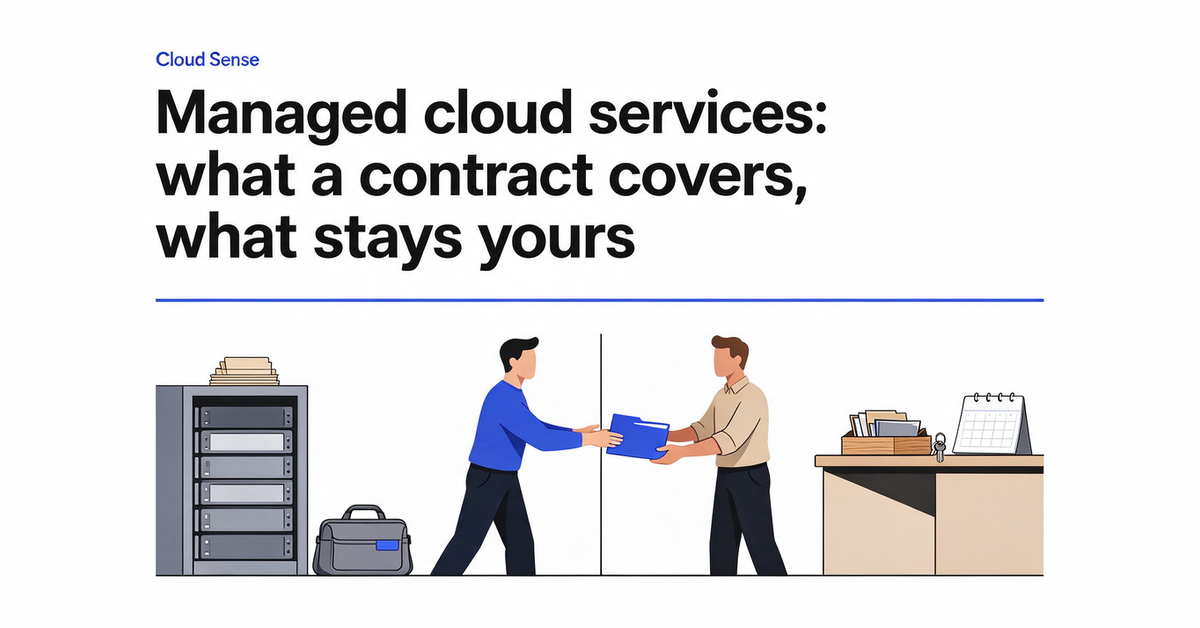
Managed cloud services: what a contract covers, what stays yours
The short version
- A managed cloud services contract is a boundary, not a menu. It says which work someone else does, and leaves the rest with you.
- The boundary moves with the service. On a virtual machine your team patches the operating system. On a managed database, the provider does.
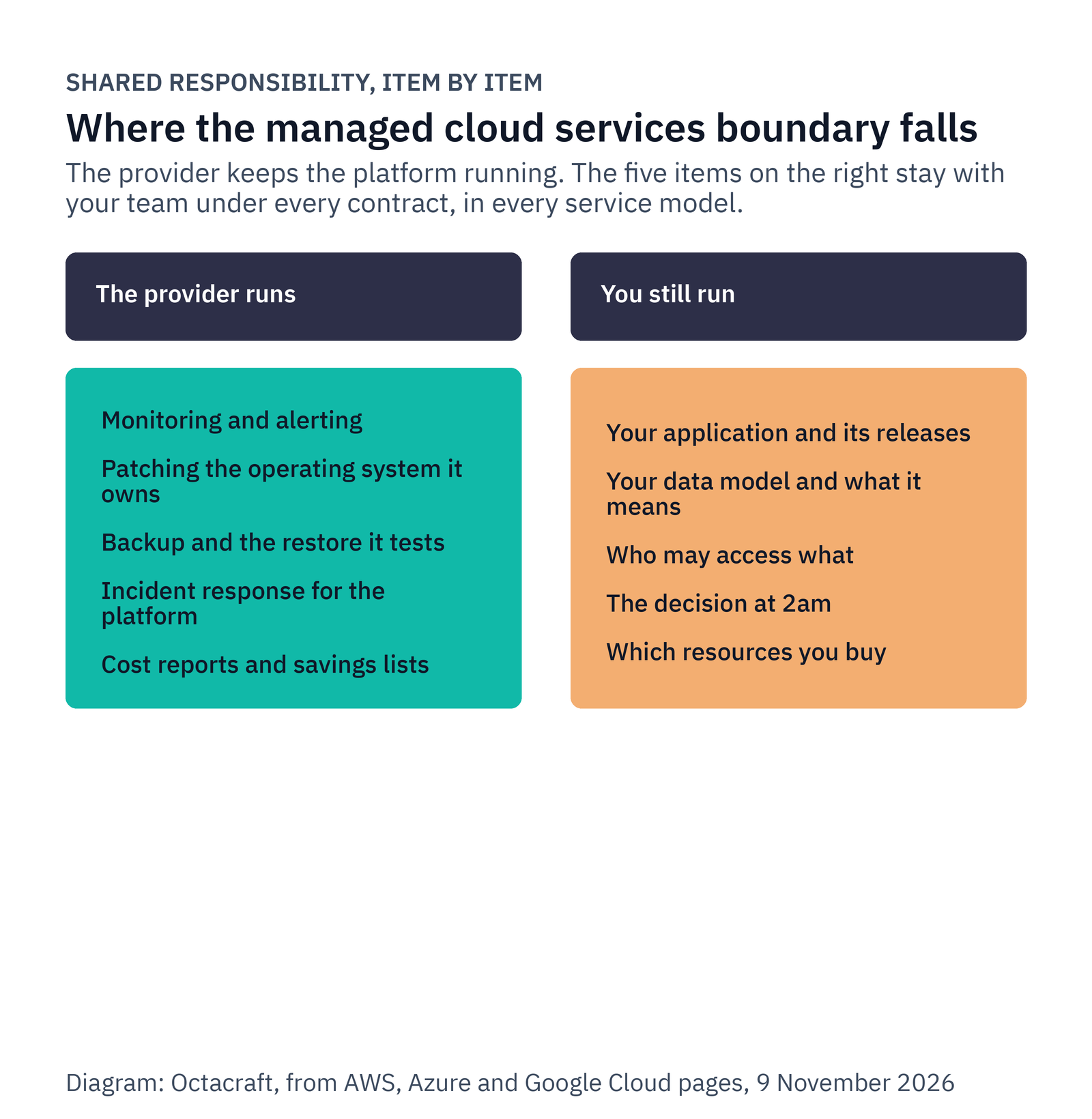
- Five things stay yours: your application, your data model, who gets access, the 2am decision, and which resources you buy.
- Split the bill into compute, storage and egress before you sign. A cost you cannot split is a cost you cannot tune.
- Four questions move the price more than any discount will: scope, response time, tooling and exit.
Page one of the proposal says fully managed. Page nine has a table headed customer responsibilities, and your team’s name sits in six of the eight rows.
You have been asked to move a working system onto managed cloud services. The contract in front of you decides who does what at 3am. What it lists is a set of services. What it sets is a boundary.
What managed cloud services mean in a proposal
Managed cloud services are the day to day operation of a cloud environment handed to a provider: monitoring, patching, backup, incident response, security checks and cost tuning, run to an agreed scope. The platform belongs to the provider. The decisions about what runs on it stay with you.
AWS describes its own service in those terms. Monitoring, incident management, security, patch, backup and cost optimization arrive as an extension of your team (AWS Managed Services, read 9 November 2026).
Every verb there is maintenance of a machine that already runs. The list is honest, and it is about keeping the lights on rather than the system your customers use. It is also fixed, while your system is not.
The line moves with the service you buy
Shared responsibility is the name for the split. AWS frames it as security of the cloud against security in the cloud. The provider protects the facilities, hardware, network and virtualization. The customer protects what it puts on top (AWS shared responsibility model, read 9 November 2026).
The line is not drawn once. AWS says customer responsibility “will be determined by the AWS Cloud services that a customer selects”. On a virtual machine the customer patches the guest operating system and the firewall rules. On object storage or a managed database the provider runs the platform, and the customer manages the data and its permissions.
Microsoft publishes the split as a matrix, which is the version to take into a negotiation. Data, configurations and identities stay with the customer in every model, including software as a service. The operating system belongs to the customer on virtual machines and to Microsoft on platform services (Azure shared responsibility, updated 24 August 2026).
Google draws the same line and adds a warning. In infrastructure as a service, “the bulk of the security responsibilities are yours” (Google Cloud shared responsibilities, last reviewed 28 October 2026).
| What you buy | What the provider runs | What you still run | Example |
|---|---|---|---|
| Virtual machines | Hardware, network, hypervisor, physical security | Operating system patches, middleware, application, firewall rules | A server you configured yourself |
| Managed database or storage | Infrastructure, operating system, platform, availability | Data, classification, encryption choices, access permissions | A managed relational database |
| Software as a service | Application, platform, network controls, updates | Identities, user accounts, the data you put in, client devices | A hosted finance or email suite |
Two contracts can both say managed cloud services and mean different things. The split follows the service, not the word on the cover. Ask for it row by row, against the services on your own invoice.
Five things managed cloud services do not do
Whatever the service model, five things stay with you. They decide whether the system works for your business, and a managed cloud services proposal tends to leave them out.
Your application
No provider of managed cloud services owns your code. It keeps the machine healthy and says when it is not. It does not know what a correct order looks like or which report finance checks on the first of the month. When a deploy breaks the checkout, the provider restores the server and you fix the deploy. Whether to build that application or buy it is a separate question, and custom software versus off-the-shelf is how we weigh it.
Your data model
Backup is not a data model. A managed cloud services contract covers the copy, not the meaning. The provider copies bytes on a schedule and can put them back. It cannot tell you which table is the source of truth, or which field a regulator would ask about. That knowledge has to sit with someone on your side, in writing.
Who gets access, and to what
Every framework above leaves identities and access decisions with the customer. Azure lists identities and access management as customer responsibilities in all four deployment models. AWS makes permissions the customer’s job on its storage services. A provider can enforce a rule you wrote. It should not decide who may read payroll.
The 2am decision
An incident has two halves. Restoring the service is the half a managed cloud services contract buys. Deciding what the business does while it is down is the other: take orders by phone, switch to the paper form, tell the client the deadline moves. The engineer on call restores the platform. Nobody there can decide whether you open the branch late.
Which resources you buy
Cloud cost optimization appears on every list of managed cloud services, and it is the item a provider cannot act on alone. Deleting a test environment or shrinking a database needs someone who knows what the system is for. The provider sends a list of savings. Your team approves the ones that will not break a process nobody documented.
What the bill looks like when it is split
A managed cloud services bill is not one number. It is a file of line items, one for each combination of product, usage type and operation. That is how the provider’s own billing export describes it (AWS Cost and Usage Reports, read 9 November 2026). Group those lines four ways and the contract stops being abstract.
Compute is what runs. Storage is what sits still. Egress is what leaves the provider’s network, and it is the line that surprises finance. Nothing in the architecture diagram hints at a charge for answering a customer. The fourth line is the provider’s fee for managed cloud services, on a separate invoice.
We are withholding our own split. The billing export for a full month has not been pulled for this piece. A split rebuilt from a remembered invoice total would be a guess with a decimal point on it. What follows is the method we will run, and what you can run on your own export this week.
| Bucket | What lands in it | Where it shows in the export | The question it answers |
|---|---|---|---|
| Compute | Instances, containers, managed runtimes, licensing attached to them | The product and usage type lines for each running service | What are we paying to keep running? |
| Storage | Volumes, object storage, snapshots, backups and their retention | Storage and snapshot usage types, by volume or bucket | What are we paying to keep? |
| Egress | Data leaving the provider’s network, plus inter-region transfer | Data transfer usage types, split by direction | What are we paying to answer customers? |
| Managed fee | The provider’s charge for operations, support and tooling | Not in the cloud bill; the provider’s own invoice | What are we paying someone to run it? |
Run the split on your managed cloud services bill for three months, not one. A single month catches a release or a month end batch and calls it a trend. Three months gives you a run rate you can defend in a budget meeting.
What cloud migration cost adds to the first invoice
Cloud migration cost is a project cost, not a line on the monthly bill. It covers the move itself: inventory, the rebuild of anything that cannot be lifted as it stands, testing before cutover, and the weeks when old and new run at once. The run rate is only comparable after the old estate is switched off.
Three items get left out of most managed cloud services migration budgets. Data transfer out of the old provider is one, and it grows with the size of what you move. The overlap period is another: two environments, two bills, one set of users. The third is the managed fee starting before handover finishes. Some managed cloud services contracts include part of the move. Most price it as a separate project.
Cloud hosting for small business is a different purchase
Cloud hosting for small business usually means a shared server or a virtual machine with a control panel, sold by the month, where you or your web person do the work. Managed cloud services are the step above: a written scope of operations and someone accountable for it, priced for the responsibility rather than the disk space.
The test is not company size. It is the consequence of the system stopping. A brochure site can sit on cheap hosting for years. A booking system or a payroll run needs a named operator, a restore time and a phone number. Below that line, buying managed cloud services is paying for assurance you cannot use.
Questions that change the price
Price in this market is mostly scope. Two managed cloud services quotes for the same cloud spend can differ by a multiple, and the gap sits in four places.
Is the scope written per service or per server? A per server scope is easy to count and easy to argue about, because a managed database is one service and six servers. Ask any provider of managed cloud services which one the quote uses, and what a new service costs.
Does response mean an answer or a fix? A fifteen minute response can mean an engineer replies. It can also mean the service works again. The second is worth more and is priced for it. Get the definition in writing, with the clock starting when you report the fault.
Who pays for the tools the provider runs? Monitoring, log storage, backup vaults and security scanning all cost money. Some providers bill them at list price. Others include them. Ask for the line items, not the total.
What does exit look like? Documentation, infrastructure code, credentials and a handover period cost the provider real hours. A contract that is silent on exit assumes you stay. Ask what you receive on the last day.
A short contract checklist
Eight lines to look for in a managed cloud services contract before the signature. Each one is a sentence you can point at when something goes wrong at 3am.
- The scope names each service on your invoice, not each server in the rack.
- Patching states whose job the guest operating system is.
- Backup states the restore time you should expect, and who tests the restore.
- Incident response defines severity levels, the response time for each, and who declares an incident.
- Access decisions stay with you in writing, including who may grant production access.
- Cost tuning names a cadence and the report you receive each time.
- Maintenance windows and change notice are written down, with the hours they fall in.
- Exit lists the documentation, the infrastructure code, the credentials and the length of the handover.
Frequently asked questions
What is included in managed cloud services?
Usually monitoring, patching, backup, incident response, security checks, cost reporting and a support channel with a defined response time. What is included varies by provider and by service type, so the contract should name each item against the services on your invoice rather than describe them in one sentence.
What is not covered by a managed cloud services contract?
Your application, your data model, your access decisions, the business decisions during an outage, and the choice of which resources to buy. Providers keep the platform running. They do not own how your system behaves for your customers, and a contract that implies otherwise is worth a second read.
Can a small business buy managed cloud services?
Yes, and it is often the right time to do it. The test is consequence, not headcount. If a system takes payments, holds records a regulator may ask about, or has customers waiting on it, a named operator with a restore time is worth the fee. A brochure site rarely needs one.
Who is responsible for security in the cloud?
Both sides, in different layers. The provider secures the facilities, hardware and virtualization. You secure the operating system where you control it, your application, your data, and who can reach it. Microsoft and Google both put identities and data with the customer in every service model.
How do I compare two managed cloud services quotes?
Compare the scope line by line: which services, which response definition, which tools are billed to you, and what exit provides. A cheaper quote usually means a narrower scope or an answer rather than a fix. Price per server tells you nothing until those four are aligned.
If you are holding a scope document you cannot price, send us the scope page and your last two cloud bills. We will mark what the managed cloud services fee covers, what stays with your team, and which four questions to put to the provider. You can also reach the team directly, and more of this work sits in Cloud Sense.
Philip Bassey is Octacraft’s Chief of Staff. As part of his responsibilities, he oversees the interdepartmental activities to see that our processes are documented and those that need publishing are published. He writes about the work between a system going live and a team trusting it.

Philip Bassey is Chief of Staff at Octacraft, where he oversees the interdepartmental activities that keep our processes documented and the ones worth publishing published. He writes about operations that are engineered into systems instead of held together by memory.