Proposal software: a six-step teardown of why quotes take days
The short version
- A quote takes days because three things sit in different places: the price rules, the approval and the document.
- The rep is rarely the delay. Authority and price data live with people the rep cannot reach in the moment.
- A standard quote should leave the same business day. A discounted one waits for one named approver, with a clock on the wait.
- Proposal software earns its fee when pricing, approval and the PDF come from one record.
- Measure one quote type for a month before you buy. Six timestamps show where the days go.
A quote request lands on Monday morning. The rep has the numbers by lunch. The buyer holds the quote on Thursday, and by then two competitors have replied.
That gap is the subject of this teardown. A quote takes days because the price rules, the approval and the finished document live in three separate places. Most proposal software is bought to fix the document. The document is the cheapest of the three problems to solve, which is the trap in most proposal software purchases.
Below is the flow as it runs in most B2B firms of 50 to 300 people, and the six places it stops. Then the build order that makes a standard quote leave the same day.
The evidence comes from vendor documentation for HubSpot, Salesforce and Microsoft Dynamics 365, and from published buyer research. Where we have no measured number, we say so.
Proposal software: what the category sells, and what it leaves out
Proposal software builds, sends and tracks a quote from CRM data. It carries templates, pricing tables, approval routing and e-signature. It removes the document work. It does not set your prices or grant anyone the right to discount. So the two waits that cost days can survive the purchase.
The promise in a proposal software demo is document speed, and the demo is built to show exactly that. A team that buys proposal software to end slow quotes often finds the same three days at the end of it, with a better-looking document attached.
The definition worth quoting
Proposal software is a tool that turns deal data into a priced document, sends it, and records the buyer’s answer. Templates, pricing tables, approval steps and e-signature are its parts. The price list is not one of them.
Most definitions of proposal software stop at the document. That is why the category gets misread at the buying stage.
Where the category stops
Read the vendor documentation and the boundary appears. In HubSpot, a quote needs a deal, a contact and at least one line item before it can be published (HubSpot, Create and send quotes, updated 18 November 2026). It also holds up to 10 attachments of up to 30 MB each.
In Dynamics 365 Sales, a new quote starts as a draft at revision 0 (Microsoft Learn, Manage quote, order, and invoice, updated 31 July 2026). Activating it makes the quote read-only, so the customer’s copy matches yours.
Both products are proposal software in the sense the market uses the term. Both expect the pricing to be decided before a quote is built. Both assume a price exists, a customer exists, and somebody has decided what a discount means. That assumption is reasonable. It is also where the week goes, because none of those three things arrives by itself. A proposal software trial will not show that gap, because a trial has no approver in it.
What happens to a quote between request and send
Six steps sit between a request and a sent quote: request logged, numbers built, discount checked, approval mailed, document assembled, sent. Three of them stop while another person answers. The waiting is not inside a step. It is in the handoffs between them.
Walk one quote through the flow and the clock is easy to follow. The request lands in a CRM record, usually with a note instead of a scope. The rep builds the numbers in a spreadsheet copied forward from last quarter. The discount goes to a manager. The manager answers by email, and the rep rebuilds the document from the same numbers.
The proposal software sits at steps two and five, and the rep controls both. By the time the PDF exists, three people have touched a quote that needed none of them. The figure below maps that chain, with the three stops marked.
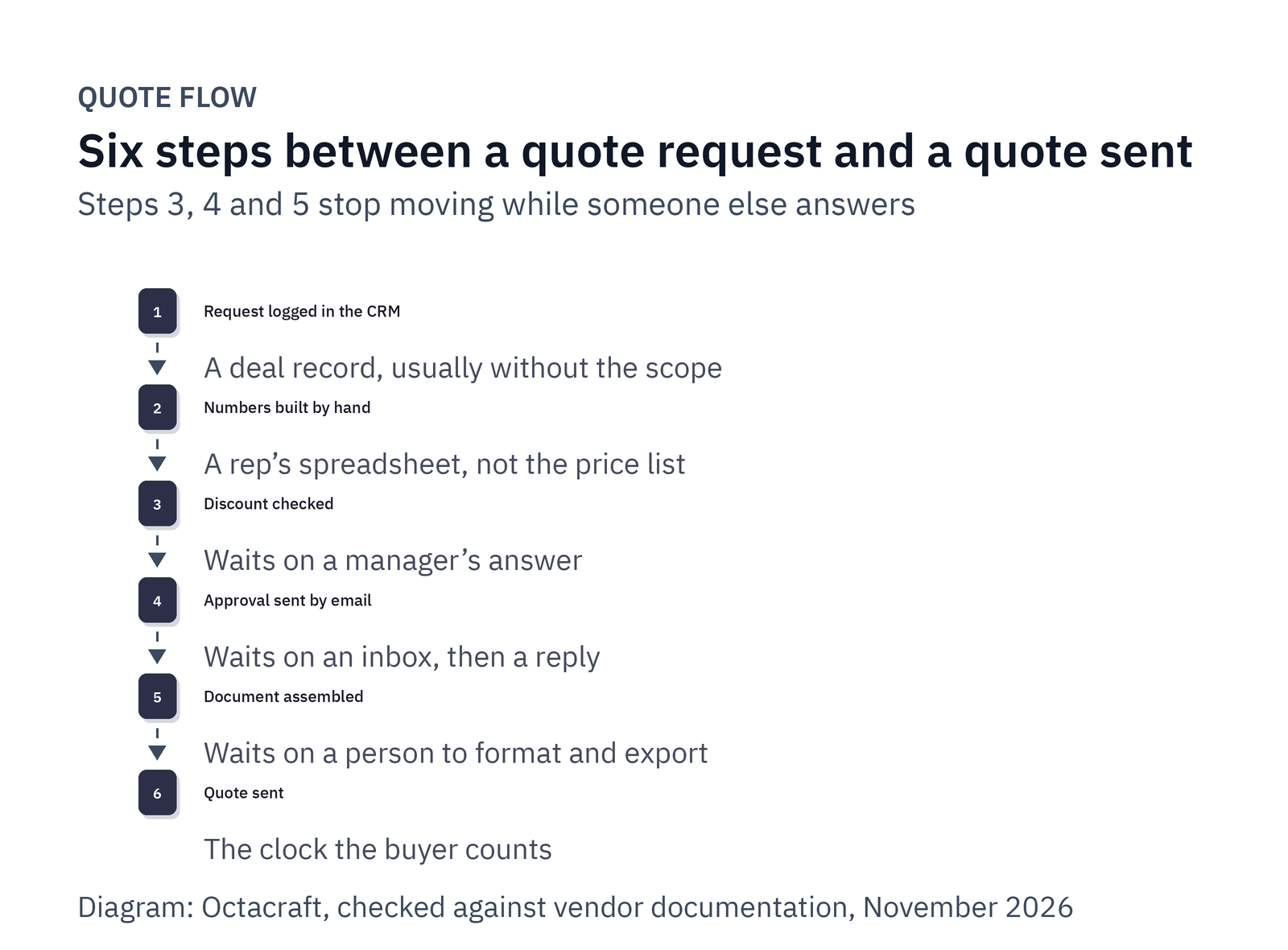
Read it as a map of where proposal software can help and where it cannot. The three stops are steps three, four and five.
Where the waiting starts: pricing lookups and discount sign-off
Two waits account for most of the delay. The first is finding the price. If the approved price sits in a list nobody trusts, the rep rebuilds it from an old quote. Then a colleague checks it, which is a second lookup with no record. No proposal software document can fix a price nobody can find. The first fix is a price list that lives in the proposal software, not a better template.
The second is the discount. A manager who approves between meetings adds a day per round trip. A quote with a 12 percent discount can take two rounds. Neither wait is a workload problem. Both are information problems, and the fix is to move the answer closer to the rep who needs it.
The rework loop: when a rep sends a revision because a rule changed mid-week
Vendors model this openly. Microsoft’s documentation says a quote goes through several revisions before it is accepted. Each revision increments the ID (Microsoft Learn, 31 July 2026). A revision is not a small event. It restarts the approval, the document and the buyer’s reading.
The common cause is a price rule that changed after the quote went out: a cost increase, a new band, a product withdrawn. The rep hears about it from the buyer. That call is the most expensive minute in the whole flow, and no proposal software feature prevents a cost increase.
| Step | What it needs | What removes the wait |
|---|---|---|
| Request logged | A deal record and a scope note | A form that captures scope with the request |
| Numbers built | The approved price for each line | A price list with effective dates |
| Discount checked | The band and the floor for that line | Bands written down before the rep asks |
| Approval mailed | An approver with the authority to say yes | Tiers that route by discount and value, with a clock |
| Document assembled | The numbers and the template | Generation from the record the CRM already holds |
| Quote sent | A signature route the buyer will use | Signature inside the same flow |
Why a same-day quote feels impossible to the rep who owns the deal
The rep is not short of time. The rep is short of authority and price data. Approval and the current price sit with a manager, a finance lead or a spreadsheet owner who answers between meetings. A same-day quote needs that answer to arrive without the rep chasing it.
Salesforce’s 2026 State of Sales statistics report that reps spend 60 percent of their time on non-selling tasks (Salesforce, Sales statistics, 2026). It names chasing internal approvals among them. Read that as a description of the quote flow rather than a complaint about reps.
There is a second half to the objection. Buyers no longer wait quietly. Gartner surveyed 632 B2B buyers in August and September 2024. It found that 61 percent prefer an overall rep-free buying experience (Gartner, 25 June 2025). It also found that 69 percent report inconsistencies between a seller’s website and what sellers tell them.
A slow quote sits inside that inconsistency. The buyer has a price band from the website in one hand and a different number in the other. That is the opening a fast quote exploits. It is also the gap a proposal software document cannot close on its own.
The cost of a slow quote, by deal shape
A slow quote costs most on the small standard deal. The buyer compares three suppliers, and you are the one who cannot be compared yet. It costs differently on a mid-size deal with a discount, where the wait invites a second round. Large custom deals move at the buyer’s pace.
Small standard deal. The buyer wants a number to put beside two others. A three-day wait means your quote arrives after the shortlist is set. Price becomes the only thing left to discuss. Proposal software does not change that, because the buyer’s calendar sets the shortlist.
Mid-size deal with a discount. The wait is an invitation. The buyer asks for a call, the manager asks for a business case. The quote grows a second round it did not need. Proposal software pays for itself fastest on this deal shape, because the approval tier is the whole problem.
Large custom deal. Here the buyer’s procurement runs the clock, and a fast quote buys little. What it buys is credibility when the questions start.
CRM sales automation keeps a tidy record of all three shapes. It timestamps every stage, and it reports the deal as healthy while the quote sits in an inbox. A pipeline view cannot tell the difference between a deal in progress and a deal waiting on an approver. What proposal software adds is the price and the approval, not the record.
Five pieces a quoting workflow needs, in build order
A quoting workflow needs five pieces, and the order matters. Price rules in the system, approval tiers that route by discount and value, document generation from CRM data, CRM write-back and signature capture. Each piece removes one wait. Build them out of order and the biggest wait stays where it was.
Price rules that live in the system, not in a rep’s saved spreadsheet
Start with the price. A price list with effective dates, discount bands and a floor for each product line ends the lookup. Most CRM automation tools will copy a value into a quote. Only a rules engine will refuse a price that breaks the band. That refusal is what keeps the price honest, and it is the piece a proposal software build should start with.
Most teams start at the document instead, because the document is visible and the rules are not. That order is the reason a first build often lands with the same cycle time it started with.
Approval tiers that route by discount size, not by seniority
Salesforce’s CPQ documentation shows the shape. An approval rule fires when a condition is met, such as a net total above a threshold. It then routes the request to a named approver (Salesforce Trailhead, Manage approval logic, accessed 24 November 2026). HubSpot offers the same idea in two levels, standard and advanced approvals. Each request carries a reason (HubSpot, Manage quote approvals, updated 24 September 2026).
Set the tier by discount and deal value. A 5 percent discount on a standard deal should not need a director. A 20 percent discount should. Each tier needs a clock and an escalation for when it runs out. Without both, the tier becomes another queue with a different name. This is the part of proposal software that buyers underestimate.
Document generation from the data the CRM already holds
The document is the cheapest piece to fix and the one most teams buy first. If the numbers come from the record, the PDF is a render rather than a rebuild. HubSpot’s quote editor builds branded quotes from deal data and line items. It then records acceptance and collects payment (HubSpot, 18 November 2026). Microsoft’s flow is the same in kind. Build the quote from the opportunity, then activate it to send (Microsoft Learn, Create or edit quotes).
This is the step proposal software is famous for. It is also the shortest step in the flow, which is why fixing it first changes less than the demo suggests.
CRM write-back, so the pipeline shows what went out
A quote that lives outside the CRM makes the pipeline a guess. Write the sent document, its version and its value back to the deal. Then the forecast counts what the buyer holds. A revision shows up as a revision rather than a mystery. Some proposal software writes back on send and some on signature, so check which before you rely on the pipeline.
Signature capture that ends the download-and-email step
E-signature is settled law in the markets most of our readers sell into. In the United States, a signature or contract may not be denied legal effect because it is electronic (15 U.S.C. 7001). In the European Union, an electronic signature may not be denied legal effect for being electronic (eIDAS, Regulation 910/2014, Article 25, consolidated text of 18 October 2024). A qualified signature carries the same effect as a handwritten one.
The practical limit is volume. HubSpot pools e-signatures per account, at 25 a month for each user on its Revenue Hub Professional plan (HubSpot, Use e-signatures with quotes, updated 28 October 2026). Quote PDFs above 40 MB may fail to sign. Check the pool against your quote count before you promise same-day signing.
What still needs a human
Four cases still need a person. A discount outside the band, custom terms, a first order from a new customer, and a price the rules do not cover. Routing those to a named person is a feature. Automating them is how a quote flow loses money quietly.
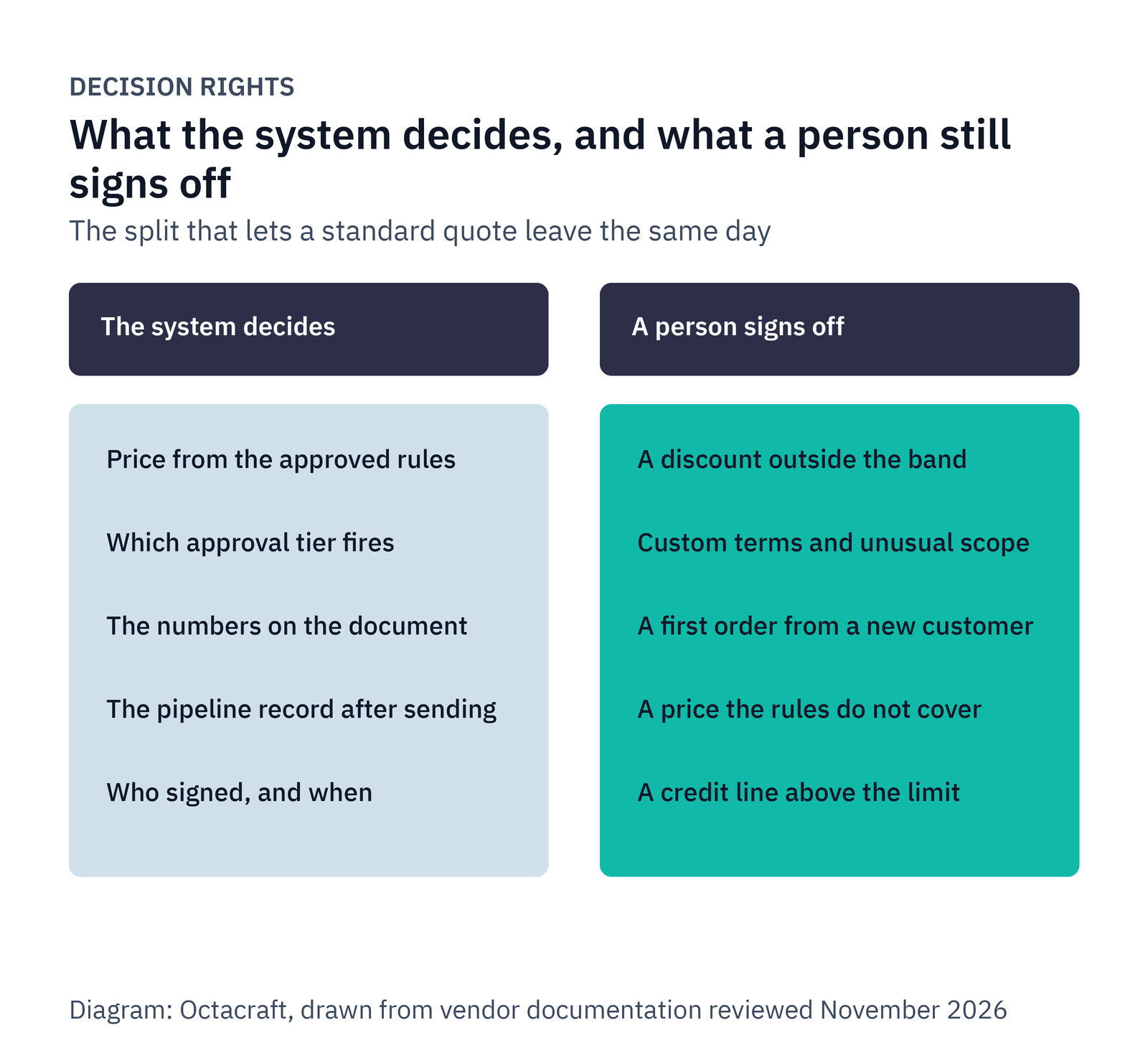
The boundary matters because the alternative is worse. A workflow that prices anything turns a pricing decision into an accident. One that refuses everything outside the rules keeps the trust that makes a same-day quote possible in the first place. A proposal software setup that skips this boundary will price a custom deal by accident. Most proposal software demos skip this slide entirely.
Give the exception a route and a name. “Custom terms go to Dana, and Dana answers within four hours” is a policy a rep can work with. “Ask the commercial team” is the queue you started with, with a new label on it.
Who this suits, and who should not buy it
This suits a B2B firm between 50 and 300 people. It sends the same quote shapes every week, and it already keeps deals in a CRM. Proposal software is the wrong purchase for a firm that prices every deal from scratch, or one that sends a handful of quotes a month. Most proposal software vendors will not say so, because the subscription costs the same either way.
Our rule of thumb: below about 20 quotes a month, a shared price list and a good template will do. The build costs more than the wait it removes. Proposal software would add a subscription to a problem a spreadsheet can solve.
It also does not suit a firm with no owner for the price list. If nobody can say who sets a discount band, the tool routes the question to a queue with no answer at the end of it. Fix the owner first. The build can wait a month.
How to run this without a big-bang rollout
Run it in 30 days on one quote type. Week one, log six timestamps per quote. Week two, write the price rules for that type. Week three, wire the approval tier and its clock. Week four, run parallel with the old flow, then switch.
Week one is measurement, and it is not optional. Log the request time, the numbers-ready time, the discount-asked time, the approval time, the document time and the send time. Six fields in the CRM will do, and they cost nothing to add. The six timestamps also make a proposal software pilot measurable, which most pilots are not.
Week two is the price list. Take the quote type you chose and write the bands down, including the numbers your best rep already uses. The work is a spreadsheet and an argument, not a build.
Week three is approval. One tier, one named approver, one clock. The search phrase “workflow automation CRM” describes what most teams try next, and it is the wrong order. Proposal software wired before the rules will route questions nobody has answered.
Week four is the parallel run. Send every quote both ways for two weeks and compare the timestamps. Keep the old route open for one deal type until the two sets of numbers agree.
The follow-up after the send is a separate flow. Email automation CRM rules read well until the buyer replies, and then a person has to answer. We wrote about that gap in our piece on follow-up timing, and the quoting flow feeds it.
How long a quote should take, and how to measure it
A standard quote should leave inside one business day, because nothing in it needs a decision outside your rules. A discounted quote should wait for one named approver, with that wait measured. A custom quote moves at the buyer’s pace, and no tool changes that.
Measure it the way pricing teams do. Pricefx defines quote turnaround time as the average number of days between quote creation and submission (Pricefx documentation, accessed 24 November 2026). That single number, split by quote type, tells you where to build first. Put it in front of any proposal software vendor before you sit through the demo.
Our working targets, from the flows we have mapped. Standard quotes the same day, discounted quotes inside 24 hours of the request reaching the approver. Custom quotes take the time the buyer’s process needs. Those are targets we set for a build, not measurements we publish. A proposal software demo measures the document. Your measurement has to include the approval.
If a quote sits longer than a day, the cause is usually visible in the six timestamps. The step that consumed the time is the one to fix, and it is rarely the step the team blames. Teams blame the rep. The timestamps usually blame the approval.
Two more reads if the flow crosses other teams. The five approval bottlenecks that cost a week a month, and the test for buying software or building the workflow. Both apply to quoting more than they look like they should.
A quote that arrives in a day also changes what the follow-up looks like. That is why CRM automation that does not annoy customers and a fast quote are the same project seen from two ends.
Frequently asked questions
How long should a quote take to send?
A standard quote should go out inside one business day. A discounted quote should wait no longer than one approval cycle with a named approver. Custom quotes follow the buyer’s procurement. Measure the average days from creation to submission, split by quote type.
What is CPQ software?
CPQ stands for configure, price, quote. It is the part of a selling system that builds a product configuration, prices it from rules, and produces the quote. Proposal software usually covers the document and the signature. CPQ covers the pricing logic behind them.
Is proposal software the same as CPQ?
No. Proposal software centers on the document: templates, pricing tables, e-signature and tracking. CPQ centers on the rules that produce a valid price. A quote flow needs both, and the rules decide whether a standard quote can leave in a day.
Do we need proposal software if our CRM already sends quotes?
Only if the CRM lacks the pricing and approval layer. A CRM can produce a document from deal data. It will not stop a rep pricing outside the band unless the rules live in it, and it will not shorten an approval that runs by email.
Where does a quoting workflow break first?
At the discount. Price lookups slow a quote by hours. An approval that runs by email slows it by days, and the delay grows with every revision. Fix the approval tier and its clock before you buy a document tool.
If the quote flow is where your week goes, bring us the six steps and the approval thread. We will map the waits with you.
Philip Bassey is Octacraft’s Chief of Staff. As part of his responsibilities, he oversees the interdepartmental activities to see that our processes are documented and those that need publishing are published. He writes about the gap between a system going live and a team trusting it.

Philip Bassey is Chief of Staff at Octacraft, where he oversees the interdepartmental activities that keep our processes documented and the ones worth publishing published. He writes about operations that are engineered into systems instead of held together by memory.